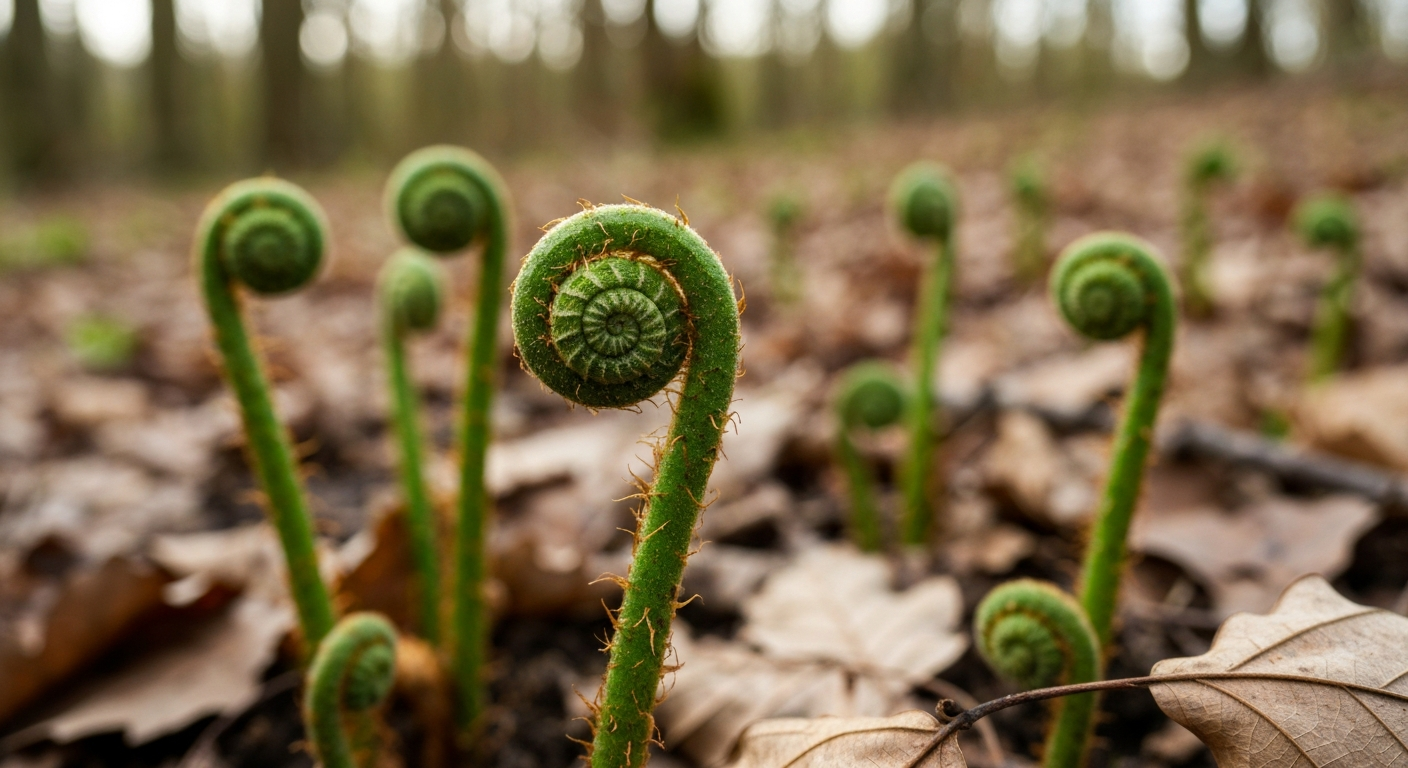
Yes, fiddleheads do grow in the UK. In fact, almost every fern you walk past in a British woodland is producing them right now in spring. The catch is that most of those tightly coiled young fronds belong to species you should not eat. The one fern whose fiddleheads are widely regarded as edible, the ostrich fern (Matteuccia struthiopteris), is not a common native wild plant here in the way it is in North America or eastern Europe. It is present in Britain, appearing in naturalised patches and as a popular garden plant, but you are far more likely to stumble across bracken fiddleheads than ostrich fern ones, and bracken is a species you want to avoid eating entirely.
Do fiddleheads grow in UK? Guide to foraging & growing in Britain
James Hartwell
26 Jul 2026
What exactly is a fiddlehead?
A fiddlehead (sometimes called a crozier) is simply the tightly coiled young frond of a fern before it unfurls. Almost all ferns develop their new leaves this way, through a process called circinate vernation, where the leaf tip curls inward like the scroll of a violin headstock. It is not a special organ or a separate plant part: it is just a very young leaf caught at the right moment. That coiled stage lasts anywhere from a few days to a couple of weeks depending on species and temperature, after which the frond opens out and becomes the flat, familiar ferny leaf.
The culinary interest in fiddleheads is largely a North American and Scandinavian tradition. In Canada and the northeastern United States, ostrich fern fiddleheads are harvested commercially and sold in farmers' markets each spring as a seasonal vegetable, with a flavour often described as somewhere between asparagus and green beans. That culinary culture never really took hold in Britain in the same way, which is partly why UK foraging guides give fiddleheads less attention than, say, wild garlic or nettles. But interest is growing, and if you want to eat them here you absolutely can, you just need to know which species is which.
Which British ferns produce fiddleheads: edible versus poisonous at a glance
Here is the honest summary before we get into detail. Every fern in Britain produces fiddleheads. The question is purely which ones are safe to eat. The table below covers the species most likely to be encountered in UK gardens and countryside.
| Species | Common Name | Native/Naturalised in UK | Fiddlehead Edible? | Notes |
|---|---|---|---|---|
| Matteuccia struthiopteris | Ostrich fern | Naturalised (patches in England/Scotland) | Yes, when properly cooked | The main edible species; must be boiled thoroughly |
| Pteridium aquilinum | Bracken | Widespread native | No | Contains ptaquiloside, a carcinogen; avoid entirely |
| Athyrium filix-femina | Lady fern | Widespread native | Not recommended | No established culinary tradition; avoid |
| Dryopteris filix-mas | Male fern | Widespread native | Not recommended | Can cause digestive upset; avoid |
| Osmunda regalis | Royal fern | Native (rare, declining) | Not recommended | Protected in some sites; do not forage |
| Polystichum setiferum | Soft shield fern | Widespread native | Not recommended | No established edibility record in UK |
The takeaway from that table is straightforward: in the UK, only ostrich fern fiddleheads have any real case for being eaten, and even then they must be cooked properly. Everything else, particularly bracken, should be left well alone.
How to identify ostrich fern fiddleheads (and what to avoid)
Getting the ID right here is not optional. Bracken looks nothing like ostrich fern to an experienced eye, but to a beginner in early spring, any tightly coiled green shoot poking through leaf litter can look temptingly similar. Use all of the following features together, not just one.
Signs you are looking at ostrich fern fiddleheads
- A deep, U-shaped groove running along the inner (concave) side of the smooth green stem. This is the single most reliable field ID feature for Matteuccia.
- Thin, papery brown scales or husks clinging loosely to the coiled head when it first emerges. These flake off easily and are not hairy or woolly.
- A clean, smooth stem with no woolly or fuzzy hairs. Bracken, by contrast, has soft hairs on its uncoiling fronds.
- The mature plant at the same location should show a distinctive shuttlecock or vase shape, with upright outer fronds and separate, shorter, dark brown fertile fronds standing in the centre during winter and early spring.
- Ostrich fern typically grows near water: riverbanks, stream edges, and damp woodland margins.
Red flags that mean step away
- Hairy or woolly texture on the coiled frond: this points toward bracken or other non-edible species.
- No U-shaped groove on the stem: without this feature, do not harvest.
- Growing in dry, open moorland, heathland, or acidic grassland: this is bracken territory, not ostrich fern.
- A round or flat stem cross-section rather than a grooved one.
- Uncertainty: if you are not completely confident, do not pick it. There is no shame in leaving it.
I would also strongly recommend that before you forage any fiddlehead in the UK, you identify the same plant through multiple seasons. Visit a site in summer when the full fronds are visible, photograph the mature plant, note the fertile fronds, and only then return in spring knowing exactly what you are harvesting from. Rushing this step is where foragers get into trouble.
Where fiddleheads grow in the UK: habitats and microclimates
Bracken fiddleheads, which again you should not eat, will turn up almost anywhere in Britain: moorland, heathland, open woodland, roadside verges, and hillsides. If you're also curious about warm-season lawn species, see does bermuda grass grow in the UK for guidance on its climate suitability and where it might appear in Britain. It is one of our most aggressive and widespread plants, and its fiddleheads appear from April onward across most of the country.
Ostrich fern is a different story. In the wild in Britain it is naturalised rather than truly native, meaning it has escaped from gardens and established itself in places rather than being here originally. You are most likely to find it along riverbanks and stream margins in northern England and parts of Scotland, particularly in areas where it has been planted in gardens nearby and self-spread via runners. It loves the same kind of conditions it occupies in its native range: consistently moist or wet soil, dappled shade, and shelter from drying winds. The banks of rivers in the Lake District, Yorkshire Dales, and parts of lowland Scotland are the most plausible places to encounter naturalised colonies. In southern England, genuinely wild or naturalised ostrich fern is much rarer. Most encounters with the species in the south will be in managed gardens.
Lady fern and male fern fiddleheads, meanwhile, are everywhere: damp hedgerows, woodland edges, shaded banks, and stream sides throughout Britain. They are visually present in almost every habitat where moisture and shade coexist, but as noted above, neither is recommended for eating.
When fiddleheads appear across UK regions: a seasonal guide
The emergence window for fiddleheads is short, typically two to three weeks per crown, and timing varies noticeably across the UK. The key driver is soil temperature: fiddleheads begin pushing through once soil consistently reaches around 7 to 10 degrees Celsius at root depth.
| Region | Typical Emergence Window | Notes |
|---|---|---|
| South West England (Cornwall, Devon) | Late March to mid-April | Mild winters mean earlier emergence; microclimate shelter adds further warmth |
| South East England | Early to mid-April | Warming trend, but cold snaps can delay by a week or more |
| Midlands and East Anglia | Mid to late April | Continental influence brings cold springs; later than the south |
| Wales | Mid-April to early May | Highly variable with altitude; valley floors emerge earlier than upland sites |
| Northern England (Yorkshire, Lake District, Cumbria) | Late April to mid-May | Cooler springs; best naturalised ostrich fern sites are here |
| Scotland (Lowlands) | Early to mid-May | Cold spring soils delay emergence noticeably |
| Scotland (Highlands) | Mid to late May | High altitude and latitude push emergence late; some sites still emerging in early June |
Microclimate matters enormously here. A sheltered, south-facing bank beside a river in Yorkshire can produce fiddleheads a full fortnight ahead of an exposed north-facing woodland on the same latitude. Urban gardens in cities like Leeds or Manchester, where the heat island effect raises overnight temperatures, will often see emergence ahead of surrounding rural land. If you are growing ostrich fern in your garden rather than foraging, keep an eye on the crowns from mid-March onward in the south and from early April in the north. The edible window once fiddleheads emerge is short: harvest when the coil is tight and under about 5 cm in diameter, before the frond begins to unfurl. After that the texture becomes tough and the palatability drops.
Growing your own ostrich fern: practical steps for UK gardens
If foraging for ostrich fern fiddleheads feels too uncertain, or if you simply cannot find a reliable wild source nearby, growing your own is a very realistic option. For guidance on other commonly asked garden plants, for example, whether mullein grows in the UK, see does mullein grow in the UK. Matteuccia struthiopteris is widely sold by UK nurseries and is rated fully hardy in British conditions (RHS H7, surviving well below -20°C). It is, in many respects, an easier garden plant than people assume.
Site selection and soil
Ostrich fern needs reliably moist soil and partial to full shade. RHS guidance recommends planting Matteuccia struthiopteris in moist, shady sites and provides cultivation advice for ferns in UK conditions RHS guidance recommends planting Matteuccia struthiopteris in moist, shady sites and provides cultivation advice for ferns in UK conditions.. It will survive in sun if the soil stays consistently wet, but in a typical British summer it will struggle and scorch if both sunny and dry. The ideal spot is beside a pond, along a shaded border with heavy soil that retains moisture, or under deciduous trees where it gets filtered light in summer and winter light when the canopy drops. Soil pH should ideally be neutral to slightly acidic (pH 5.5 to 7). It is not fussy about soil type provided drainage is not so sharp that it dries out in summer.
Planting crowns
The most reliable way to establish ostrich fern in a UK garden is to plant pot-grown crowns from a reputable nursery, either in autumn or early spring. Plant the crown at the same depth it was growing in the pot, typically with the top of the crown just at or slightly below soil level. Space crowns at least 60 to 90 cm apart because they spread via stolons (underground runners) and will form expanding colonies over time. Water in well and mulch around the base with leaf mould or composted bark to retain moisture. In the first summer, do not harvest any fiddleheads: let the plant establish fully.
Propagation from offsets
Once an established colony is running well, you can propagate by dividing offset crowns in early spring or autumn. Dig around an outer crown that has formed on a runner, cut it free, and replant it in a prepared spot with plenty of moisture. This is far more predictable than growing from spores, which requires sterile compost, humidity control, and patience over many months. For most UK gardeners, division is the practical method.
Watering and feeding
In most parts of the UK, rainfall does a reasonable job of keeping ostrich fern happy, but during dry spells in summer (more common in the south and east) you will need to water generously. A layer of mulch 5 to 8 cm deep around the crowns makes a significant difference to moisture retention and is well worth doing each autumn. Feeding is minimal: a top-dressing of leaf mould or well-rotted compost in autumn is all the plant really needs. Avoid high-nitrogen fertilisers, which push lush growth that can be more susceptible to late frosts.
Harvesting sustainably from garden crowns
Research on sustainable harvesting from UMaine (where ostrich fern cultivation and foraging has been studied more rigorously than anywhere in the UK) shows that repeatedly stripping all fiddleheads from a single crown causes decline. The practical rule is to take no more than half the fiddleheads from any one crown in a season, leaving the remainder to unfurl and photosynthesize for the plant's energy reserves. Harvest the tightest, youngest coils when they are under about 5 cm tall. Snap or cut cleanly at the base of the stem.
Legal and conservation considerations for foraging in the UK
Foraging law in Britain is sometimes misunderstood. If you're curious about other wild plants, see our brief guide on do poppies grow in the UK for facts about their status and habitats. Under the Wildlife and Countryside Act 1981, it is not illegal to pick wild plants for personal consumption in England, Wales, and Scotland, provided the land is accessible to you and you are not uprooting the plant. However, this general permission has important limits. For guidance on whether milkweed grows in the UK, see does milkweed grow in the UK.
- You cannot forage on Sites of Special Scientific Interest (SSSIs) or Areas of Special Scientific Interest (ASSIs in Northern Ireland) without consent from Natural England, NatureScot, Natural Resources Wales, or DAERA respectively.
- You must have permission to be on the land in the first place: picking plants on private land without the landowner's consent is trespassing.
- The National Trust allows sustainable, personal foraging of common species on many of its sites, but this is a site-by-site policy and the Trust explicitly requires you to identify species carefully, only pick genuinely common species, and leave plenty for other foragers and wildlife.
- Royal fern (Osmunda regalis) is a native British species that is declining and locally protected; do not forage it.
- Ostrich fern is not a native British species; where it occurs in naturalised wild populations it is relatively uncommon, and stripping a colony bare is both ecologically poor practice and contrary to most land management agreements.
The honest advice for anyone wanting fiddleheads in the UK is to grow your own. For related information on fragrant grasses and whether they can be grown here, see our guide on does sweetgrass grow in UK. It sidesteps every one of these legal and conservation questions, gives you reliable ID certainty, and means you are harvesting from healthy, well-fed crowns rather than a limited wild population. Given how easily Matteuccia struthiopteris grows in UK gardens, this really is the most practical route. If you're also planning pond planting, see can lotus flowers grow in the UK for guidance on whether lotus is suitable in British gardens.
Forager safety: contamination, poisoning risks, and how to cook fiddleheads properly
This section matters more than it might initially seem, because fiddleheads have a genuine food-safety record that is worth taking seriously. In the 1990s, the CDC investigated outbreaks of gastrointestinal illness in New York and western Canada linked to eating raw or lightly cooked ostrich fern fiddleheads. The exact toxic compound has not been definitively isolated, but the pattern is clear: raw fiddleheads or those that have only been lightly sautéed without prior boiling have caused illness. Proper cooking eliminates the risk.
Cooking safely
- Rinse fiddleheads thoroughly in cold water and rub off any remaining papery brown scales.
- Boil in a generous amount of water for at least 15 minutes. UMaine Cooperative Extension specifically recommends this as the safe minimum based on the outbreak investigations.
- Drain and use immediately, or refresh in cold water if serving cold or storing.
- Do not skip the boiling step and substitute a quick sauté or steam: the outbreak cases involved exactly this kind of light cooking.
Once properly boiled, fiddleheads can be finished in butter, roasted, added to pasta, or used in any way you would use asparagus or green beans. For storage, blanch for 2 minutes, chill rapidly in iced water, drain, and freeze in airtight bags. They keep well in the freezer for up to a year.
Bracken: a genuine chemical hazard
Bracken (Pteridium aquilinum) deserves a direct warning because it is by far the most common fiddlehead-producing plant you will encounter anywhere in Britain, and it is not safe to eat. Bracken contains ptaquiloside, a norsesquiterpene glucoside that has been classified by the International Agency for Research on Cancer (IARC) as a probable human carcinogen. The compound is DNA-damaging, has been clearly linked to cancers in livestock, and is sufficiently water-soluble that it leaches into soil and watercourses. It also transfers into milk and meat from grazing animals. This is not a theoretical risk. The UK Food Standards Agency has active monitoring for ptaquiloside in food products, and safety reviews have consistently treated bracken as a chemical risk. No amount of cooking makes bracken fiddleheads safe, and the idea that people in some cultures have eaten them without apparent harm does not change the toxicological picture.
Contamination and pesticide risks in foraged fiddleheads
Even when you have correctly identified ostrich fern, think about where the plants are growing. Riverbanks downstream of agricultural land may carry pesticide and herbicide residues in floodwater deposits. Roadside plants accumulate heavy metals from vehicle emissions and road runoff. Fiddleheads from any of these locations carry contamination risks that boiling will not eliminate. If you are foraging rather than growing your own, choose sites that are clearly away from agricultural run-off, roads, and former industrial land. When in doubt, grow your own in clean garden soil.
Common pests and problems when growing ostrich fern in the UK
Ostrich fern is genuinely low-maintenance once established, but a few problems are worth knowing about. Vine weevil grubs can damage crowns, particularly in containers: if a plant wilts suddenly in late summer for no obvious reason, dig it up and check the roots. Slugs will graze emerging fiddleheads in spring, which is frustrating when the harvest window is only two to three weeks. A ring of sharp grit or copper tape around crowns in early spring helps. In very dry summers (increasingly common in southern England and East Anglia), the fronds will scorch and brown early: water deeply and mulch well to prevent this. The plant is not really suited to the drier parts of East Anglia or the Thames Valley without regular irrigation, and in those areas you may find you need to water weekly from June to August.
Should you forage, grow your own, or skip it entirely?
For most UK gardeners, growing your own ostrich fern is the clear winner. Foraging for it in the wild requires locating a naturalised population (genuinely uncommon in much of England and Wales), being completely confident in your identification, checking the legal situation for that specific land, and assessing contamination risks. That is a lot of homework for a two-week harvest window. By contrast, Matteuccia struthiopteris is readily available from nurseries, costs a few pounds per crown, thrives in the moist shaded spots that many UK gardens have in abundance, and will produce a reliable annual harvest within two to three years of planting.
If you do want to forage, the most realistic approach is to start with a garden plant, learn it thoroughly across all seasons, and only then look for it in your local landscape with that reference image firmly in your mind. Never harvest anything you have not positively identified as Matteuccia, and never skip the 15-minute boil. It is a worthwhile seasonal vegetable when you get it right, but the margin for error with both ID and cooking is not forgiving.
FAQ
Do fiddleheads grow in the UK?
Yes. Fiddleheads (the tightly coiled young fronds or 'croziers' of ferns) are produced by most British fern species each spring. Some species that produce fiddleheads are common in gardens and wild places across the UK; however only certain species (notably ostrich fern, Matteuccia struthiopteris) are widely recommended as edible.
Which British ferns produce fiddleheads that are safe to eat?
Ostrich fern (Matteuccia struthiopteris) is the principal species recommended as edible in temperate regions and is recorded in parts of Britain. Identification features used by foragers include the smooth fertile stem with a deep U‑shaped groove on the inner side, brown papery scales on emerging shoots, and a distinctive separate fertile frond form on mature plants. Only harvest fiddleheads when you are certain of species identity.
Which British ferns are poisonous or should be avoided?
Bracken (Pteridium aquilinum) is widespread in the UK and produces fiddleheads but contains the toxin ptaquiloside and is considered a chemical risk; it should not be eaten. Many other ferns are also poorly studied for edibility and should be avoided unless positively identified as a known edible species (e.g., ostrich fern). Do not eat raw or uncertain fiddleheads.
How can I identify edible ostrich‑fern fiddleheads and avoid look‑alikes?
Key field ID points for ostrich fern: (1) emerging fiddleheads have thin brown papery scales (not sticky hairs); (2) the stem of the shoot is smooth with a deep U‑shaped groove on the inner side; (3) mature plants have a distinctive tall fertile frond and separate sterile fronds (an 'ostrich' shape). By contrast bracken fiddleheads are often hairy/rough, lack the U‑shaped groove and appear in dense, spreading colonies. When in doubt, do not harvest.
Where and when do fiddleheads appear across UK regions and microclimates?
Fiddleheads emerge in spring. Timing varies by region and site: typically late March to May in milder lowland areas, later at higher elevations and colder microclimates (April–June). Shady, moist woodland edges, stream banks and garden beds with consistent moisture produce fiddleheads earlier; south‑facing exposed sites can push emergence earlier in mild winters.
Can I cultivate edible fiddleheads in a UK garden?
Yes—in suitable conditions. Ostrich fern can be grown successfully in the UK where the site is reliably moist, sheltered, and shady or part‑shade. Existing UK horticultural advice treats many hardy ferns as garden plants; choose a species known to be edible (Matteuccia) sourced from reputable suppliers and follow site and maintenance guidance to ensure vigour and safety.
Next Article
Does Bermuda grass grow in the UK? What to expect
Can Bermuda grass survive in the UK? See climate limits, how to identify it, and practical steps to grow or alternatives