Yes, you can grow pandan in the UK, but not outdoors and not without some effort. Pandanus amaryllifolius is a wet-tropical plant that will not survive a UK winter in the ground. Frost kills it. What you can do is grow it successfully in a container indoors, in a heated conservatory, or in a greenhouse kept above 15°C. It won't sprawl to the sizes you'd see in Southeast Asia, but you can absolutely raise a healthy plant that produces fragrant, harvestable leaves year-round if you keep it warm, humid and in good light.
Can You Grow Pandan in UK? Practical Guide for Gardeners
James Hartwell
12 Aug 2026
What is Pandanus amaryllifolius?
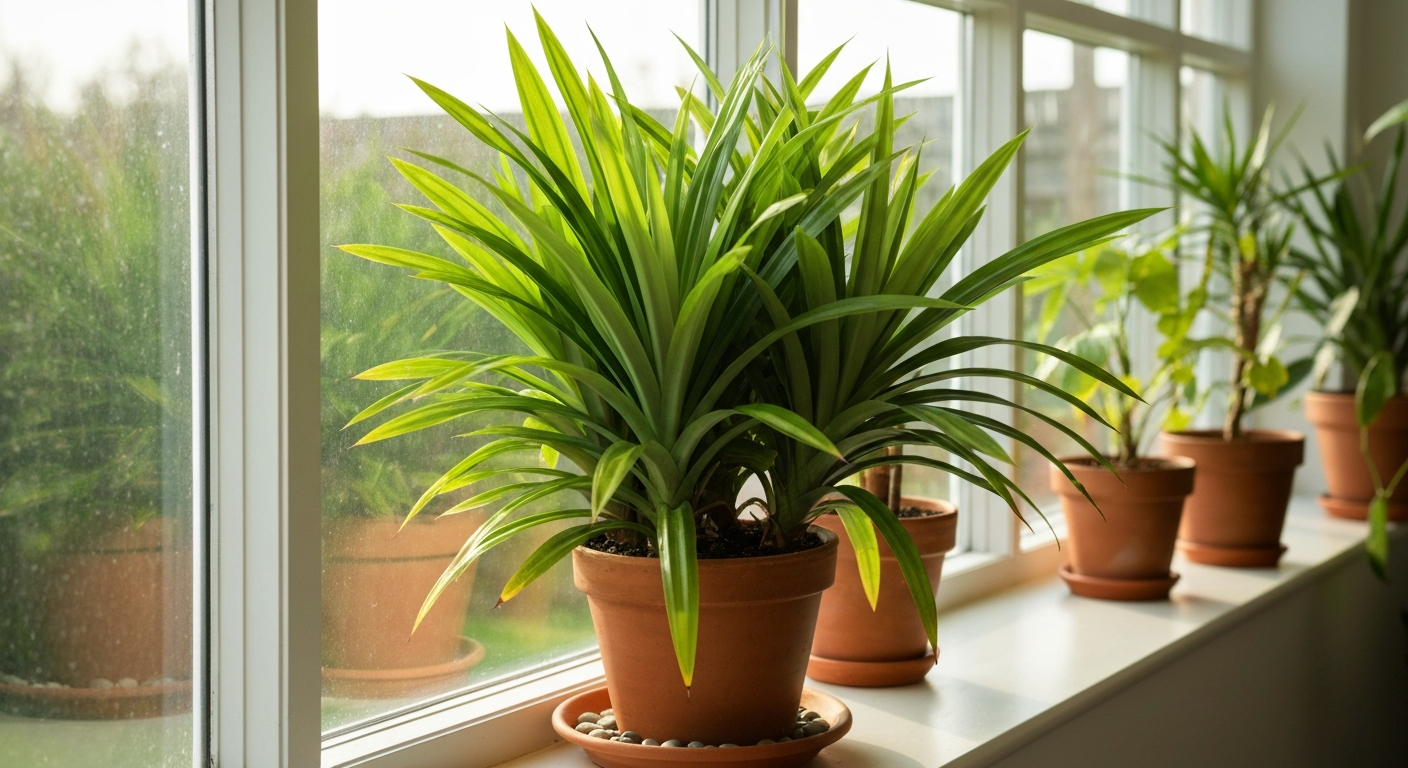
Pandan (Pandanus amaryllifolius) is a tropical, clumping, palm-like plant native to the Maluku Islands in Indonesia. It has been cultivated and introduced widely across South and Southeast Asia, including India, Malaysia, the Philippines, Thailand and Vietnam, where it is considered an essential culinary herb. The plant grows as a rosette of long, flat, bright-green leaves that spiral out from the base and can reach 30 to 45 cm in length under good conditions. It rarely flowers in cultivation and almost never produces viable seed, which is why propagation is done vegetatively.
The leaves are the whole point. They contain 2-acetyl-1-pyrroline, the same compound responsible for the aroma of basmati rice, and they give a sweet, grassy, almost vanilla-like fragrance to rice dishes, cakes, curries and drinks. UK-based cooks who make Southeast Asian or South Asian food quickly discover how hard it is to substitute that flavour with anything else, which is exactly why growing your own is so appealing. Fresh pandan leaves are also visually attractive, and the plant makes a striking houseplant even if you never cook with it.
UK climate limits for pandan
The fundamental problem is temperature. Pandan grows actively at 22 to 35°C and should not regularly drop below 15°C if you want healthy growth. The absolute minimum before damage begins is around 10 to 12°C, and even a brief frost will kill the leaves and can kill the plant outright. The UK's Met Office 1991-2020 baseline puts the average January temperature at around 4.1°C nationally, and most UK regions record multiple air-frost days every winter. Even in the mildest coastal spots in Cornwall or the Isles of Scilly, overnight lows regularly dip below 10°C from November through March. That is simply too cold for pandan to sit outside unprotected.
The RHS classifies Pandanus amaryllifolius as tender and not winter-hardy in the UK, which is honest and accurate. On top of temperature, our summers rarely hit the sustained warmth pandan wants. A typical warm UK summer day in the south might reach 22 to 25°C for a few hours, but then cool sharply at night. Scotland and northern England get even less. This isn't a plant you can push outside in May and leave to fend for itself like a tomato.
Light is another constraint. Pandan prefers bright, filtered light, not deep shade and not harsh direct midday sun. UK winters are short on daylight regardless, and even south-facing windows can deliver surprisingly low light levels between October and February. If you're growing indoors through winter, supplemental lighting is a genuine help rather than a luxury.
Outdoor vs indoor feasibility
Let's be direct: reliable outdoor cultivation in the UK is not feasible. Even in the warmest summer months, you can move a containerised pandan plant outside to a sheltered spot, and it will likely enjoy the warmer days from late June through August. But it comes back in before temperatures drop in September, and it spends the bulk of the year under glass or indoors. Treating it as a permanent outdoor plant is not realistic anywhere in Britain.
Indoor and under-glass growing, on the other hand, works well. A heated conservatory, a warm kitchen windowsill, or a section of a heated greenhouse can give pandan everything it needs. The plant is not huge, typically staying under 1 metre tall in a container in the UK, so it fits comfortably into a domestic space. The main things you need to manage are: keeping the temperature above 15°C at all times, providing reasonable humidity (50 to 70% relative humidity is the target), and ensuring enough light. University and extension guidance commonly recommends raising local relative humidity into roughly the 50–70% range (often cited up to 60–80% for best leaf quality in tropical foliage) to reduce stress and lower spider mite risk for tropical houseplants Boston Fern Care Guide — humidity guidance and extension references (example of recommended RH for tropical foliage).
| Growing location | Feasibility | Main challenge | Verdict |
|---|---|---|---|
| Outdoors year-round | Not feasible | Winter frosts kill the plant | Do not attempt |
| Outdoors summer only (in container) | Feasible June-August in southern UK | Must move in before September | Fine as a seasonal patio plant |
| Unheated greenhouse or conservatory | Not feasible over winter | Temperatures drop below safe minimum | Needs heating to work |
| Heated conservatory (min 15°C) | Very feasible | Humidity can be low in winter | Recommended |
| Heated greenhouse (min 15°C) | Very feasible | Running costs for heating | Recommended |
| Warm indoor room / windowsill | Feasible | Low winter light, central heating dries air | Works with care |
Choosing where to grow: container, conservatory, heated greenhouse or indoors
A container is not optional, it is the method. Pandan cannot go in open ground in the UK, and growing it in a pot is what gives you the flexibility to move it between indoors and outside with the seasons. Use a pot at least 25 to 30 cm in diameter to start, with good drainage holes. Pandan does not like sitting in waterlogged compost, even though it is a humidity-loving plant. A well-draining mix is essential.
For potting mix, research on commercial cultivation in Malaysia suggests a roughly 3:1:1 ratio of loam-based compost to organic matter (well-rotted compost or perlite) to coarse sand or grit. Regional cultivation research (AAFRJ, 2025) gives practical grower guidance: pandan prefers warm, moist sites; a recommended polybag mix is 3 parts soil : 1 part compost/chicken manure : 1 part sand, and it recommends an NPK fertiliser such as 21:21:21 for leaf production blank" rel="noopener noreferrer">Progress on the studies of Pandanus amaryllifolius, the cultivation in Malaysia and its application in various fields (AAFRJ, 2025). In UK terms, mixing a peat-free loam compost with added perlite and a little horticultural grit works well. You want moisture retention without compaction and without the roots sitting in standing water.
A heated conservatory is probably the best environment for most UK gardeners. It keeps the plant within the living space of the house, stays naturally warmer than a standalone greenhouse, and usually has good natural light. Make sure the heating is set to a minimum of 15°C overnight from October to April, and check that the plant is not positioned next to a single-glazed cold spot where it might experience local temperature dips.
A heated greenhouse works just as well and often gives better humidity control. Keeping the temperature above 15°C through a UK winter has a cost: a small electric tubular heater or a paraffin heater can maintain a frost-free greenhouse at around 3 to 4°C cheaply, but getting to 15°C in January requires more energy. Insulating the greenhouse with bubble wrap, partitioning a smaller inner section, and using a thermostatically controlled heater all help reduce running costs significantly. A common approach is to create a warm zone within a larger cold greenhouse using fleece curtains or a small polycarbonate inner tent.
Growing on a windowsill or in a warm room works but has limits. Central heating creates very dry air (often below 40% relative humidity), which stresses pandan and invites spider mites. A south or west-facing window in a kitchen or bathroom tends to give better natural humidity. Winter light through a north-facing window is not enough. If your best available indoor spot is a north-facing room or an office with artificial light only, a grow light is a practical solution.
Using grow lights for winter
Full-spectrum LED grow lights have come down significantly in price and are genuinely useful for tropical houseplants through the UK's dim winter months. Pandan is not a light-hungry plant like a fruiting crop, so you do not need a high-intensity setup. A moderate PPFD (photosynthetic photon flux density) in the range of 100 to 200 µmol per metre squared per second is plenty for leaf maintenance and slow growth. Running a good LED panel on a timer for 12 to 14 hours per day over winter keeps the plant from going into stasis. Position the light 30 to 50 cm above the canopy and check the manufacturer's PPFD data for that distance rather than relying on the wattage number alone.
Microclimate strategies and site selection
If you want to move your pandan outside during summer, choosing the right spot matters. A south-facing patio or courtyard that absorbs daytime heat and releases it overnight can keep temperatures noticeably higher than open garden beds. A south-facing brick or stone wall acts as a thermal buffer, and a spot sheltered from wind reduces the chill factor that damages tropical leaves even when air temperature is technically above the safe minimum.
Frost pockets are the enemy. Low-lying gardens where cold air settles on still nights can see temperatures several degrees lower than a nearby elevated spot. If your garden tends to have late spring frosts in hollows or along fence lines, keep your pandan away from those areas entirely. For the outdoor summer period, raised patios, container groupings on decking, and spots next to warm house walls are your best bet.
Regional differences matter here. In the South West, coastal Cornwall or Devon, you might get away with putting pandan outside slightly earlier (late May rather than late June) and keeping it out slightly longer (perhaps into mid-September). In the Midlands or northern England, the outdoor window is shorter and the risk of a cool August night is real. In Scotland, I would not bother moving it outside at all unless you have a particularly sheltered urban microclimate and a warm summer forecast. The honest position is that pandan does best when treated as a permanent indoor plant in the UK, with outdoor summer placement as a bonus rather than a plan.
Light, temperature and humidity: the day-to-day care
Pandan wants bright, filtered light. In a conservatory or greenhouse, shading the glass lightly in midsummer prevents leaf scorch, while in winter you want maximum light reaching the plant. Indoors, position it in the brightest spot available. Avoid deep shade, which produces pale, floppy leaves with weaker fragrance.
Keep the temperature above 15°C at all times. Between 20 and 28°C during the day encourages active growth. Cold draughts, especially from opening doors in winter, can shock the plant even if the room's average temperature is fine. Keep pandan away from external doors and draughty windowsills.
Humidity is often the overlooked factor. Aim for 50 to 70% relative humidity around the plant. In a centrally heated UK home in winter, the ambient RH can fall to 30 to 40%, which stresses the leaves and creates the conditions spider mites love. Practical solutions include placing the pot on a tray of damp pebbles (so the water evaporates around the leaves without the roots sitting in water), grouping tropical plants together, using a small room humidifier nearby, or misting the leaves lightly in the morning. In a greenhouse, simply keeping a water tray on the floor and damping down the paths on warm mornings helps considerably.
Watering and feeding
Water regularly but do not waterlog. During active growth in spring and summer, the compost should be kept consistently moist, never bone dry and never sitting in water. Check the top 2 to 3 cm of compost with your finger and water when it feels dry to the touch. In winter, reduce watering significantly, roughly every 10 to 14 days depending on how warm and dry the environment is. Use room-temperature water rather than cold water straight from the tap, especially in winter.
For feeding, a balanced NPK fertiliser (21:21:21 or similar) diluted to half strength and applied every two to three weeks during the growing season (April through September) is a reasonable approach. Do not feed in winter when the plant's growth slows. Over-feeding a stressed or slow-growing plant in low winter light encourages salt build-up in the compost without driving useful growth.
Sourcing pandan in the UK
Pandan is not stocked at most mainstream garden centres in the UK, so you need to know where to look. The most reliable sources are specialist online tropical plant nurseries, which have grown considerably in number over the last few years. Search specifically for Pandanus amaryllifolius rather than just 'pandan', as the name is sometimes confused with other Pandanus species that do not have the same culinary fragrance. Some of the better-known UK tropical plant suppliers list it periodically, though stock can be intermittent.
Asian grocery shops are a surprisingly useful source. Fresh pandan stems with nodes are sometimes sold alongside the leaves, and a cutting with a node and a little root tissue will strike readily if treated as a cutting (more on that below). This is genuinely one of the cheapest ways to start a plant if you happen to have a good Asian supermarket nearby. Check that the stems are not wilted or desiccated, and look for any small white root stubs near the base.
Plant swaps and online trading communities (Facebook groups for tropical plant enthusiasts, UK-based groups for exotic and subtropical growers) often have pandan offsets for sale or trade, particularly in spring. This is worth joining even if you only want one plant, as members often share honest growing advice specific to UK conditions alongside the plants themselves.
When buying, look for a plant with firm, upright, bright-green leaves and visible root growth at the base. Avoid plants with yellowing leaf tips (often a sign of cold stress or underwatering in transit), brown or mushy stem bases (rot), or very pale leaves with elongated internodes (etiolated from low light during storage). A small but healthy plant is a much better starting point than a large stressed one.
Propagation methods
Pandan does not produce viable seed in cultivation, so every plant you grow starts from a piece of another plant. There are three main approaches, and all of them work reliably if you get the timing and conditions right.
Division and offsets
This is the easiest method if you already have a mature plant or can get one. Pandan naturally produces offshoots (called offsets or suckers) around the base of the parent plant. When these have developed their own roots, usually visible as small white aerial root stubs at the base, you can detach them cleanly with a sharp knife or secateurs. Pot each offset into a small container (10 to 15 cm) with well-draining mix, water it in, and keep it in a warm (above 18°C), humid spot out of direct sun for three to four weeks while it establishes. Once new leaf growth begins, treat it as a normal established plant.
Stem cuttings
This is the method used when you are starting from a grocery store stem or a cutting without roots. Take a stem section with at least two to three nodes (the points where leaves emerge), ideally 15 to 20 cm long. Allow the cut end to dry for an hour or two, then insert the base into a mix of perlite and coir or a very free-draining seed compost. Keep the medium barely moist rather than wet, maintain temperature above 20°C (a heated propagator is ideal), and provide bright indirect light. Rooting typically takes four to eight weeks. Covering the cutting with a clear plastic bag or placing it in a propagator helps maintain the humidity the cutting needs before its roots can take up water.
Buying established plants
Buying an established plant from a specialist nursery is the fastest and most reliable route to a productive pandan. A plant in a 1 to 2 litre pot with healthy growth can be harvesting-ready within a season. The trade-off is cost, which is typically higher than starting from a cutting, but for a single culinary plant it is often the sensible choice. Re-pot into a slightly larger container as soon as you get it home if the roots are tightly bound, and give it a week or two to acclimatise before moving it into its final position.
Harvesting, storage and culinary uses
Wait until a pandan plant is well-established with multiple healthy leaves before harvesting. For a plant grown from a small offset or cutting, that means letting it settle for at least a full growing season. When you do harvest, take outer leaves from the base rather than stripping the centre, which would set the plant back. A healthy container-grown pandan in the UK can produce usable leaves year-round if kept in good conditions, though growth is much slower in winter.
Fresh pandan leaves can be used immediately or wrapped in a damp cloth and refrigerated for up to a week. For longer storage, leaves freeze well: wash, dry, and seal them in a freezer bag. Frozen leaves retain most of their fragrance. They can also be blended with water and strained to make pandan extract, which stores in the fridge for a few days or can be frozen in ice cube trays for convenience. Common culinary uses include flavouring rice (tuck a leaf into the pot while cooking), making pandan coconut custard (kaya), flavouring cakes, and adding leaves to Southeast Asian curries and desserts.
Pests, diseases and common problems
Spider mites are the most common pest on pandan grown indoors in the UK, and low humidity is almost always the cause. The first sign is a faint speckling or bronzing on the upper leaf surface; check the underside for fine webbing and tiny moving dots. Increase humidity immediately, rinse the leaves with water, and use a neem oil spray or a miticide appropriate for indoor plants. Keeping RH above 50% is genuinely the best prevention.
Mealybugs occasionally appear, hiding in the leaf axils and at the base of the plant. They look like small white cottony blobs. Remove them by wiping with a cotton bud dipped in isopropyl alcohol, then treat with neem oil or an insecticidal soap spray.
Root rot is the main disease risk and is always caused by overwatering or a poorly draining mix. Symptoms are yellowing leaves, a soft or discoloured stem base, and a sour smell from the compost. If you catch it early, remove the plant from the pot, trim away rotten roots with sterile scissors, dust the cuts with powdered cinnamon or sulphur, and repot into fresh, dry mix. Reduce watering significantly afterwards.
- Yellow leaf tips: usually cold stress, underwatering, or fluoride/chlorine sensitivity in tap water. Try using rainwater or filtered water.
- Pale, floppy leaves: insufficient light. Move to a brighter spot or add a grow light.
- Brown leaf edges: low humidity combined with dry air from central heating. Increase humidity around the plant.
- Slow or no growth in winter: normal if temperatures have dropped. Check night-time minimum temperatures and increase heating if below 15°C.
Realistic expectations and alternatives
A container-grown pandan in a warm UK home or heated conservatory will stay relatively compact, typically under 80 to 100 cm tall with leaves perhaps 30 to 40 cm long. It will not reach the lush 1.5-metre clumps you see in tropical gardens, but it will produce fragrant, usable leaves and is a genuinely rewarding plant to grow once you get the conditions right. The main ongoing effort is maintaining temperature and humidity through winter, which requires either a heated indoor space or a willingness to invest a little in greenhouse heating.
If that level of commitment sounds like too much for your situation, it is worth knowing that pandan is not alone in being a tropical culinary plant that needs careful management in the UK. For information on a very different but similarly climate-sensitive beverage plant, see can you grow rooibos in the UK. If you're curious about other unusual plants and their UK suitability, see can you grow protea in the UK for guidance on cultivating proteas in British conditions. Vanilla, for instance, requires even more demanding conditions as a climbing orchid. If you're curious about growing vanilla specifically, see can you grow vanilla in the UK for details on its requirements and challenges. Peppercorns also need sustained tropical heat. Stevia, by contrast, is genuinely easier to grow in the UK as it tolerates cooler temperatures and can be treated more like a tender annual. If you are exploring unusual edible plants and want something less demanding than pandan, stevia is a more forgiving starting point. For practical growing tips and climate guidance, see can you grow stevia in the UK.
That said, pandan is not an impossibly difficult plant for UK growers. It sits somewhere in the middle of the difficulty range for tropical exotics: harder than a chilli or a ginger, but considerably easier than something like rooibos (which needs specific South African fynbos conditions) or growing cocoa in the UK. If you have a warm, bright indoor space and you love Southeast Asian cooking, it is absolutely worth the attempt.
FAQ
Can you grow pandan (Pandanus amaryllifolius) in the UK?
Yes — but only with winter protection. Pandanus amaryllifolius is a wet‑tropical, frost‑tender plant and is not hardy outdoors across the UK. It will survive and produce good edible leaves when grown in a warm conservatory, heated greenhouse or as a container houseplant kept above its safe minimum temperature (ideally ≈15°C or warmer). Outdoor, unprotected cultivation is only possible in exceptional sheltered microclimates that never experience air frost.
Why is pandan not hardy outdoors in the UK?
Pandan is native to tropical Southeast Asia and prefers daytime temperatures roughly 22–35°C and minimums above about 15°C. UK winter long‑term averages and regular air‑frost events (Met Office data) mean most garden sites drop well below pandan’s frost‑sensitive threshold, so plants left outdoors will suffer cold damage or die.
Is pandan OK in an unheated conservatory, greenhouse or indoors?
Unheated conservatories and greenhouses that fall below about 10–13°C in winter are risky; for reliable leaf quality and survival aim to keep pandan above ≈15°C if possible. If you can maintain 10–15°C and good humidity, the plant will generally survive but grow more slowly. For best results keep it in a heated greenhouse/room maintained around 18–25°C.
What light does pandan need in UK conditions?
Pandan prefers bright, filtered light — strong indirect light or morning sun with afternoon shade. In winter or dim rooms provide supplemental full‑spectrum grow light (target moderate PPFD for foliage: roughly 50–200 µmol·m−2·s−1). Aim for a 12–14 hour photoperiod if using artificial lighting to support leaf production.
What soil or potting mix should I use for container pandan?
Use a loose, free‑draining but moisture‑retentive mix: for example 3 parts loam or multipurpose potting compost + 1 part well‑rotted compost or aged manure + 1 part coarse sand or perlite. The mix should be humus‑rich and slightly acidic to neutral. Good drainage prevents root rot while organic matter keeps moisture and nutrients available for leaf growth.
How should I water and feed pandan?
Keep the rootball consistently moist but not waterlogged. Water when the top 2–3 cm of compost starts to dry. In summer provide more frequent watering; reduce frequency in cooler months but avoid letting roots dry out. Feed with a balanced NPK liquid fertiliser (e.g., 20–20–20/21–21–21) at a half‑strength dose every 2–4 weeks during the growing season to promote leafy growth. Alternatively use a slow‑release granular fertiliser applied in spring and mid‑season.
Next Article
Can You Grow Peppercorns in the UK? Practical UK Guide
Can you grow peppercorns in the UK? Practical verdict, precise greenhouse steps, yields, pests, and UK-friendly alterna