You can grow vanilla in the UK, but only indoors or in a permanently heated, humid greenhouse. Vanilla planifolia is a tropical vine that needs temperatures between 21 and 32 °C year-round, relative humidity around 80%, and bright indirect light. The UK's mean annual temperatures sit somewhere between 8 and 13 °C depending on where you live, which rules out any outdoor cultivation outright. Met Office, Location‑specific long‑term climate averages (1991–2020) provide location-specific 1991–2020 mean temperatures, humidity and sunshine data for the UK Met Office — Location‑specific long‑term climate averages (1991–2020) provide location-specific 1991–2020 mean temperatures, humidity and sunshine data for the UK.. Even an unheated greenhouse won't cut it for more than a few summer weeks. That said, with the right setup, a heated conservatory, a well-managed grow room, or a large bright bathroom, vanilla is genuinely possible as a UK houseplant, and with patience and hand pollination, you can get pods.
Can you grow vanilla in the UK? Practical Guide & Verdict
Is vanilla actually worth trying in the UK?
Honest answer: it depends entirely on what you want from it. If you're picturing a productive crop that cuts your vanilla extract bill, it's a long road. Vanilla vines typically take three to five years from cutting to first flower, and even then you'll be hand-pollinating individual blooms in a narrow two-to-eight hour window. Pod maturation takes around nine months after pollination, and the curing process adds months more. It is, genuinely, one of the most labour-intensive crops on earth, which is exactly why good vanilla extract is expensive.
If you're growing it as a fascinating horticultural project, a beautiful climbing vine with unusual flowers and a direct connection to one of the world's most coveted spices, then it's absolutely worth it. I've grown one vine in a large heated propagator setup and another in a south-facing conservatory, and both have been rewarding even before a single pod appeared. The plant itself is striking: thick succulent stems, waxy leaves, and aerial roots that grip anything they can find. Just go in with clear eyes about the time, cost, and climate management involved.
Difficulty rating for UK growers
- Difficulty: High — one of the most demanding tropical crops you can attempt indoors in Britain
- Time to first pods: 3–5 years minimum from a cutting, sometimes longer
- Ongoing effort: Weekly humidity checks, monthly feeding, seasonal pruning, and hand pollination when flowers appear
- Equipment cost: Budget £200–£800+ for heating, humidity control, and grow lights depending on your setup
- Reward if successful: Genuine home-grown vanilla pods worth more per gram than gold by weight — and bragging rights
Which vanilla species should UK growers choose?
Vanilla planifolia is the one you want for classic vanilla flavour. It's the species behind around 80% of global vanilla production, and it's the most widely available to UK growers through specialist tropical plant nurseries and online suppliers. Its pods carry that deep, sweet, creamy aroma most people associate with vanilla extract and vanilla bean paste. This is your default choice.
Vanilla × tahitensis, Tahitian vanilla, is a natural hybrid with a noticeably different flavour profile, more floral, slightly aniseed, and prized by pastry chefs for specific applications. It grows under similar conditions to V. planifolia but the pods are shorter and plumper, and the flavour chemistry is distinct. If you want variety, or if you find a plant available, it's worth trying alongside V. planifolia rather than instead of it.
Vanilla pompona, sometimes called West Indian vanilla, produces short, thick pods and is less commonly cultivated commercially. The flavour is weaker and less refined. Unless you specifically want to grow it for interest, V. planifolia is the better investment of your greenhouse space.
| Species | Flavour Profile | Pod Size | UK Availability | Best For |
|---|---|---|---|---|
| Vanilla planifolia | Classic, sweet, creamy | Long, thin (15–25 cm) | Moderate — specialist nurseries | Main crop, extract, pods |
| Vanilla × tahitensis | Floral, aniseed, complex | Short, plump | Limited — online specialists | Gourmet cooking, variety |
| Vanilla pompona | Mild, less refined | Short, thick | Rare in UK | Collector interest only |
Outdoor, greenhouse, or indoors, what actually works in the UK?
Outdoors: not a realistic option
I'll be direct here: you cannot grow vanilla outdoors in the UK in any practical sense. The plant needs temperatures to stay above 15 °C even at night (Kew's tropical nursery maintains a minimum night temperature of around 20 °C), and UK summers simply don't deliver that consistently. A July heatwave in the south might give you a few borderline weeks, but any cold snap will set the plant back severely, and UK winters are obviously fatal to an unprotected tropical vine. Outdoor cultivation is a non-starter.
Unheated greenhouse: marginally better but still not enough
An unheated greenhouse gives you warmer daytime temperatures through spring and summer, but night temperatures will drop far too low for most of the year. From October through to April, a standard unheated UK greenhouse will regularly dip below 5 °C. Vanilla would not survive a British winter in an unheated structure. You could move a potted plant in and out seasonally, but vanilla actively dislikes temperature swings, and moving a large trained vine repeatedly is impractical.
Heated greenhouse or conservatory: the best realistic option
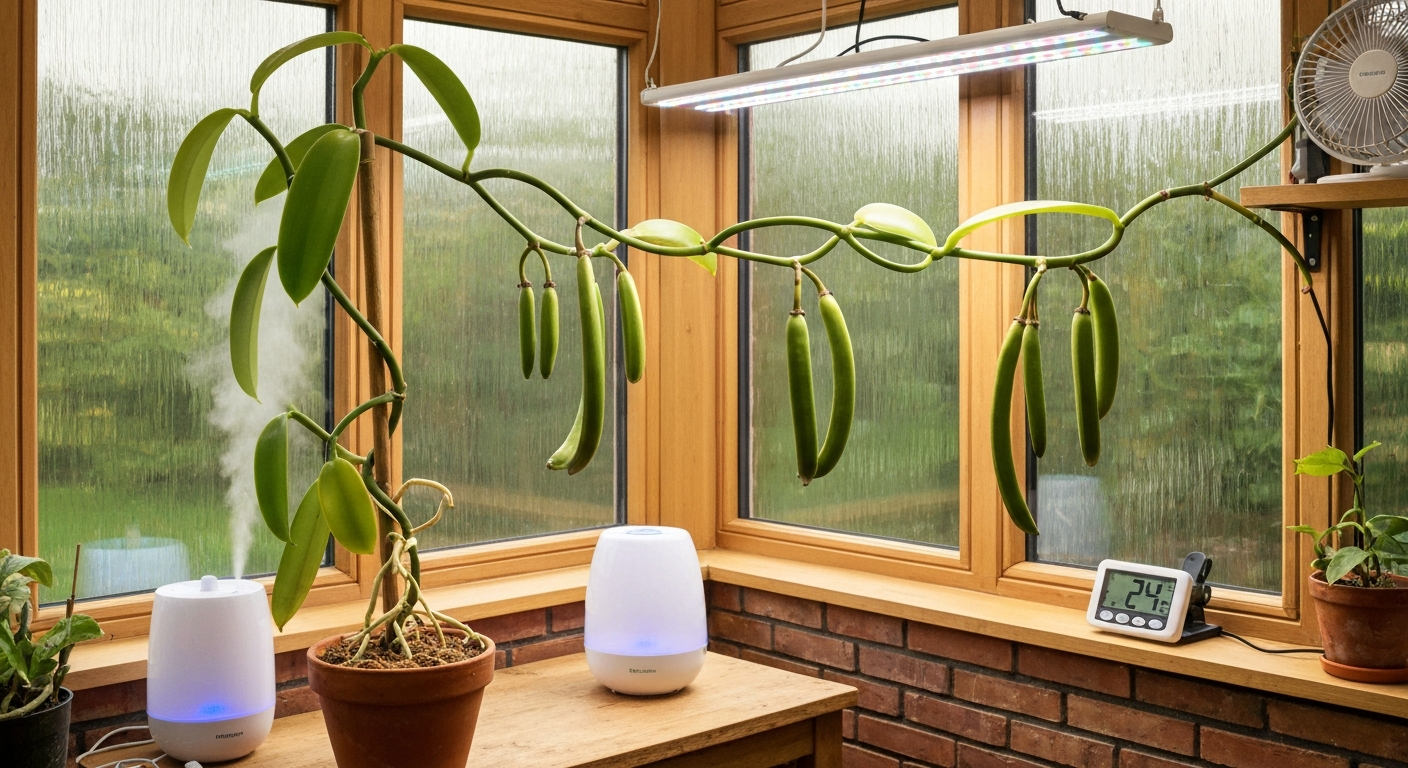
A permanently heated greenhouse or a south-facing, well-insulated conservatory is the gold standard for UK vanilla growing. You need to maintain a minimum of 18–20 °C overnight throughout the year, with daytime temperatures ideally reaching 24–29 °C in the growing season. Pair this with a humidifier to keep relative humidity at 70–85%, supplemental LED grow lights in winter (UK winter days are far too short and dim to sustain good growth), and adequate ventilation to prevent fungal disease, and you have a workable setup. The heating costs are real, budget for them upfront.
Indoors: genuinely viable with the right room
A warm indoor space, particularly a heated south-facing room, a large bright bathroom with consistent warmth and steam, or a dedicated grow-tent with LED lighting and a humidifier, can work well. Vanilla actually tolerates the stable temperatures most UK homes maintain if you supplement the light. The challenge indoors is humidity: centrally heated UK homes in winter can drop to 30–40% relative humidity, which is miserable for a tropical vine. A good ultrasonic humidifier running near the plant makes a significant difference.
Growing vanilla by UK region, what's realistic where you are
| Region | Climate Challenge | Best Setup | Feasibility |
|---|---|---|---|
| Scotland | Coldest winters, lowest light, short days | Heated grow room or insulated conservatory with full LED lighting | Possible but highest cost and effort |
| Northern England | Cold winters, moderate light | Heated greenhouse or warm south-facing indoor room with grow lights | Possible with good heating setup |
| Midlands | Average UK conditions, cold winters | Heated conservatory or indoor grow tent | Moderate effort, viable indoors |
| South West | Milder winters, higher humidity outdoors | Heated conservatory works well; humidity easier to manage | Good conditions for heated greenhouse approach |
| South East | Warmest summers, drier air | Heated conservatory or bright indoor room; watch humidity in winter | Best UK region for this crop |
| Urban heated homes (any region) | Central heating dries air; stable temperatures | Grow tent or large south-facing window with humidifier | Viable year-round with humidity management |
If you're in the South West or South East, you have the easiest path, mild winters reduce heating costs, and outdoor air humidity in the South West particularly means conservatory RH levels are more naturally supportive. Scottish and Northern England growers can absolutely succeed, but you need to commit to higher energy bills and more robust supplemental lighting from October through March.
Exact climate thresholds vanilla needs from you
Vanilla planifolia is not flexible about its core requirements. Here's what the research and practical growing experience tells you to aim for:
| Parameter | Optimal Range | Absolute Minimum | Notes |
|---|---|---|---|
| Air temperature (day) | 24–29 °C | 18 °C | Below 15 °C causes visible stress; below 10 °C risks death |
| Air temperature (night) | 20–22 °C | 15–18 °C | Kew maintains min 20 °C night temp in tropical collections |
| Relative humidity | 75–85% | 60% | Below 50% causes leaf stress and poor root growth |
| Light (PPFD) | 200–320 μmol·m⁻²·s⁻¹ | ~150 μmol·m⁻²·s⁻¹ | Bright indirect light; direct midday sun can scorch leaves |
| Photoperiod | 12–14 hours light daily | 10 hours | Supplement with grow lights from October to March in the UK |
| Ventilation | Gentle airflow | None tolerated | Prevents botrytis and fungal rots; avoid cold draughts |
| Rainfall equivalent (potted) | Water regularly, no waterlogging | Never fully dry out | Epiphytic roots need moisture but die in standing water |
The light requirement is worth emphasising. Vanilla is a shaded forest plant in the wild and performs best under partial shade, around 40% shade is standard in commercial plantations. In practice for UK growers, this means bright indirect light (near a south-facing window, but stepped back from direct midday glass in summer) or a good quality full-spectrum LED grow light rather than blasting it with the highest-intensity lamp you can find. Studies measuring PAR in vanilla shade-house trials recorded maximum instantaneous levels around 200 μmol·m⁻²·s⁻¹, with propagation work using 200–320 μmol·m⁻²·s⁻¹, a mid-range LED panel on a 12-hour timer fits this well. Propagation trials have used PPFD ≈200–320 μmol·m⁻²·s⁻¹, supporting this light recommendation (see Effect of commercial LED lighting on vegetative propagation of two vanilla species, propagation/PPFD study (ResearchGate preprint)) blank" rel="noopener noreferrer">Effect of commercial LED lighting on vegetative propagation of two vanilla species — propagation/PPFD study (ResearchGate preprint).
A word on ventilation
This is the thing people overlook. High humidity plus poor airflow is a recipe for grey mould, root rot, and stem fungal issues. In a heated greenhouse or grow tent, run a small clip fan or oscillating fan on low at all times. The airflow should be enough to gently move the leaves, not a gale, just circulation. This mimics the natural airflow of a forest canopy and significantly reduces disease pressure.
Getting the soil and potting mix right
Vanilla planifolia is a hemi-epiphyte: in the wild it grows up tree trunks with its aerial roots anchoring into bark and leaf litter, not heavy soil. In a pot, replicating that open, airy, fast-draining medium is essential. Standard garden compost or multipurpose potting mix will stay too wet and kill the roots.
The best potting mix for vanilla is essentially an orchid-style medium adjusted for a vine rather than a compact epiphyte. A reliable recipe that works well:
- 2 parts medium-grade orchid bark (pine or fir bark, 10–18 mm grade)
- 1 part perlite (coarse, for drainage and aeration)
- 1 part coconut coir (moisture retention without compaction)
- Optional: a small handful of horticultural charcoal per pot to suppress bacterial rot
Target a pH of 6.0–7.0. Vanilla is tolerant within this range, but drifting below 5.5 will lock out nutrients. Check your mix pH with a basic probe or test kit and adjust with dolomite lime if needed. Do not use lime-rich compost or anything strongly alkaline.
Container sizing and repotting
Start cuttings in relatively small containers, a 15 cm pot is fine for a new cutting. Vanilla actually flowers better when slightly pot-bound, so don't rush to upsize. A mature vine heading toward flowering does well in a 20–30 cm deep pot or a wooden orchid basket lined with sphagnum. The key is that the pot must have excellent drainage: use pots with multiple drainage holes and stand them on feet or a layer of gravel, never in a saucer of water. When you do repot (every two to three years is usually enough), disturb the roots as little as possible, vanilla resents root disturbance.
Support structures and training your vanilla vine
Vanilla is a vigorous climber that produces aerial roots along the stem nodes, and it needs something to grip. In commercial plantations, vines are trained on wooden stakes or live support trees to a height of around 1.2–1.5 m, then looped back down to keep flowers within reach for hand pollination and harvest. That principle translates directly to UK setups, with a few adaptations.
Stakes and single poles
For indoor growing in a conservatory or grow room, a sturdy bamboo cane or wooden stake (at least 2 cm diameter) pushed into the pot and secured to the wall or ceiling is the simplest starting structure. Tie the vine loosely to the stake every 15–20 cm with soft ties or jute twine, encouraging the aerial roots to anchor as they develop. Once the vine reaches the top of your stake, you loop it gently downward and train it horizontally, this triggers flowering nodes in mature vines.
Trellis panels and wall-mounted systems
In a greenhouse, a timber trellis panel or wire mesh panel fixed to the back wall gives the vine room to spread across a wider area. Space horizontal wire runs about 30–40 cm apart. Train the growing tip along each level and secure it loosely. This approach lets you maximise flowering nodes across the length of the vine while keeping everything at a workable height.
Hanging mounts and ceiling rigs
In a grow tent or larger indoor space, some growers use a hanging mount system where the vine is trained along horizontal strings or wooden dowels suspended from the ceiling. This works well for maximising light exposure to the whole vine length and is easier to reach for hand pollination. Use ceiling hooks rated for the weight of the vine plus any irrigation tubing, and check the fixings regularly.
Placement tips by setup
- Conservatory: Position the pot against the warmest wall (usually the house wall), train upward then loop horizontally below the glazing for best light. Keep the pot off cold floor tiles using pot feet or a wooden board.
- Heated greenhouse: Train along the back or side wall away from vents; keep the vine at least 30 cm from the glass to avoid cold-glass temperature drops at night.
- Grow tent: Fix a trellis net across the upper section and train the vine across it; position grow lights 40–60 cm above the canopy and adjust as the vine grows.
- Indoor room: Place the pot near a south-facing window but stepped back 30–50 cm to avoid direct midday sun through glass; a stake anchored to a nearby wall or furniture piece works fine for early training.
Getting hold of plants, buying vanilla in the UK
You can source vanilla plants from specialist tropical plant nurseries in the UK and from reputable online sellers. Look for established rooted cuttings rather than seeds, vanilla rarely comes true from seed and germination is slow and unreliable. A cutting with three to five nodes and a few established aerial roots is ideal. Some UK orchid nurseries stock V. planifolia year-round; others have seasonal availability, so it's worth checking before spring.
If you're buying from overseas or importing cuttings, be aware that post-Brexit plant health rules apply. Live plants entering Great Britain require a phytosanitary certificate from the country of origin, and some categories of plants also require a UK plant passport on arrival. Buying from within the UK or from a reputable EU exporter who handles the paperwork correctly is the safest route. Check GOV.UK's guidance on importing plants and plant products before ordering from outside Great Britain.
Propagating your own vanilla from cuttings
Once you have a healthy vine, taking cuttings is straightforward. Cut a stem section with at least four to six nodes, ideally 30–60 cm long. Remove the bottom one or two leaves, dust the cut end lightly with rooting hormone powder, and place the cutting into your prepared orchid-bark mix with the lower nodes buried or resting against moist sphagnum. Keep it warm (25–28 °C), humid, and in bright indirect light. Aerial roots should begin developing from the buried nodes within two to six weeks in good conditions, though it can take up to eight weeks if temperatures are on the lower end.
Don't pot up too early. Wait until you can see healthy new root growth and a new leaf or two emerging from the growing tip before treating the cutting as an established plant. Vanilla cuttings are fairly forgiving once rooted, the tricky bit is maintaining the right humidity and warmth during that initial rooting period, which is why a heated propagator or a plastic bag tent over the cutting helps enormously.
Year-round care in a UK climate
Spring and summer (March to September)
This is your main growing season. Increase watering frequency as temperatures rise, aiming to keep the medium evenly moist but never sodden. Feed with a balanced liquid orchid fertiliser at half strength every two to three weeks, vanilla appreciates nutrients during active growth but is sensitive to salt build-up from over-feeding. Ventilate the greenhouse more on warm days but be cautious about cold draughts. In June and July, watch for any signs of flowering on mature vines: small clusters of buds appear at leaf nodes along the middle sections of the vine.
Autumn and winter (October to February)
Reduce watering but don't let the medium dry out completely. UK winter light is seriously inadequate for vanilla, a mature vine will slow right down and may drop a leaf or two, which is normal. Keep grow lights running on a 12-hour timer. Maintain heating: letting the temperature slip below 15 °C even for one cold night can cause significant setback. Check heating equipment monthly. Humidity control becomes more critical as central heating or greenhouse heaters dry the air, run your humidifier on a hygrometer-controlled timer to maintain 70–80% RH.
Triggering flowering: the dry rest period
Commercial growers induce flowering by giving vanilla a relative dry rest of around six to eight weeks, reduced watering and slightly lower (but still warm) temperatures. This mimics the short dry season vanilla experiences in its native habitat. For UK growers, a mild reduction in watering frequency in late autumn (not stopping water, just reducing frequency from every four to five days to every seven to ten days) alongside the natural winter temperature reduction can help push a mature vine toward flowering. Don't take this too far, the plant still needs warmth and should never experience temperatures below 15 °C even during this rest.
Flowering and hand pollination, the critical step
Vanilla flowers are stunning: pale greenish-yellow, trumpet-shaped, and delicately fragrant. Each flower opens for one day only, typically in the morning, and closes by afternoon. Outside vanilla's native Mexico (where the Melipona bee and certain other insects handle pollination), every flower that opens must be hand-pollinated if you want pods. This applies everywhere vanilla is grown commercially, Madagascar, Indonesia, Tahiti, and it applies to your UK greenhouse too.
Step-by-step hand pollination
- Check your vine each morning during flowering season — flowers open in the early morning and you have a window of roughly two to eight hours.
- Take a small, clean, dry toothpick or fine artist's paintbrush.
- Gently pull back the small flap (the rostellum) that separates the anther (male part) from the stigma (female part) — this membrane physically prevents self-pollination and must be moved aside.
- Using the toothpick, transfer the pollen mass (the pollinia — a small waxy yellow lump) from the anther directly onto the sticky surface of the stigma, pressing gently to ensure contact.
- Repeat for each flower — a single flower pollinated successfully will swell at its base within a week if the operation worked.
- Mark pollinated flowers with a small twist of coloured wire around the stem so you know which potential pods to monitor.
Don't panic if you miss a flower or two, a mature vine in good conditions may produce dozens of flowers in a season. Success rates improve with practice. I find a 50–70% strike rate is typical when you're new to it, rising toward 80–90% once you've got the feel for the rostellum.
From pollination to pods, the long wait
After successful pollination, the ovary at the base of the flower begins to swell into a pod over the following weeks. Full pod development takes around eight to nine months. The pods are ready to harvest when they have just started to turn yellow at the tip, at this point the beans inside have fully developed but the pod hasn't yet split. Don't wait for full yellowing or the pod will split on the vine.
Harvesting and curing vanilla beans
Harvesting a vanilla pod is the easy part, curing it is a multi-month process that develops the flavour compounds (particularly vanillin) from their odourless precursors. A freshly harvested vanilla pod smells of almost nothing. The characteristic vanilla aroma only develops during curing.
The curing process step by step
- Blanching (killing): Immerse the freshly harvested pods in hot water at around 60–65 °C for two to three minutes. This stops the enzymatic processes that would cause the pod to continue ripening and splits the cells to release flavour precursors. Immediately remove and pat dry.
- Sweating (initial fermentation): Wrap the blanched pods in a wool or cotton blanket and place them in a sealed wooden box or insulated container. Leave for 24–48 hours in a warm place (around 40–45 °C if possible — a warming drawer, airing cupboard, or propagator set low works). The pods will turn dark brown and moist.
- Daily sun-drying and nightly sweating: Spread pods on a rack in bright indirect sunlight (or under a grow light) during the day for three to four hours, then return to the wrapped box overnight. Repeat this daily cycle for two to six weeks, checking for mould. Wipe any surface mould immediately with a lightly alcohol-dampened cloth.
- Slow air-drying: Once the pods are pliable, dark, and beginning to develop a waxy sheen, move them to a well-ventilated shaded space. Allow them to slowly dry over a further two to three months, turning weekly.
- Conditioning: Store cured pods in a sealed glass jar or airtight container for at least one to two additional months. This final conditioning phase deepens and mellows the flavour. The finished pods should be dark brown, slightly waxy, flexible (not brittle), and fragrant.
The entire curing process from harvest to finished beans typically runs four to six months. It's involved, but the result, genuine home-cured vanilla with a flavour you won't find in a supermarket bottle, is genuinely extraordinary.
Pests, diseases, and common problems
Vanilla in a UK controlled environment is relatively pest-light compared to field-grown tropical crops, but a few problems come up regularly.
| Problem | Symptoms | Cause | Fix |
|---|---|---|---|
| Root rot | Yellowing leaves, mushy stem base, vine collapse | Overwatering or poor drainage | Remove affected sections, repot into fresh dry medium, reduce watering frequency |
| Botrytis (grey mould) | Grey fuzzy growth on stems or leaves | High humidity + poor airflow | Improve ventilation, remove affected growth, reduce RH slightly |
| Spider mites | Fine webbing, pale stippling on leaves | Low humidity, warm dry conditions | Increase humidity, wipe leaves with damp cloth, use neem oil spray |
| Mealybugs | White fluffy deposits in leaf axils | Common houseplant pest | Remove manually with cotton bud dipped in rubbing alcohol, use insecticidal soap |
| Scale insects | Brown bumps on stems, sticky honeydew | Common in warm conservatories | Scrape off manually, treat with neem oil or systemic insecticide |
| Yellow leaves (without mould) | Older leaves turn yellow and drop | Normal if limited to lower leaves; otherwise low nutrients, cold, or overwatering | Check temperature logs, feed if growth has been strong, adjust watering |
Equipment you'll actually need
Being upfront about equipment costs is important because they catch people off guard. Here's a realistic list for a heated conservatory or grow-tent setup:
- Greenhouse or conservatory heater: minimum 1–2 kW electric heater with thermostat control — budget £60–£200
- Ultrasonic humidifier with hygrometer and timer: £30–£80 depending on capacity
- Full-spectrum LED grow light (minimum 200 μmol·m⁻²·s⁻¹ output at canopy level): £40–£150
- Digital thermometer/hygrometer combo: £10–£25 — essential for monitoring, not optional
- Orchid bark, perlite, and coir for potting mix: £20–£30 per batch
- Clip fan or small oscillating fan for ventilation: £15–£30
- Bamboo canes, timber stakes, or trellis panel for support: £10–£40 depending on setup
- Rooting hormone powder if propagating: £5–£10
- Optional: heated propagator for cuttings and winter insurance: £30–£80
Realistic yield and cost assessment
A single mature UK-grown vanilla vine in good conditions might produce 10–30 pods per year once it reaches flowering age, potentially more from a large well-managed vine, but that's a realistic home-growing range. Each pod at commercial rates is worth several pounds, so the raw value is there. But factor in the equipment costs, electricity for heating and lighting year-round, the three-to-five year wait before first flowering, and the time investment in hand pollination and curing, and you're clearly not doing this to save money. You're doing it because it's one of the most interesting growing projects available to a UK indoor gardener, full stop.
How vanilla compares to other challenging tropical crops in the UK
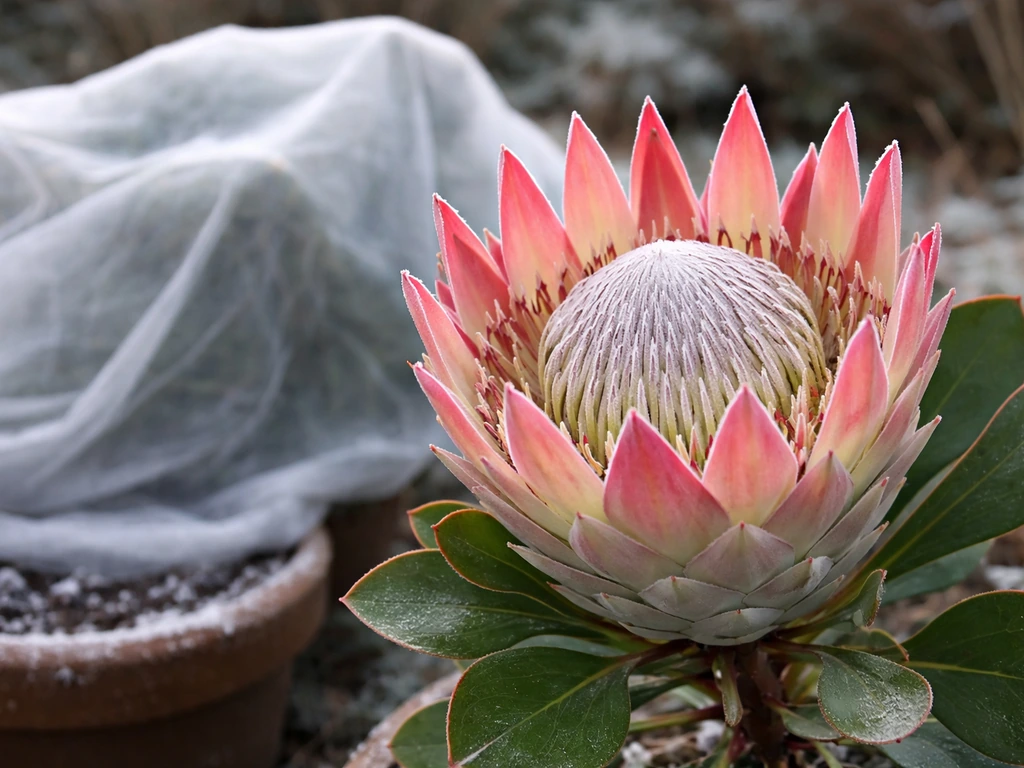
Vanilla sits at the difficult end of the spectrum for UK tropical growing, but it's not uniquely hard compared to some of its cousins. If you're curious about another tropical option, see can you grow pandan in uk for guidance on growing pandan under British conditions. If you're considering alternative sweetener plants, see Can you grow stevia in the UK for guidance on cultivating stevia under British conditions. If you're interested in other exotic crops that require similar controlled indoor conditions, it's worth knowing that peppercorns, pandan, and rooibos each present their own very different challenges in British conditions, and stevia is actually one of the easier tropical herbs to manage as a UK pot plant by comparison. If you're curious about other UK surprises, see the guide on whether you can grow protea in the UK for advice on cultivating proteas in British conditions can you grow protea in the UK. For practical guidance on cultivating peppercorns in Britain, see can you grow peppercorns in the UK. Chocolate (cacao) shares vanilla's demand for consistent tropical warmth and is similarly best suited to a heated greenhouse or conservatory in the UK.
Should you grow vanilla in the UK, the honest verdict
If you have a heated greenhouse or a warm, bright conservatory, and you're genuinely interested in the process rather than purely the product, then yes, vanilla is a rewarding and achievable UK project. It won't suit everyone: the multi-year timeline, the equipment costs, and the active management required during flowering make it a serious commitment. But for the right grower with the right setup, there's something deeply satisfying about growing the world's most painstakingly produced spice in a British conservatory and curing your own pods. If you're in the South East or South West with a well-insulated conservatory, this is particularly worth trying. If you're in Scotland with a well-equipped heated grow room and a serious interest in the project, it's doable too, it'll just cost more to heat.
FAQ
Can you grow vanilla (Vanilla planifolia and alternatives) in the UK?
Yes — but not outdoors in an unheated UK garden. Vanilla (especially V. planifolia) is a tropical vine that needs sustained warm (≈21–32 °C) and very humid (~70–85% RH) conditions. In the UK reliable flowering and pod set require a heated conservatory/greenhouse or indoor growroom with humidity control, or a seasonal container habit where plants are kept indoors/under heat year‑round. Unheated greenhouses or outdoor summers are generally insufficient for commercial pod production.
Which vanilla species should UK growers choose?
Vanilla planifolia is the standard commercial choice (classic vanilla flavour). Alternatives: Vanilla × tahitensis (Tahitian profile) and Vanilla pompona (thicker, shorter pods) are options if you prefer their flavour or tolerance traits. For hobbyists, V. planifolia is recommended for availability and documented cultivation protocols.
What exact temperature and humidity does vanilla need in the UK?
Target daytime air temperature 24–30 °C, night temperatures not below ~18–20 °C. Optimal band is ≈21–32 °C. Relative humidity should be high: aim 70–85% RH. Vanilla tolerates short cooler or drier spells but sustained temperatures <18–20 °C or RH <50% will slow growth and prevent flowering.
How much light and what growing medium does vanilla require?
Bright, indirect light — avoid strong midday sun. Aim for moderate PPFD ~200–300 μmol·m⁻²·s⁻¹ (approx. 40% shade from full sun). Use an open, well‑draining, aerated potting mix: coarse bark or orchid mix + moisture‑retaining peat or coconut coir + perlite/vermiculite; target pH ≈6–7. In pots use larger volumes to buffer moisture and temperature swings.
How should you support and train vanilla vines?
Train vines up a sturdy vertical support 1.2–1.5 m high (wooden pole, trellis, or wires). Secure stems loosely; provide horizontal ties/wires to spread laterals when flowering to make hand‑pollination and harvest easier. Spacing in beds/pots should allow access to flowers and good airflow.
What are practical propagation methods and where to obtain plants in the UK?
Vegetative stem cuttings are the most practical: take cuttings with several nodes, allow a few days to callus and root in a warm, humid propagator or under mist; rooting often 1–8 weeks depending on conditions. Tissue‑cultured plantlets are also available commercially and give uniform stock. Buy from reputable orchid/vanilla nurseries; check import/plant health rules for international purchases.
Can You Grow Protea in the UK? Guide and Checklist
Learn if you can grow protea in the UK, plus the best cultivars, soil, protection, and overwintering checklist.