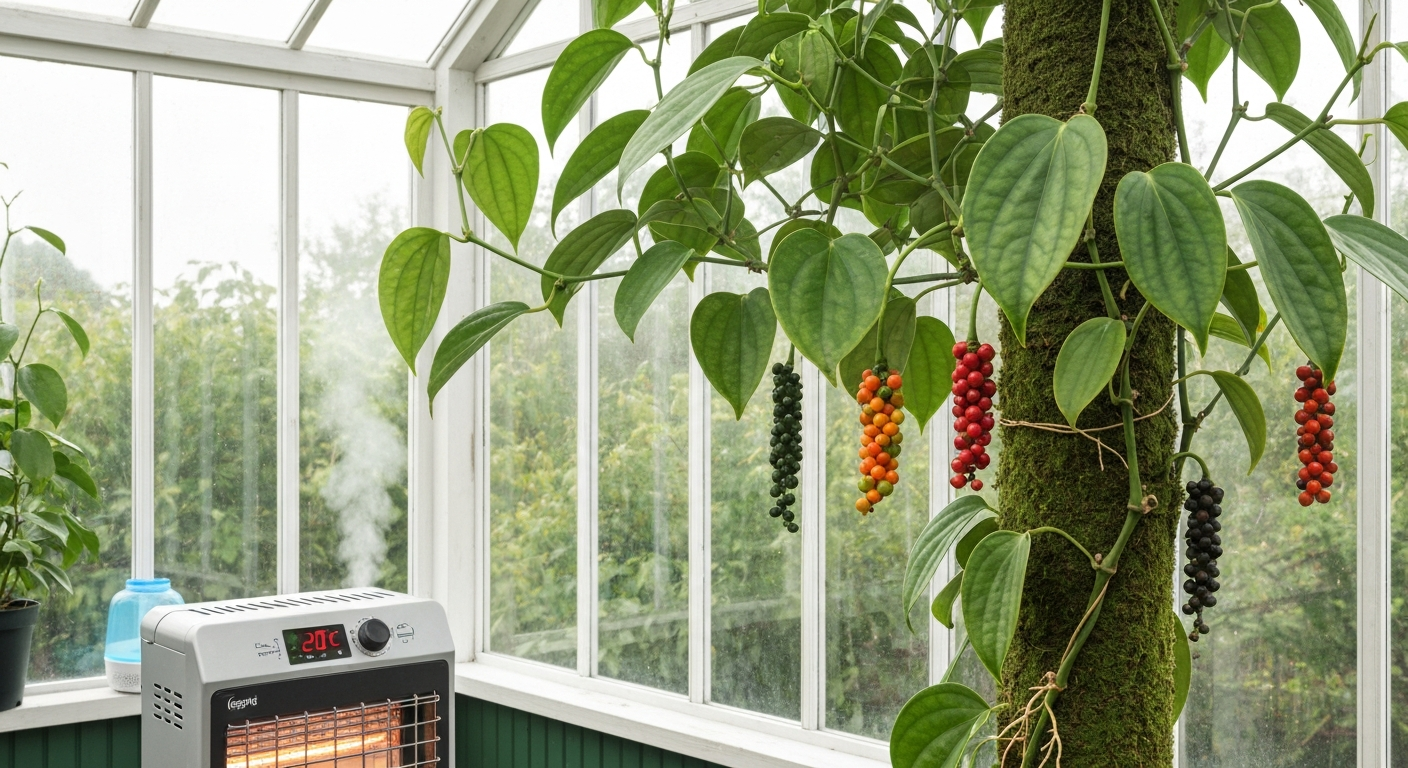
Yes, you can grow black pepper (Piper nigrum) in the UK, but not outdoors and not easily. This is a humid-tropical vine that needs temperatures above 18–20 °C to thrive, consistent humidity around 75–80%, and at least 3–4 years before it produces a single peppercorn. Realistically, you need a heated greenhouse or a warm conservatory to keep it alive through winter and growing vigorously enough to fruit. If you have that setup and the patience for a long-term project, it is genuinely possible to harvest your own peppercorns in Britain. If you don't, the alternatives at the end of this article are worth a serious look.
Can You Grow Peppercorns in the UK? Practical UK Guide
James Hartwell
22 Jul 2026
Quick verdict: can you grow Piper nigrum in the UK?
Piper nigrum is classified RHS H1a, meaning it needs a minimum of 15 °C under glass year-round and really prefers 18–22 °C even in winter. The UK's average outdoor climate sits nowhere near that. Even in the mildest corners of Cornwall or the Isles of Scilly, outdoor temperatures drop well below what this vine can survive, and outdoor humidity patterns are nothing like the 75–95% RH it naturally grows in across South and Southeast Asia. This is not a plant you can push outside in summer and drag back in during October. It needs a permanent heated home.
That said, plenty of UK gardeners have healthy, actively growing plants in heated glasshouses and large conservatories. The vine is attractive, the leaves are glossy and interesting, and the project of growing your own spice has genuine appeal. Just go in knowing that fruiting is the reward for doing almost everything right for several years running, not something that happens by accident.
Climate feasibility and site selection across the UK
The single most important decision is where in your property this plant lives. A heated greenhouse is the best option because you have full control over temperature, humidity and ventilation. A south-facing conservatory attached to a heated house is a reasonable second choice, especially if it stays above 12–15 °C overnight in winter. An unheated greenhouse, even in the South West, will not work reliably: UK winters regularly drop below 5 °C even in mild regions, and even a brief dip to that temperature can severely damage or kill a pepper vine.
Regional differences do matter. If you're growing in a conservatory in Devon or Kent, your ambient winter temperatures will be softer than in Yorkshire or Scotland, and supplemental heating costs will be lower. But wherever you are in the UK, you're heating this plant through winter, full stop. North of the Midlands, a dedicated heated greenhouse becomes less optional and more essential. The honest answer for Scottish gardeners is that a well-insulated heated glasshouse with supplemental lighting is the realistic path, because natural DLI (the total daily light a plant receives) in a Scottish winter is genuinely inadequate for tropical growth.
Exact growing requirements: temperature, humidity and light
Black pepper grows best between 23–32 °C, with an optimum around 26–28 °C for root and shoot development. It tolerates as low as 10 °C for short periods but stops growing meaningfully below about 18 °C and suffers real damage below 10 °C. For fruiting, you want sustained warmth, ideally keeping the growing space at 20–25 °C during the day and no lower than 15–18 °C at night.
Humidity is equally critical. In its native range, Piper nigrum experiences relative humidity of 65–95%, typically around 75–80% through most of the year. For practical guidance on measuring and reporting greenhouse relative humidity and vapour pressure deficit (VPD), see Guidelines for measuring and reporting environmental parameters for experiments in greenhouses, Plant Methods (PMC) monitoring RH and VPD. A UK home or unmanaged conservatory sitting at 40–50% RH in winter is not enough. You will need to actively manage humidity through regular misting, pebble trays filled with water, or a small electric humidifier near the plant. Aim for 70–80% RH. If you have a separate heated greenhouse, you have more control, but watch for the other extreme: stagnant humid air encourages fungal problems, so gentle airflow matters.
On light, black pepper is actually more forgiving than many tropical crops. In the wild it frequently grows as a climbing vine through forest canopy, so it tolerates filtered and indirect light well. In a UK greenhouse or conservatory, a south or south-east aspect is ideal, and during summer you may want to provide some shade to prevent leaf scorch. In winter, especially north of the Midlands, natural light levels will be too low to maintain active growth. Supplemental LED grow lights (target DLI of around 12–15 mol/m²/day for vegetative growth; slightly higher if you want to encourage flowering) can make a significant difference between a vine that barely ticks over and one that actually develops. Use PPFD/DLI measurements rather than lux to size your lighting properly. Controlled Environment Agriculture: Understanding Grow Lights, University of Missouri Extension advises greenhouse lighting strategy should be DLI‑based (use PPFD/DLI, not lux) and explains how to size supplemental LED lighting to make up the DLI deficit Controlled Environment Agriculture: Understanding Grow Lights — University of Missouri Extension.
Soil, containers and support: the practical setup
Black pepper needs well-drained, humus-rich compost with a pH of around 5.5–6.5. A mix of good-quality peat-free multipurpose compost with added perlite (roughly 70:30) works well for drainage. Adding some worm castings or well-rotted bark chips improves organic matter content. Avoid heavy, water-retentive composts, as waterlogged roots are one of the fastest ways to kill this plant.
Start young plants in 30–40 cm (12–16 inch) pots and move up to 50–60 cm (20–24 inch) containers as the vine matures. Piper nigrum has a substantial root system and a cramped pot will limit both vigour and eventual fruiting. Make sure every container has generous drainage holes, and use pot feet or a raised base to prevent the drainage holes from sitting in standing water.
Support is non-negotiable. This is a vigorous climbing vine that can reach several metres in the right conditions. A sturdy moss pole works well for the first year or two, but as the vine matures you'll want a more substantial trellis or support frame anchored securely in the pot or into the greenhouse structure. The vine uses adventitious roots to cling, and it will need tying in as it grows upward. Give it vertical height to climb rather than letting it scramble horizontally, as upright training encourages more lateral fruiting branches.
Propagation: seeds vs cuttings for UK growers
Cuttings are the clear practical choice for UK gardeners, and this is how commercial black pepper is propagated worldwide. Semi-hardwood stem cuttings with 2–3 nodes root reliably and give you a plant that is genetically identical to the parent, which matters if you're taking cuttings from a known productive variety. With a light hormone rooting powder or dip (IBA at around 200–500 ppm), cuttings in a free-draining coir or perlite-rich mix will root within 20–45 days when kept warm (25–28 °C) and humid under a propagation cover or in a heated propagator. Rooting success rates of over 70% are achievable with consistent care.
Seed propagation works but comes with real drawbacks. Pepper seeds are heterozygous, so seedlings are variable and may not match the parent plant's fruit quality. They also take longer to reach bearing age than cuttings-grown plants. Fresh seed germinates reasonably well at 25–28 °C, but sourcing genuinely fresh, viable seed in the UK is difficult, as dried peppercorns from the kitchen are not viable. If you're starting from scratch and can source cuttings or an established plant from a UK specialist nursery, go that route every time.
| Method | Rooting/Germination time | Time to first fruit | True to type? | UK viability |
|---|---|---|---|---|
| Semi-hardwood cuttings (2–3 node) | 20–45 days | 3–4 years | Yes | Best option |
| Single-node cuttings | 30–60 days | 3–4 years | Yes | Good |
| Seed (fresh viable seed only) | 20–40 days | 4–5+ years | Variable | Difficult — fresh seed hard to source |
Planting, training and pruning: getting the vine established
Once your cutting has rooted and produced a few centimetres of new growth, pot it on into a 15–20 cm container with your prepared compost mix and introduce it to its permanent warm growing space gradually rather than shocking it with sudden temperature or light changes. Position the moss pole or trellis at planting and begin guiding the main stem upward immediately, tying it loosely with soft plant ties every 15–20 cm.
In the first year, focus on root and framework development rather than pushing the vine hard. From year two onward, you can encourage lateral branching by pinching out the main growing tip at around 1.5–2 m to redirect energy into side shoots. These lateral branches are where flower spikes will eventually emerge, so a vine with good lateral coverage produces far better than a single upright stem. Lightly prune out any weak, damaged or inward-pointing shoots each spring to keep the structure open and air-circulating.
Pollination and fruiting expectations in UK conditions
Piper nigrum produces small, self-fertile flowers on hanging spike inflorescences (called catkins or spikes), and it does not require a second plant or insects for pollination. However, in the still air of a UK greenhouse or conservatory, natural pollen movement is reduced. You can encourage pollination by gently shaking the flowering spikes or running a soft paintbrush over them when in full flower. Doing this once or twice daily during the flowering period noticeably improves fruit set in my experience.
Realistic fruiting expectations need to be honest: in UK conditions, most plants will not flower until year 3 or 4, and the first flowering may be modest. From pollination to harvestable fruit is around 6–8 months (180–240 days), which in a UK greenhouse means managing the fruit through at least one full winter period. Fruit set is heavily influenced by sustained warmth and consistent humidity during that window. A plant that experiences temperature drops or drought stress during fruit development will drop berries before they mature. This is perhaps the hardest part of UK black pepper culture.
Realistic timeline and likely yields
Let's be specific about what you're signing up for. A rooted cutting planted in a heated UK greenhouse in spring of year one will not produce fruit until roughly year 3 at the earliest, and many UK-grown plants reach full production closer to years 4–5. Full production in field conditions comes after around 7 years. In a container with constrained root volume and suboptimal winter temperatures, expect yields at the lower end of any range.
In field conditions with good management, mature vines can yield around 2 kg of dried black pepper per vine annually. For a UK container-grown vine, expect considerably less, perhaps 100–400 g of dried peppercorns per vine per year once fully established and under genuinely good growing conditions. That's still meaningful for home use given that black pepper is expensive per gram, but it is not a commercial proposition. Think of it as a long-term spice garden project with the bonus of an attractive indoor climbing plant for the first few years.
| Year | Expected stage | Notes for UK growers |
|---|---|---|
| Year 1 | Root and framework establishment | Focus on warmth, humidity, feeding and vertical training |
| Year 2 | Active vine growth, lateral branching | Begin pinching for lateral development; continue environmental management |
| Year 3–4 | First flowering possible | Hand-pollinate; fruit drop risk is high at this stage if conditions dip |
| Year 4–5 | First modest harvest | Expect 100–200 g dried pepper from first productive season |
| Year 6–7+ | More consistent production | Yields improve if environment is maintained; 200–400 g per vine realistic |
Step-by-step growing routine for UK greenhouses and conservatories
The following routine covers the full growing year once your plant is established in its permanent growing space.
- Spring (March–May): Resume regular feeding with a balanced liquid fertiliser every 2 weeks as temperatures rise and new growth appears. Check root development and pot up into a larger container if rootbound. Guide new growth upward and tie in lateral shoots. Begin gentle ventilation as daytime temperatures increase.
- Early summer (June–July): Increase watering frequency as temperatures peak inside the greenhouse. Maintain humidity at 70–80% through misting or a humidifier. Provide light shading if direct sun is causing leaf scorch. Inspect for pests weekly. Continue feeding fortnightly.
- Late summer (August–September): Flower spikes may appear on mature plants. Hand-pollinate daily by gently shaking or brushing spikes. Maintain consistent moisture; do not let the compost dry out during pollination and early fruit set. Reduce supplemental shading as light levels drop.
- Autumn (October–November): Begin reducing watering slightly as growth slows. Maintain minimum 15–18 °C overnight. Check heating systems before the first cold spell. Switch on supplemental LED lighting if natural light drops below adequate levels. Reduce feeding to once a month.
- Winter (December–February): Minimum temperature 15 °C, ideally 18–20 °C. Water when the top 2–3 cm of compost is dry, not on a fixed schedule. Keep humidity up but ensure gentle air movement to prevent fungal issues. Run supplemental lighting for 12–14 hours if natural DLI is insufficient. Do not feed until signs of active spring growth return.
- Year-round: Monitor for pests at every watering. Wipe leaves periodically to remove dust and improve light absorption. Remove any yellowing or damaged leaves promptly. Repot into fresh compost every 2–3 years.
Overwintering and seasonal moves: keeping plants alive through UK winters
This is where many UK attempts at growing Piper nigrum fail. A single cold night below 10 °C can cause significant leaf drop and root damage; temperatures below 5 °C are likely fatal. The plant cannot be moved casually between a summer outdoor position and an indoor winter one, partly because the transition shock is stressful, and partly because even a mild UK autumn night can drop to damaging temperatures unexpectedly.
The most reliable approach is a dedicated, thermostatically controlled heated greenhouse set to a minimum of 15 °C, ideally 18 °C. If you're using a conservatory, insulate it well and fit a min-max thermometer so you can monitor overnight lows. In a bad UK cold snap, even a south-facing conservatory on a well-insulated house can drop to 8–10 °C overnight without supplemental heating. Horticultural fleece over the plant on the coldest nights adds a degree or two of protection, but it's not a substitute for adequate heating. Do not rely on this as a long-term strategy.
An unheated greenhouse is only suitable in mild coastal areas of the far South West, and even then, it's a gamble every winter. If you're serious about fruiting this plant rather than just keeping it alive, heated indoor space is non-negotiable.
Pests, diseases and common problems in UK settings
The warm, humid conditions you're creating for your pepper vine are exactly what several common greenhouse pests enjoy. Regular inspection is the best defence, and catching problems early prevents the kind of infestation that can weaken a vine you've spent years growing.
- Red spider mite: extremely common in warm, dry conditions. Fine webbing and stippled, yellowing leaves are the signs. Increase humidity (mites hate it) and introduce Phytoseiulus persimilis biological controls early in the season as a preventive measure.
- Scale insects: brown or cream waxy bumps on stems and leaf undersides. Wipe off with a damp cloth or use a soft brush. For heavy infestations, neem oil spray or a systemic pesticide labelled for ornamental use can help.
- Mealybugs: white fluffy clusters in leaf axils and stem joints. Use a cotton bud dipped in isopropyl alcohol to remove small colonies, or introduce Cryptolaemus montrouzieri (mealybug destroyer) as a biological control.
- Fungal root rot (Phytophthora): the biggest disease risk for this plant in UK conditions. Caused by overwatering or poorly draining compost. Prevention through good drainage and not watering to a schedule (only when needed) is far more effective than treatment. Infected plants rarely fully recover.
- Leaf spot fungi: occasional in high-humidity environments with poor air circulation. Remove affected leaves promptly and improve ventilation. Avoid wetting foliage when temperatures are low.
- Yellowing leaves: very common and can have multiple causes: overwatering, underwatering, nutrient deficiency (particularly magnesium or iron at low pH), low temperature or insufficient light. Check conditions systematically rather than assuming one cause.
Harvesting and processing: black pepper vs white pepper
Piper nigrum berries grow in clusters on hanging spikes. They start green, ripen to yellow-red, and a fully ripe berry is deep red. The timing of harvest determines which type of pepper you make, and the good news is you can make several types from the same vine.
- Green pepper: harvest the whole spike when berries are fully developed but still green. Use fresh, freeze, or preserve in brine. This is the mildest form.
- Black pepper: harvest spikes when the first one or two berries on the spike begin to turn yellow-orange but most are still green (around 6–8 months after flowering). Spread the berries on a tray in a warm, ventilated space to dry. They will wrinkle and turn black within 3–5 days in warm conditions, longer in UK ambient temperatures. A dehydrator at 40–45 °C speeds this up and gives consistent results. Dry until hard throughout, then store in an airtight jar away from light.
- White pepper: harvest fully ripe red berries. Soak them in water for 7–10 days until the outer skin softens and can be rubbed away, revealing the pale inner berry. Rinse thoroughly, dry completely, and store. White pepper has a different, slightly fermented flavour profile and is more pungent in some uses.
Storage is straightforward: whole dried peppercorns keep their flavour well in an airtight container for 2–3 years. Grind as you need rather than storing pre-ground. For a UK home grower, even a modest harvest of 100–200 g of dried peppercorns is genuinely satisfying and noticeably fresher and more aromatic than anything you'll buy at a supermarket.
Sourcing tips for UK growers: where to find plants, cuttings and seeds
Finding Piper nigrum in the UK takes a bit of effort compared to common herbs and vegetables. It is not a plant you'll find at a garden centre, but it does appear regularly through specialist sources.
- Specialist online nurseries: several UK-based tropical and exotic plant nurseries stock Piper nigrum plants or rooted cuttings. Search for 'tropical spice plants UK', 'Piper nigrum UK', or 'exotic edibles UK'. Buy from nurseries that describe active growth, dispatch with adequate heat packs in cold months, and provide a real UK address.
- Online plant marketplaces: eBay and Etsy have UK sellers offering rooted cuttings and occasionally potted plants. Look for recent positive reviews and sellers who describe active plants with roots, not just unrooted cuttings sent in an envelope.
- Seed suppliers: a few specialist seed companies offer Piper nigrum seeds. Always confirm seeds are fresh (harvested within the current or previous season) as viability drops significantly with age. Dried culinary peppercorns will not germinate.
- Plant swaps and specialist societies: the Hardy Exotic Plant Society and various tropical plant forums and Facebook groups have members who propagate and share cuttings. This is often the most reliable source of healthy, UK-acclimatised material.
- When ordering online in winter: always request heat packs in packaging and ask the seller to delay dispatch if temperatures will drop below 5 °C during transit. A cold parcel can kill a healthy tropical plant in transit.
UK-friendly alternatives for outdoor gardeners
If you don't have a heated greenhouse or conservatory, or if you want a peppery flavour hit from something you can actually grow outdoors in a British garden, there are real alternatives worth considering. These are not the same as black pepper in flavour, but some are genuinely excellent spices in their own right. For another relevant comparison, see can you grow stevia in the uk.
| Plant | Hardiness (UK) | Flavour profile | Outdoor viability |
|---|---|---|---|
| Tasmanian pepper (Tasmannia lanceolata) | H4–H5 (down to about -10 °C) | Hot, peppery, with berry and eucalyptus notes | Yes — survives outdoors in most of UK |
| Sichuan pepper (Zanthoxylum simulans / Z. schinifolium) | H5 (fully hardy) | Numbing, citrus-peppery, distinct from black pepper | Yes — fully hardy shrub/small tree |
| Pink pepper (Schinus molle / S. terebinthifolia) | H2–H3 (frost-tender) | Fruity, mild, slightly resinous | Southern UK only, or pots in/out |
| Garden cress (Lepidium sativum) | Fully hardy annual | Peppery, fresh, mustardy | Yes — very easy annual from seed |
| Nasturtium seeds (pickled) | Hardy annual | Caper-like, peppery when pickled | Yes — extremely easy to grow |
Of these, Tasmanian pepper is the standout recommendation for UK gardeners who want a genuine peppery spice from an outdoor-grown plant. The berries and leaves both carry heat and complexity, it's evergreen in mild areas, and once established it needs very little care. Sichuan pepper is similarly rewarding and gives a completely different but genuinely interesting flavour. These are not consolation prizes, they're good plants in their own right. If you're exploring what other unusual spice and flavour plants can realistically be grown in the UK, you might also be interested in whether you can grow vanilla, stevia or pandan here, as these are similarly tropical in origin with similar greenhouse requirements to black pepper. For a detailed guide on whether you can grow vanilla in the UK, including requirements and practical tips, see 'Can you grow vanilla in the UK' (78a0aaf9-e66f-4281-9410-4046d906d8cd). If you're exploring other interesting beverage and tea plants, see can you grow rooibos in the UK for guidance on growing that South African tea shrub in British conditions. If you're also curious about growing protea in the UK, see our guide can you grow protea in the UK. For more on similar tropical greenhouse projects, see our guide on can you grow pandan in the UK. If you're exploring other tropical crops, see our guide on can you grow chocolate in the UK for related greenhouse requirements and tips.
Is it worth trying? A decision checklist
Before you commit to what is genuinely a multi-year project, work through these practical questions honestly.
- Do you have a heated greenhouse or warm conservatory that reliably stays above 15 °C overnight in winter? If no, stop here and look at the alternatives above.
- Can you maintain 70–80% humidity in that space without promoting fungal disease? If not, are you willing to buy and run a humidifier?
- Are you in a region (north of the Midlands, Scotland) where you'd need supplemental LED lighting for 4–5 months of winter? Factor in the running cost.
- Can you commit to 3–4 years before you see fruit, and 5–7 years for meaningful production?
- Are you interested in the plant as a long-term conservatory or greenhouse feature, not just as a fast crop? If the journey matters as much as the harvest, this suits you well.
- Do you have the space for a vine that can reach 2–4 m with adequate support and a large container?
- Are you comfortable with a project that requires regular monitoring (humidity, temperature, pests, watering) rather than set-and-forget growing?
If you ticked yes to most of the above, growing Piper nigrum in the UK is a rewarding long-term project and there is no reason you can't eventually harvest your own peppercorns. If you answered no to the first two questions in particular, the alternatives like Tasmanian or Sichuan pepper will give you more satisfaction for significantly less effort and investment. Either way, there's a version of this project that works for your situation, and that's the one worth pursuing.
FAQ
Can you grow black pepper (Piper nigrum) in the UK?
Yes — but only realistically indoors or in heated glass structures (heated greenhouse, conservatory) or in very sheltered frost‑free microclimates year‑round. Piper nigrum is a humid‑tropical vine that needs warm temperatures, high humidity and stable conditions to flower and set fruit. Outdoor UK conditions (even in the milder south) are generally too cool and variable for reliable fruiting; unheated polytunnels or outside plants will usually survive as decorative vines for a time in very sheltered spots but rarely produce commercial or consistent yields.
What temperature and humidity does black pepper need to grow and fruit?
Target daytime temperatures around 23–30 °C and night temperatures not much below 18–20 °C for active growth and flowering. It tolerates short dips but prolonged temps under 15 °C reduce growth and stop flowering. Relative humidity ideally 65–85% (high humidity supports healthy leaves, flowering and fruit development). In UK practice, maintain frost‑free glasshouse temperatures (aim ≥15 °C year‑round to keep the plant alive; ≥20 °C for flowering and fruiting) and use humidifying strategies to raise RH when needed.
How much light does black pepper need in the UK greenhouse or conservatory?
Black pepper is a shade‑tolerant understory vine that prefers bright, indirect light rather than full, hot sun. In UK glasshouses place plants where they get bright filtered light (east/south‑east aspects) or provide shading from midday sun to avoid leaf scorch. If natural Daylight Integral (DLI) is low, especially in winter, add supplemental LED grow lighting to maintain steady vegetative growth and encourage flowering — measure light rather than guessing and add supplemental light during short winter days if you want year‑round production.
What soil, pH and container size are required for potted pepper plants?
Use a freely draining, humus‑rich potting mix with good water retention (loam/compost + coir/perlite). Aim for slightly acidic pH ~5.5–6.5. For young plants start in 30–40 cm (12–16 in) pots; for a plant you expect to fruit long‑term move to large, stable containers (50–60 cm / 20–24 in or equivalent) to provide root volume and anchorage for climbing vines.
How should I support and train a pepper vine in a container or greenhouse?
Provide a strong, tall support (moss pole, timber post, metal trellis) capable of bearing several metres of vine and fruit weight. In plantations pepper is trained up living standards or poles — in pots fix the support to pot base or bench to prevent tipping. Train the main stem up the support and prune side shoots to manage canopy, improve air circulation and direct resources into fruiting canes.
Should I start from seed or cuttings? Which is better for UK growers?
Vegetative cuttings are recommended. Single‑node or 2–3 node semi‑hardwood cuttings rooted in a shaded nursery medium have high success and produce true‑to‑type plants that fruit earlier (commercial practice). Seed is possible but seedlings are genetically variable, take longer to reach bearing and are less predictable — not ideal if you want reliable fruit in a greenhouse environment.
Next Article
Can you grow vanilla in the UK? Practical Guide & Verdict
Can you grow vanilla in the UK? Feasibility, greenhouse vs indoor options, exact care, pollination, harvesting & curing.