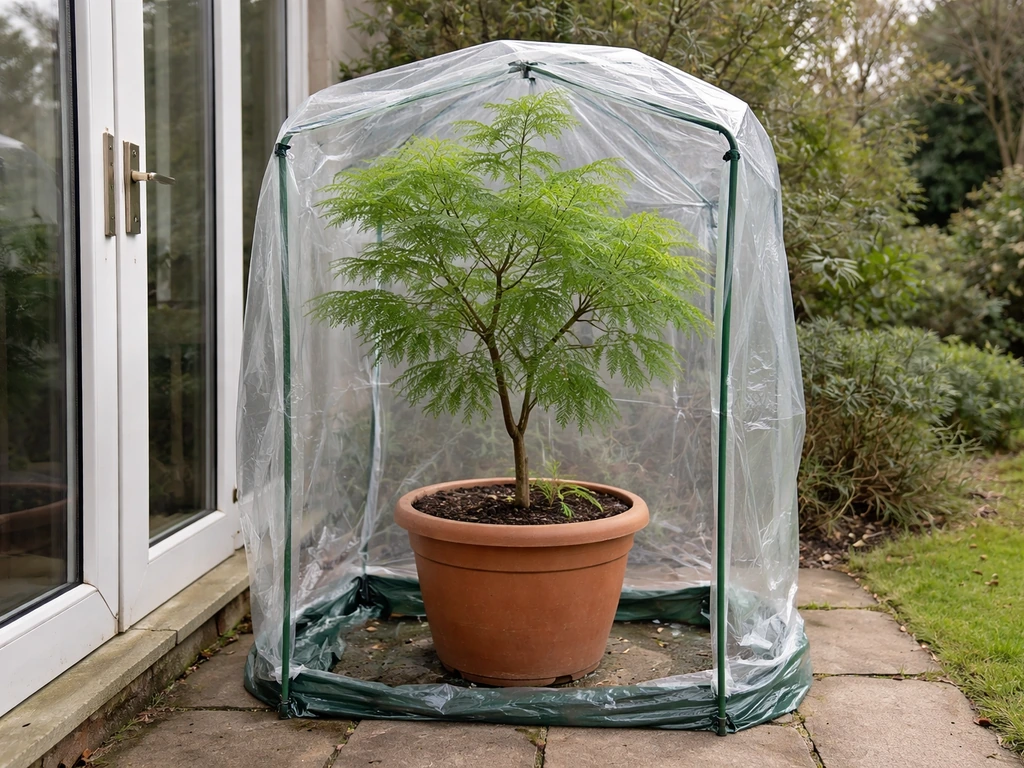
You can grow jackfruit in the UK, but only under glass with serious heat. Outdoors, even in the mildest corners of Cornwall or the Isles of Scilly, the UK climate is simply too cold for a tree that demands mean temperatures of 25–30 °C to fruit and cannot tolerate sustained exposure below 5 °C without serious damage. In a heated conservatory or tropical greenhouse kept above 15 °C year-round, you can keep a jackfruit alive and, with luck and effort, eventually get flowers. Fruiting is rare, slow and genuinely difficult. This is a project for committed enthusiasts, not a practical crop for most UK growers.
Can You Grow Jackfruit in the UK? Practical Guide for Gardeners
James Hartwell
10 Aug 2026
Who this guide is actually for
If you have a heated greenhouse, a large south-facing conservatory, or a very warm indoor space with excellent light, this guide is written for you. I also cover the outdoor angle honestly for growers in the South West and South East who want to know whether a summer patio experiment is worth attempting. If you're in the Midlands, Wales, Scotland or Northern Ireland and hoping to grow jackfruit in open ground, I'll save you some time: it won't work, and no microclimate trickery changes that. This guide is most useful for:
- Greenhouse owners with heated structures capable of maintaining a 15 °C winter minimum (ideally higher)
- South West and South East gardeners with frost-free or near-frost-free microclimates who want to try summer outdoor placement
- Conservatory growers with large, bright, south-facing spaces that stay genuinely warm year-round
- Smallholders and plant collectors interested in tropical fruiting trees as a long-term project
- Indoor growers with a spare room, supplemental lighting and enough patience for a tree that takes years to flower
Can I realistically try this? A quick decision checklist
Before spending money on a grafted sapling, run through these questions honestly. The more 'no' answers you give, the more likely you are to end up with a dead or permanently stunted tree.
- Can I guarantee a winter minimum of at least 10 °C, preferably 15 °C, in my growing space? (Below 5 °C causes severe damage; frost will kill young trees outright.)
- Do I have a space that receives at least 6–8 hours of bright, direct or near-direct light daily? (Supplemental grow-lights help indoors but add cost.)
- Is my growing space large enough to eventually accommodate a container at least 45–60 cm deep and wide, and a tree potentially reaching 3–4 m under glass?
- Can I maintain humidity around 60–70% during the growing season without creating mould or condensation problems?
- Am I prepared to wait 3–8 years before seeing any fruit, possibly longer in UK conditions?
- Do I have a reliable watering and feeding routine during the active growing season (roughly April to September in UK terms)?
- Can I manage hand-pollination, since natural pollinators won't be present in a closed greenhouse or conservatory?
- Am I comfortable with the realistic possibility that the tree never fruits in the UK, despite doing everything right?
UK climate feasibility: where jackfruit stands any chance
The UK sits roughly between USDA hardiness zones 7 and 9, but those zones only tell you about winter cold, not about the heat accumulation and humidity jackfruit actually needs to thrive and fruit. The RHS classifies jackfruit as H1a, meaning it requires a minimum temperature above 15 °C and must be kept under glass all year. That alone rules out any permanent outdoor planting anywhere in the UK, full stop.
The Isles of Scilly are the warmest place in Great Britain, averaging around 11.6 °C annually with fewer than two air frost days per year. Dover's long-term climate data (1991–2020 Met Office normals) shows a mean annual minimum of 8.65 °C. Even these are well below what jackfruit needs for active growth. What southern coastal microclimates do offer is the possibility of placing a containerised tree outdoors during a warm British summer, roughly June to August, without cold-shock risk. That's useful but it doesn't change the fundamental equation: the tree must come back inside long before autumn frosts, and it must overwinter in genuine warmth.
The Eden Project in Cornwall is the most cited UK example of fruiting jackfruit, and it's worth being direct about what that means. Eden grows jackfruit inside a fully heated tropical biome that replicates rainforest conditions. Kew Gardens cultivates Artocarpus species in its Palm House and tropical glasshouses for the same reason. Neither of these is outdoor cultivation; both require infrastructure most gardeners simply don't have. They're useful proof that jackfruit can be kept alive and productive in the UK, but only with near-tropical controlled conditions.
Jackfruit basics: what you're actually dealing with
Artocarpus heterophyllus is a large, fast-growing evergreen tree native to tropical South and Southeast Asia. In its natural habitat it regularly reaches 10–20 m, though grafted and dwarf cultivars grown in containers top out considerably lower. The tree is monoecious, meaning male and female flowers appear on the same tree, which is helpful, but pollination still needs to happen (more on that later). The fruit is the largest tree-borne fruit in the world: mature specimens can weigh 10–50 kg each, with hundreds of fruits per tree in a good tropical season. In a UK container setting, fruit size will be much smaller and yields dramatically lower.
The species occupies a climatic niche roughly 30° north to 30° south of the equator, from sea level up to about 1,600 m, with mean temperatures commonly in the 16–22 °C range for growth and 25–30 °C for good fruiting. Annual rainfall in its native range runs 1,000–2,400 mm, typically well distributed. That's relevant because the UK gets reasonable rainfall totals but the cool temperatures mean the tree won't use water efficiently, and waterlogged roots in cold soil are a common killer in UK container attempts.
Research comparing cold stress responses across Artocarpus species shows jackfruit is comparatively more chilling-tolerant than breadfruit or mangosteen, and there are genuine genotypic differences between cultivars in how they respond to low temperatures. Some cultivars show more cold-resilient gene expression patterns under chilling conditions. That's encouraging for UK greenhouse growers choosing a variety, but it doesn't mean jackfruit is suitable for outdoor UK winters. It means some cultivars will survive a brief cold snap slightly better than others, not that they'll thrive.
Temperature, light, humidity and seasonal needs
Temperature
This is the non-negotiable. Jackfruit needs a minimum of 10–12 °C to avoid cold stress, and sustained temperatures below 5 °C cause severe shoot and root damage. True frost events kill young trees. For active growth and any prospect of flowering, aim for 20–28 °C during the day and no lower than 15–18 °C at night. Controlled greenhouse experiments use approximately 28 °C day temperatures and 25 °C nights. A peer‑reviewed PMC article reports greenhouse acclimation conditions for hardened jackfruit plants as approximately 28±2 °C day, 25 °C night, a 10‑hour photoperiod at ~200 μmol·m⁻²·s⁻¹ and ~70% relative humidity. In a UK conservatory in December, you'll need supplemental heating to get anywhere close, and that comes with meaningful running costs.
Light
Jackfruit is a full-sun tree. In greenhouse trials, a 10-hour photoperiod at around 200 μmol·m⁻²·s⁻¹ is used for hardened plants. UK winter days drop well below 8 hours of usable light in most of the country, and the low sun angle means intensity drops sharply too. A south-facing glazed structure helps enormously in summer. In winter, supplemental LED grow-lights are close to essential if you want the tree to do anything other than barely survive. Running grow-lights for 12–14 hours in winter adds to the cost but genuinely makes a difference.
Humidity
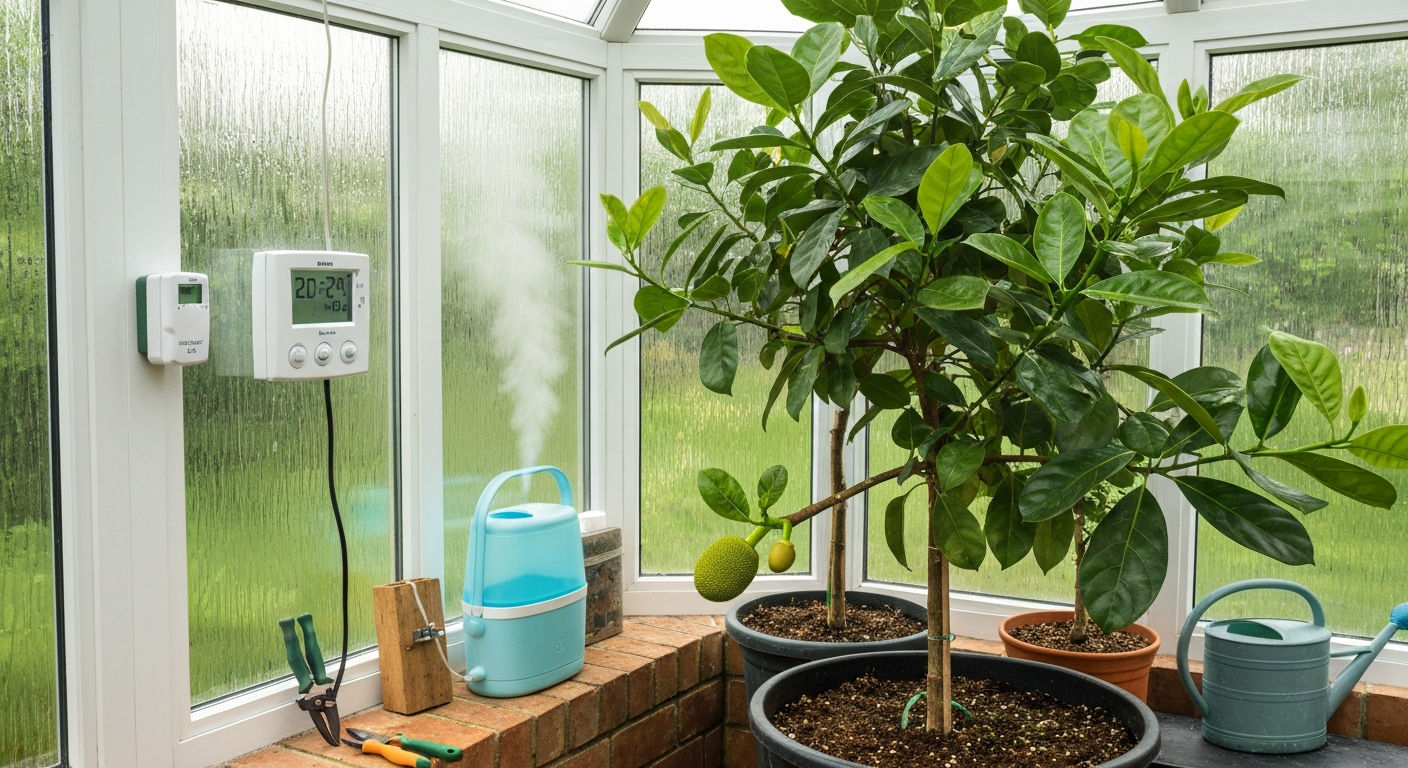
Target 60–70% relative humidity during the growing season. UK homes in winter are typically much drier (40–50% or less with central heating running), so you'll need a humidifier or regular misting. Conversely, a heated greenhouse in summer can become very humid, which encourages fungal issues. Good ventilation is essential: the RHS recommends active ventilation, shading and damping down for tropical glasshouse plants, and jackfruit needs the same management. RHS guidance (Greenhouse ventilation, shading and humidity management, RHS Advice) advises keeping tropical glasshouse plants above about 15 °C in winter and using ventilation, shading and damping down to manage humidity and summer heat Greenhouse ventilation, shading and humidity management — RHS Advice.
Water and feeding
During active growth (spring through early autumn in UK terms), water generously but ensure the pot drains freely. Root rot from waterlogged containers in cool conditions is one of the most common failure modes I've seen and heard about from UK growers. In winter, reduce watering significantly: the tree's growth slows and the soil takes much longer to dry out in a cool greenhouse. Feed with a balanced tropical fertiliser fortnightly from April to September, switching to a low-nitrogen formula in late summer to harden growth before the darker months.
Outdoor, conservatory, heated greenhouse or indoor container: a comparison
| Growing method | Min. winter temp achievable | Fruiting prospect | Light availability | Effort and cost | Realistic verdict |
|---|---|---|---|---|---|
| Outdoor planting (UK) | Uncontrollable; frosts likely everywhere | None | Good in summer, inadequate in winter | Low effort, no cost; total loss likely | Not viable anywhere in the UK |
| Summer outdoor placement (container) | N/A (brought inside before cold) | Very low; insufficient heat accumulation | Good June–August | Medium effort (moving heavy pots) | Worth it as supplemental light boost, not standalone |
| Unheated conservatory | May drop to 5 °C or below in winter | None; cold damage likely | Good in summer, acceptable spring/autumn | Low cost; high risk in cold snaps | Not viable without supplemental heating |
| Heated conservatory (15 °C+ min.) | 15 °C+ if heating is maintained | Low but possible with years of effort | Good with south-facing aspect | High running costs; viable with commitment | The most realistic option for most UK enthusiasts |
| Heated greenhouse (tropical regime) | 15–20 °C+ with supplemental heat and lighting | Low to moderate with hand-pollination | Excellent if well-glazed; supplement in winter | High infrastructure and running cost | Best chance of fruiting; Eden/Kew model scaled down |
| Indoor container (well-lit room) | Room temperature; typically 16–20 °C | Very low; poor light limits growth | Usually inadequate without grow-lights | Medium cost with lighting; limited space | Possible as a novelty houseplant; fruiting unlikely |
Choosing the right cultivar for UK conditions
Grafted dwarf or semi-dwarf cultivars are the only sensible choice for UK growers. Standard seedling-grown jackfruit trees grow large fast, and in a UK conservatory or greenhouse that becomes a space problem within a few years. Grafted trees also fruit earlier, typically within 3–4 years versus 7–8 years or more for seedling-grown trees. Cultivars like J-31, Honey Gold, Black Gold and Golden Nugget are sold by specialist tropical nurseries and are described as more compact, earlier-fruiting and more suited to container culture. Some of these are available to UK buyers via specialist importers and online marketplaces, though supply can be inconsistent and plant health import rules apply (more on that below).
Among these, varieties with documented cold-stress resilience are worth prioritising. As noted above, cultivar-level differences in chilling tolerance are real, even if they don't transform jackfruit into a cold-hardy plant. Ask suppliers specifically about cold tolerance data when buying. A grafted tree on a known rootstock from a reputable tropical nursery will always outperform a cheap seedling of unknown provenance in a UK controlled environment.
Step-by-step growing guide for UK conditions
Container and potting setup
Start in a 30–35 cm deep container and pot up as the tree establishes. The University of Florida IFAS extension recommends a minimum of 45–60 cm depth and width for mature container production, and I'd agree: jackfruit develops a substantial taproot and resents root restriction. Use a free-draining mix: a blend of loam-based compost, perlite and coarse grit at roughly 60:30:10 works well. Avoid peat-heavy mixes that stay wet. Ensure the pot has multiple large drainage holes and raise it off the ground on pot feet so water can escape freely.
Planting and early establishment
Plant in spring when your growing space is warming up. Position in the brightest spot available. New grafted plants should be hardened slowly to their new environment rather than moved immediately into full sun or maximum heat. Keep temperatures consistent, avoid cold draughts, and do not overwater in the first few weeks. Young trees are the most vulnerable to cold stress and root rot, so getting the establishment phase right matters more than almost anything else.
Summer care and outdoor placement
From late May to late August, containerised jackfruit can be moved outdoors in the South West and South East if nighttime temperatures stay reliably above 15 °C. Watch forecasts carefully: even in Cornwall, a cool wet June can drop nights below 12 °C for days at a time, which stresses the tree. Full sun outdoors during a British summer provides excellent light intensity and genuinely helps growth. Move the tree back under glass well before mid-September and certainly before any risk of temperatures dropping below 10 °C.
Overwintering and frost protection
This is where most UK jackfruit attempts fail. The heating bill is real and the margin for error is small. Set your minimum thermostat at 15 °C and treat that as a floor, not a target. If your heating fails overnight in January and the conservatory drops to 5 °C, you may lose the tips of all actively growing shoots. Fleece can provide a degree or two of extra protection in an emergency, but it's not a substitute for proper background heat. Reduce watering from October onwards and stop feeding entirely by November. The tree will slow its growth markedly, which is fine, but it must stay warm and in reasonable light.
Pruning and root management
Keep the tree to a manageable height by pruning the main leader after the first year or two of establishment. This encourages lateral branching and makes the canopy wider rather than taller, which is more practical in a conservatory. Prune in spring before the growing season accelerates. Root-prune when potting up: trim back the ends of any circling roots and tease out any bound sections. This encourages a more fibrous root system and reduces the risk of root girdling in a container.
Pollination and the real chances of fruiting in the UK
Jackfruit is monoecious, so a single tree can theoretically produce fruit. The catch in a UK greenhouse or conservatory is that the natural pollinators (small insects, including a species of fig wasp in some accounts) won't be present. Hand-pollination is your only realistic option. Use a small dry paintbrush to transfer pollen from the male flower clusters (which appear on small twigs) to the female inflorescences (larger, appearing on the trunk and main branches, a peculiar characteristic called cauliflory). Timing matters: male and female flowers don't always open simultaneously on the same tree, so you may need to collect pollen and store it briefly in a small airtight container in the fridge.
Even with successful pollination, fruiting in UK conditions is genuinely uncommon. The Eden Project's fruiting jackfruit is the headline example because it's notable, not routine. In a home conservatory or greenhouse, you're fighting against lower-than-ideal temperatures, reduced light intensity in winter and the general stress the tree experiences in a non-tropical climate. Manage your expectations: getting the tree to flower is a significant achievement, and getting it to set and hold fruit is a real success worth celebrating.
Realistic timeline: from sapling to (possible) fruit
- Year 1–2: Establishment. Focus on root development, stable warmth and consistent watering. Expect modest foliage growth.
- Year 2–3: Canopy development. The tree starts to put on meaningful size. Begin training the structure you want.
- Year 3–5: First flowers possible on a grafted tree in ideal conditions. UK conditions will likely push this toward the upper end of this range.
- Year 5–8+: Realistic window for fruit set in a well-managed UK heated greenhouse. Many UK trees never reach this stage.
- Ongoing: Once fruiting starts, yields under UK conditions will be small (a few fruit per season at best) compared to tropical specimens.
Pests, diseases and the common ways UK attempts go wrong
In a heated, humid UK greenhouse or conservatory, the usual tropical pest suspects apply: red spider mite thrives in warm, dry conditions (keep humidity up to discourage it), mealybugs colonise stem junctions and leaf axils, and scale insects are a persistent nuisance on older wood. Use biological controls where possible, as pesticide residues in a food-producing tree are worth avoiding. Neem oil spray works well as a preventative measure on established foliage.
The most common disease problem is root rot from Phytophthora or Pythium species, almost always caused by overwatering in cool conditions. If the lower leaves yellow and drop, the stem base feels soft, and the roots look brown and mushy rather than white and firm, you've likely got root rot. Prevention through free-draining compost and careful winter watering is far more effective than any cure. A second common failure is cold damage masking itself as nutrient deficiency: if the growing tips die back, leaves mottle and growth stalls in winter, suspect cold stress before you start adjusting feeding.
Propagation and where to buy in the UK
Jackfruit can be grown from fresh seed (seeds lose viability within a few weeks of extraction, so fresh is essential) but seedling trees are unpredictable in quality and take much longer to fruit. For UK purposes, always buy a named grafted cultivar from a reputable specialist tropical nursery. A few UK-based specialist importers and tropical plant nurseries stock grafted jackfruit saplings, though supply is inconsistent. Online tropical plant marketplaces do list grafted dwarf varieties available to UK buyers, but check that any plant entering the country complies with UK plant health import regulations.
On the legal front: as of 2026, importing live plants into Great Britain from outside the UK requires compliance with UK plant health regulations, including phytosanitary certificates for material from certain origins. Buying from a UK-based seller who has already handled the import process is simpler and lower risk. Prices for grafted jackfruit saplings vary widely, typically £25–£80 for a small grafted specimen from a specialist, though rare cultivars or larger plants cost considerably more.
Easier exotic fruit alternatives worth considering
If the honest picture above has you reconsidering, that's a reasonable response. There are tropical and subtropical fruit trees that are genuinely more suited to UK greenhouse or conservatory conditions and deliver results with less infrastructure. Citrus is the obvious starting point (manageable, well-documented, rewards patience). For advice on growing fragrant greenhouse shrubs under glass, see can you grow gardenias in the UK. Figs fruit outdoors in the South East and South West with minimal protection. Passion fruit can be grown and fruited in a conservatory. Loquats manage sheltered South West walls reasonably well.
If you're drawn to unusual tropical fruit projects specifically, it's worth exploring whether plants like jujube or galangal suit your setup, as both have more temperate tolerance than jackfruit and present fewer infrastructure demands. For detailed guidance on cultivating galangal in Britain, climate suitability, planting from rhizomes, and overwintering tips, see our guide: Can you grow galangal in the UK. The jacaranda tree is another tropical species that UK enthusiasts attempt under glass; like jackfruit, its success depends heavily on providing enough genuine warmth and light, and it shares many of the same climate limitations. If you want more detail on related questions, such as can you grow jacaranda tree in UK, see the linked guidance on growing jacaranda under glass and in sheltered southern microclimates.
The honest bottom line
Growing jackfruit in the UK is technically possible in a heated tropical greenhouse or well-maintained warm conservatory, and the Eden Project proves it can fruit in British conditions, given the right infrastructure. For most home growers, the combination of year-round heating requirements, light deficiency in winter, humidity management, years-long wait for flowers, and the need for hand-pollination makes it a high-effort, low-reward project compared to almost any other fruit tree. If you have the heated space and the enthusiasm, go in with eyes open, choose a grafted dwarf cultivar, invest in a decent thermometer, and accept that the tree might be beautiful and never produce a single fruit. For most UK gardeners, the effort-to-reward ratio points firmly toward something more climate-compatible.
FAQ
Title and meta description for an SEO article about growing jackfruit in the UK?
Title: Can you grow jackfruit in the UK? Practical guide for gardeners, conservatories and greenhouse growers Meta description (≤160 chars): Can you grow jackfruit in the UK? Honest, regionised advice + step‑by‑step methods for containers, greenhouses and conservatories.
Short, evidence‑based answer: can you grow jackfruit in the UK?
Short answer: Yes, but almost never outdoors across most of the UK. Jackfruit is a tropical/subtropical tree that needs warm, humid conditions (ideally mean temperatures 16–30 °C and minimums above ≈5–10 °C). Successful UK cultivation is realistic only in heated glass (conservatory/greenhouse), tropical biomes (e.g. Eden Project) or as a large container/indoor plant that is protected from winter cold. Very sheltered warm microclimates in the far South and Isles of Scilly may allow marginal outdoor survival for some mature trees, but regular frosts or prolonged winters below 5 °C will usually cause severe damage or kill the tree.
Which UK regions or microclimates give the best chance for jackfruit outdoors?
Best chances: very sheltered, frost‑free coastal sites in the South West (Isles of Scilly, some sheltered Cornish sea‑facing gardens) and exceptional urban microclimates in the far South East (very sheltered pockets of Kent/Essex) where mean winter minima may stay well above 0 °C. Evidence: Met Office HadUK‑Grid maps show southern/coastal sites can have mean minimum winter temperatures several degrees warmer than inland locations. However, these sites are exceptions — even Dover data (example) shows better minima but still not reliably frost‑free every year.
What are jackfruit's key climate and environmental requirements?
Checklist of requirements: - Temperature: optimal daytime 25–30 °C; sustained temperatures below ≈15 °C slow growth; prolonged exposure below ≈5 °C causes severe damage; frost is generally lethal to young shoots/fruit. - Light: full sun to light shade; needs strong light for fruiting. - Humidity: prefers high humidity (≈60–80%). - Rainfall/soil moisture: likes consistent moisture; in tropics often 1000–2400 mm annually; dislikes waterlogging if roots are poorly drained. - Wind protection: young trees and fruit are damaged by wind. Sources: FAO/Feedipedia, CAB Tropical Fruits, greenhouse studies.
Are there jackfruit cultivars suitable for containers, conservatories or UK glasshouses?
Cultivar options: - Standard/traditional cultivars: large trees (can reach 10–20 m) and are generally unsuitable for small gardens or pots. - Dwarf/grafted & 'mini' cultivars: commercially sold grafted varieties (market names include 'Golden Nugget', 'Honey Gold', 'Black Gold', J‑series) are marketed for container/conservatory culture and often fruit earlier. - Choice advice: choose a grafted cultivar recommended for container culture and reported as 'dwarf' or 'semi‑dwarf'; grafted trees also tend to fruit sooner than seedling trees. Note: nursery marketing varies; ask supplier for mature size and cold‑tolerance notes.
How realistic is fruiting in the UK and what influences fruit set?
Likelihood of fruiting: low outdoors except in heated/tropical glasshouses or exceptional microclimates. Influencing factors: - Warm temperatures during floral initiation and development — ideally sustained warm (>20 °C) conditions. - Strong light levels/longer photoperiods encourage flowering. - Pollination: many cultivars are wind and insect pollinated; in UK glasshouses you may need to hand‑pollinate or introduce pollinators. Hand pollination can increase fruit set in controlled environments. - Cold stress reduces flowering and fruit development; even if a tree flowers, frost or cool nights can abort fruit. Examples: Eden Project and Kew show successful fruiting only under heated glass.
Next Article
Can You Grow Jacaranda Tree in the UK? Real Advice
Can you grow a jacaranda in the UK? Feasible only with warmth, frost protection, and container winter shelter. Real guid