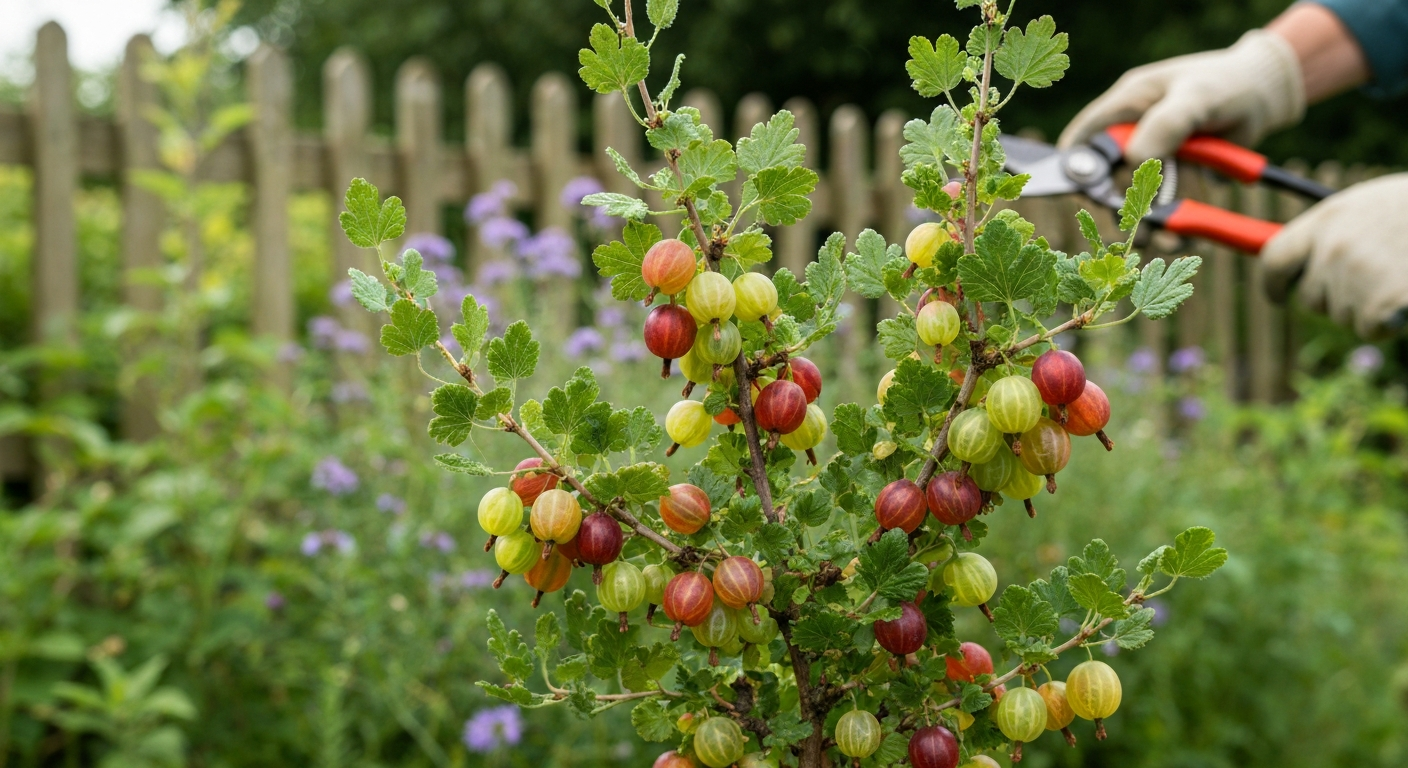
Gooseberries are one of the most reliably productive fruit crops you can grow in the UK. They thrive in our cool, damp climate, tolerate light shade better than most fruiting plants, and once established they crop heavily for 15 years or more with minimal fuss. The varieties that suit UK gardens best are 'Invicta' (tough, high-yielding, mildew-tolerant), 'Hinnonmäki Red' and 'Hinnonmäki Yellow' (excellent disease resistance and dessert quality), 'Whinham's Industry' (the best red for shadier spots), and 'Leveller' (superb flavour but needs a better site). Pick the right variety for your conditions and you'll have fruit every summer almost regardless of where you are in Britain.
Best Gooseberries to Grow in the UK: Varieties & Care

James Hartwell
13 Jul 2026
Can you grow gooseberries in the UK? Feasibility by region and microclimate
Yes, and genuinely well. Gooseberries (Ribes uva-crispa) are not a borderline crop in the UK, they're a native-climate plant that evolved for exactly the kind of cool, moist, temperate conditions we have here. Most cultivars carry an RHS hardiness rating of H4 to H6, meaning they'll handle temperatures down to around -15°C to -20°C without protection. That covers virtually every corner of the British Isles, from the Cornish coast to the Scottish Highlands.
The one genuine threat is late spring frost rather than winter cold. Gooseberries break dormancy and flower early, often in March to April, and a sharp frost during flowering will knock out your crop for that season. The Met Office is clear that late spring frosts follow a strong north-to-south and microclimate-to-microclimate pattern: valley bottoms and low-lying frost pockets can get damaging frosts weeks after a nearby sheltered slope stays frost-free. Met Office guidance 'Why frost can still occur in late Spring – Met Office (blog)' shows a clear north–south pattern in last‑spring‑frost dates and notes that microclimate (valley/frost‑pocket vs sheltered slope/coastal) strongly affects frost risk for early‑flowering crops like gooseberries. So the question isn't really 'can I grow gooseberries in [my county]?', it's 'is my specific plot a frost pocket?'
Regionally, the picture is broadly positive everywhere. In southern England and the Midlands, most sites are fine and the main task is picking mildew-resistant varieties (more on that below). In northern England, Wales and Scotland, gooseberries are actually extremely well-suited, the cooler summers slow the spread of American powdery mildew, and gooseberries need a solid winter chill (around 800 to 1,200 hours below 7°C depending on the cultivar) to crop well, which northern sites provide reliably. Coastal sites in the south-west may actually give slightly lower yields in bad mildew years because of milder, more humid summers, but this is easily managed with the right variety choice.
Understanding gooseberry types: red, green and white fruits, growth habits and what each means for UK gardens
Gooseberries come in green, yellow, red and white-skinned fruits, and the colour tells you quite a lot about how and when to use them. Green varieties (like 'Invicta' and 'Careless') are the classic culinary gooseberry, picked early while still firm and tart for crumbles, jams and fools. Yellow and red cultivars, picked when fully ripe, tend to be sweeter and better for eating raw straight from the bush. White-fleshed varieties like 'Langley Gage' are genuinely dessert-quality but rarer in the nursery trade.
Growth habit matters too, especially in smaller gardens. Most gooseberries sold in the UK are trained as open-centred bushes on a short leg (stem), which gives you a compact plant around 1 to 1.2 metres tall and wide. You can also buy or train them as cordons (a single upright stem) or fans, which are perfect for walls and fences and take up very little horizontal space. Cordon-trained plants are particularly useful in narrow borders or against a fence, and they make it much easier to net against birds and inspect for pests. Tip-bearing varieties are not a thing with gooseberries, all fruiting happens on short spurs on older wood and at the base of the previous year's shoots, which shapes how you prune them.
Best gooseberry varieties for UK gardens
The varieties below are my practical shortlist for UK growing. All are widely available from UK nurseries and the National Fruit Collection at Brogdale. I've organised them by colour group and flagged the most important attributes for British conditions: mildew resistance, flavour, season and habit.
| Variety | Fruit colour | Season | Mildew resistance | Flavour/use | Best for |
|---|---|---|---|---|---|
| Invicta | Green | Early-mid | Good | Sharp, culinary | Heavy cropping, any UK site |
| Hinnonmäki Red | Red | Mid-late | Excellent | Sweet, dessert | Northern gardens, beginners |
| Hinnonmäki Yellow (Gul) | Yellow | Mid-late | Excellent | Sweet, dessert/dual | All sites, small gardens |
| Whinham's Industry | Red | Mid | Moderate | Rich, sweet, dessert | Part-shade, north-facing walls |
| Leveller | Yellow-green | Mid | Low | Exceptional dessert flavour | Good sheltered sites, experienced growers |
| Careless | Green | Mid | Moderate | Large, culinary | Commercial and large plots |
| Pax | Red | Mid | Good | Dessert, nearly spine-free | Families, container growing |
| Rokula | Red | Early-mid | Excellent | Dessert/culinary | Cooler regions, disease-prone sites |
'Invicta' is the workhorse of UK gooseberry growing, it yields heavily, handles most soils, and its mildew tolerance is a real practical advantage. If you only grow one gooseberry and you want reliability above everything else, this is it. The Hinnonmäki series, originally from Finland, bring outstanding mildew resistance and genuinely sweet dessert-quality fruit, which makes them my top recommendation for anyone who wants to eat gooseberries fresh rather than just cook with them. 'Whinham's Industry' is the only variety I'd confidently recommend for a shadier spot, it crops reasonably well on a north-facing fence where most others would sulk. 'Leveller' is worth growing if you have a decent sheltered site and you want the best possible flavour, but don't expect it to shrug off mildew the way 'Invicta' does. 'Pax' is nearly spine-free, which makes harvesting far less painful, worth considering if you're growing with children or want to pick in a hurry.
How to choose the right variety for your site
Before you choose a variety, get honest about your site. The three things that matter most are frost exposure, air circulation and soil drainage. A frost pocket (valley bottom, walled garden without a drainage gap, low-lying patch that gathers cold air on still nights) will cost you your crop some years regardless of variety, in that situation, look for late-flowering or late-breaking cultivars and avoid pushing for an early season. A poorly drained or waterlogged site is genuinely limiting: gooseberries tolerate a wide pH range (acid to alkaline, including chalk) and don't mind moderate fertility, but they dislike sitting in wet soil. On heavy clay, improve drainage with grit and plenty of organic matter before planting, or plant on a slightly raised mound.
For aspect, full sun gives the best crops and the sweetest fruit, but partial shade (a few hours of shade per day) is workable, especially for culinary green varieties. Avoid deep shade. Shelter from strong winds matters more than most people expect: gooseberry stems are brittle and wind-snap is a real problem, particularly on exposed northern and western sites. A fence, hedge or wall on the windward side makes a significant difference. If you're growing in a container on a balcony or roof terrace, factor in both wind exposure and the drying-out rate of your compost, pot-grown gooseberries need more consistent watering than their ground-grown counterparts.
For containers specifically, choose compact or cordon-trained plants rather than full bushes. 'Pax', 'Hinnonmäki Red' and 'Hinnonmäki Yellow' all work well in pots. A standard bush in a container will still produce fruit but keep expectations proportionate, you'll get a decent crop, not the 4-5 kg a well-established open-ground bush can deliver.
Planting gooseberries: from site preparation to the first season
The best time to plant bare-root gooseberries is late autumn to early spring while plants are fully dormant, roughly November through to March in most UK regions. Container-grown plants can go in any time the soil is workable, but avoid planting into frozen or waterlogged ground. Dormant bare-root plants are cheaper, establish quickly and are the form most specialist nurseries send by post.
- Clear the site of perennial weeds thoroughly — bindweed and couch grass beneath a gooseberry bush are extremely difficult to remove once the plant is established.
- Dig in a good layer of well-rotted compost or manure to improve soil structure and water retention. A bucketful per planting hole is a useful benchmark.
- On heavy clay, work in coarse grit as well and consider planting on a slight mound to keep the crown above the waterlogged zone.
- Plant at the same depth the plant sat in the nursery (look for the soil mark on bare-root plants) — burying the stem deeper than this encourages suckering.
- Space open-ground bushes at least 1.5 m (5 ft) apart to allow good air circulation, which is your first and most important defence against powdery mildew.
- For cordons, space plants 30-40 cm apart against wires or a fence, attaching the main stem to a cane from the start.
- Water in well after planting and apply a 5-7 cm mulch of compost or well-rotted bark around (but not touching) the stem.
- In the first spring, remove any flowers to let the plant put energy into root development — this gives much better long-term performance even though it's frustrating.
Don't expect a heavy crop in year one regardless of how well you plant. A decent harvest starts in year two and builds through years three and four. By year five, a well-managed bush should be producing 4-5 kg of fruit annually with minimal intervention beyond pruning and mulching.
Pruning and training gooseberries: a year-by-year timetable
Pruning is where a lot of home growers go wrong, either doing too little (and getting a dense, mildew-prone thicket) or being too nervous to cut hard enough. The goal is an open-centred bush with a clear framework of around 8 to 10 main branches, good light penetration to all parts of the plant, and strong annual growth that produces new fruiting spurs each season.
Young plant: years one and two
In the first winter after planting, choose 4 to 6 well-spaced shoots to form your main framework branches and cut them back by half to an outward-facing bud. Remove any shoots growing into the centre of the plant entirely. In the second winter, select a few more framework branches if the plant is growing well, again cutting them back by around half. Remove any crossing, weak or inward-growing shoots. The aim is to build a goblet shape with an open centre.
Established bush: from year three onwards
Once you have a framework you're happy with, switch to the routine maintenance approach. In winter (ideally December to February), shorten all the side-shoots on framework branches back to 2 or 3 buds from the base. These shortened shoots become the fruiting spurs. Remove entirely any branches that are very old (darker, rougher bark), badly positioned or growing into the centre of the bush. Keep the centre open. In summer (June to July), you can also tip-prune new side-shoots back to 5 leaves, this improves air flow through the plant and helps prevent mildew by reducing the amount of soft, vulnerable growth.
Cordon and fan training
For a single cordon, train one vertical stem up a cane against wires. Each winter, shorten all side-shoots back to 2 buds and reduce the leader (the main tip) by around a third until you reach your desired height, then treat it like a side-shoot. For a fan, select 6 to 8 main branches and tie them to wires in a fan shape, then treat each branch as you would a cordon. Both forms are pruned in the same season as open bushes but produce much more accessible fruit in a smaller footprint.
Feeding, mulching and winter care: an annual maintenance calendar
Gooseberries are not particularly hungry plants but they do respond well to a consistent feeding routine. The main nutrients to think about are potassium (for fruit quality and disease resistance) and nitrogen (for steady growth, but don't overdo it as excessive nitrogen encourages lush, mildew-prone shoots).
| Time of year | Task |
|---|---|
| January-February | Prune while fully dormant. Check stakes and ties on cordons/fans. |
| March | Apply a balanced general fertiliser (e.g., pelleted chicken manure or Growmore) around the drip line. Top-dress with sulphate of potash at around 15-20g per sq metre on light soils. |
| April | Apply a 5-7 cm mulch of compost or well-rotted bark, keeping it away from the stem. Watch for frost forecasts and cover flowering plants with fleece on cold nights if needed. |
| May-June | Water if dry — gooseberries are more drought-sensitive during fruit swell than at any other time. Check for sawfly eggs on leaf undersides. Net against birds as fruits start to colour. |
| June-July | Summer prune side-shoots to 5 leaves to improve air circulation. Begin harvesting culinary green fruit from early July while still firm. |
| July-August | Continue harvesting. Ripe dessert varieties at full colour. Remove any mildew-affected shoot tips promptly. |
| September-October | Harvest complete. Remove fallen leaves and any debris from around the plant base to reduce overwintering disease spores. |
| November-December | Plant new bare-root stock. Begin winter pruning from mid-November onwards once leaves have dropped. |
In a normal UK winter, established gooseberries need no protection whatsoever. Their H4-H6 hardiness rating means they're built for British conditions. The one exception is container-grown plants in very exposed or elevated positions, the rootball in a pot is above ground and can freeze solid, which is genuinely damaging. In those situations, move pots into an unheated shed or garage from December to February, or wrap the pot in bubble wrap or hessian.
Pests and diseases: what to actually worry about in UK gardens
American gooseberry mildew
This is the big one. American gooseberry mildew (Podosphaera mors-uvae) is the single most important disease of gooseberries in the UK and Europe, and it's been the reason many home growers gave up on the crop in the past. It shows up as a white powdery coating on young shoot tips, leaves and fruit, particularly in warm, dry spells with humid nights. Badly affected fruit becomes discoloured and unmarketable; heavily infected plants lose vigour over time.
The most effective control by a long margin is variety choice. Cultivar trials over multiple years have demonstrated enormous differences in susceptibility, varieties like the Hinnonmäki series and 'Invicta' are consistently classified as resistant to moderately resistant, while older varieties like 'Leveller' are genuinely susceptible. Beyond variety choice, open-centre pruning to maximise air flow, avoiding over-feeding with nitrogen, and keeping the area beneath the plant weed-free and well-mulched are all genuinely effective cultural controls. For home gardeners who need a spray option, potassium bicarbonate formulations applied preventively have shown good results in field trials, reducing mildew incidence on both leaves and fruit when applied early and repeatedly.
Gooseberry sawfly
Gooseberry sawfly (Nematus ribesii) is a pest that can defoliate a bush completely in a matter of days if you miss it. The caterpillar-like larvae hatch from eggs laid on the undersides of leaves in the centre of the plant in April and May, and they work outwards fast. NIAB-EMR research has developed pheromone traps to help commercial growers monitor adult flights in April and May, and the same principle applies to home gardeners, timing your inspections to coincide with the first adult flight is far more effective than routine spraying. Check the undersides of leaves in the centre and lower parts of the bush from April onwards, and remove larvae by hand as soon as you spot them. A heavy infestation caught early can be controlled with a jet of water or by hand-picking; catching it late usually means reaching for a suitable insecticide.
Other pests and issues
- Birds: bullfinches take buds in late winter and thrushes take ripe fruit — net early, before fruit starts to colour.
- Aphids (gooseberry aphid): causes leaf curling on shoot tips in spring; usually controlled by predators in balanced gardens but can be pinched out or treated with an appropriate contact spray.
- Gooseberry cluster cup rust: orange cup-shaped pustules on leaves, linked to sedge plants nearby; remove sedges from the vicinity if this recurs.
- Reversion virus (transmitted by big bud mite): causes distorted growth and poor cropping; no cure — remove and destroy affected plants and buy certified stock.
Harvesting, uses and storing gooseberries
Gooseberries have two distinct harvest windows. For culinary use, pies, crumbles, jams, sauces for mackerel or goose, pick fruit while still firm and green, usually from late June into July. For dessert eating, leave fruit on the bush until fully coloured and slightly soft; on red and yellow varieties this is usually mid to late July. A useful trick with a large crop is to do a first pick in early July, thinning the fruit by about half, this lets the remaining fruits swell significantly and improves dessert quality.
Fresh gooseberries keep in the fridge for around a week. For longer storage, they freeze exceptionally well: open-freeze on a tray and then bag them. Frozen gooseberries are nearly identical to fresh when cooked, making gooseberries one of the most practical home-grown fruits for batch processing. Gooseberry jam sets easily because of high pectin levels, and the fruit can also be bottled or made into gooseberry wine, which is a traditional British countryside preserve with a surprisingly good track record.
Growing gooseberries in containers and small spaces
Container growing is genuinely viable for gooseberries, more so than for many other fruit crops. The RHS recommends a minimum pot size of 40 cm (16 inches) wide and deep, and this is a realistic minimum rather than an ideal. I'd lean toward 45-50 cm if your balcony or patio can take the weight, because a larger rootball stays moist longer and supports bigger crops. Use a loam-based compost like John Innes No. 3 rather than a pure peat-free multipurpose: it retains moisture better, holds nutrients longer and provides the weight and structure that gooseberry roots need.
Watering is the main management challenge in containers. Gooseberries in pots can go from fine to stressed in 48 hours during a warm dry spell, and water stress during fruit swell is the most common cause of small, disappointing crops. Check soil moisture every couple of days from April to August and water whenever the top 5 cm feels dry. Feed with a liquid high-potassium fertiliser (tomato feed works well) every two weeks from bud burst until the end of harvest. Repot or top-dress with fresh compost every two to three years to replenish nutrients and maintain soil structure.
For very small spaces, a single patio slab's worth of room, a cordon-trained gooseberry in a tall narrow container is probably the best option in the whole soft-fruit world. One vertical stem, trained against a fence, takes up almost no footprint, produces a surprisingly decent crop, and is easy to net, inspect and pick.
Propagating gooseberries and where to buy
Gooseberries are easy to propagate from hardwood cuttings taken in autumn. In October or November, cut healthy shoots of the current year's growth to around 30 cm, remove all but the top 3 or 4 buds (this prevents suckering from buried nodes), and push them into a slit trench of gritty soil in a sheltered spot. Leave them over winter and they'll be rooted by the following autumn. It's genuinely one of the most reliable forms of fruit propagation for a home gardener, and a single established plant can give you 6 to 10 cuttings per year.
For named varieties, buy from a reputable specialist nursery or the National Fruit Collection at Brogdale in Kent, which holds one of the most comprehensive collections of UK gooseberry cultivars and sells both plants and sends them by post. Online fruit nurseries like Chris Bowers, R.V. Roger and Blackmoor Nurseries all stock the main recommended varieties. Avoid unnamed gooseberries from garden centres where the variety isn't labelled, variety choice is too important for disease resistance and flavour to guess.
If gooseberries aren't quite right for your plot
If your site has genuine constraints, deep shade, severe frost exposure, very exposed coastal wind, or extremely waterlogged soil, gooseberries may still grow but you'll be fighting uphill. It's worth considering related crops that handle different conditions better. For other tough-site options, see our short guide on does juniper grow in the UK, which explains juniper's suitability for British gardens and coastal sites. Raspberries are another classic British crop that tolerates similar conditions to gooseberries and actually prefers slightly acidic soil; they're more tolerant of exposed northern sites in some ways. Lingonberries suit very acidic, well-drained soils in cooler regions of the UK and are worth considering if your soil pH is below 5. For guidance on whether lingonberries grow in the UK, see do lingonberries grow in the UK. 5. Sea buckthorn is extremely wind-hardy and will grow on almost any free-draining soil including coastal sand, though it's a very different fruit. Cranberries suit boggy, very acidic conditions where gooseberries would fail entirely. Hops are an option if your interest is in productive climbing plants for a large structure rather than straightforward fruit production. Each of these crops has its own profile of climate feasibility, soil requirements and effort, worth exploring if you're trying to match the right plant to an awkward site. If you're exploring alternatives, also see can you grow hops in the UK for practical guidance on whether hops are suitable for British gardens.
FAQ
Can gooseberries be reliably grown across the UK and which microclimates are best?
Yes. Gooseberries (Ribes uva‑crispa) grow reliably across most UK regions but perform best in sheltered, sunny to part‑shade sites. Avoid frost pockets (valley bottoms and cold hollows) because late spring frosts at flowering reduce yield. Coastal, south‑facing slopes and sheltered garden walls give earlier, safer crops; north or shaded sites delay budburst and can reduce frost risk. Use your local last‑frost timing (Met Office guidance and local observation) to assess risk for early‑flowering varieties.
Which specific gooseberry varieties are recommended for UK gardens and why?
Recommended, widely available UK varieties with their strengths: - Invicta: heavy cropping, broadly mildew‑tolerant, good for general garden use and smallholders. - Hinnonmäki series (e.g., Hinnonmäki Gul): excellent mildew resistance, reliable cropping, good for humid sites. - Whinham’s Industry: red dessert gooseberry, good flavour and midseason harvest. - Careless: large fruit, midseason, used commercially and by growers wanting big dessert berries. - Leveller: yellow dessert variety with good flavour. Choose cultivars rated resistant to powdery mildew where disease pressure is high.
How should I choose the right type (green, red, yellow) for my site and uses?
Choose by use and microclimate: - Green/acid types (e.g., 'Invicta') are great for cooking, jams and pies and tend to be hardy croppers. - Red/yellow dessert types (e.g., 'Whinham’s Industry', 'Leveller') are sweeter eaten fresh; they can be slightly less vigorous. - If your site is humid, prioritise mildew‑resistant cultivars (Hinnonmäki series). For exposed sites or containers choose compact, robust varieties or grow against a sheltered wall.
Can gooseberries be grown in containers and what size/soil do they need?
Yes. Use a container at least 40 cm (16 in) wide and deep with good drainage. Fill with a loam‑rich, free‑draining compost/soil mix and plenty of organic matter. Containers need consistent moisture and regular liquid feeding through the growing season and some winter protection for the rootball in very exposed locations.
Step‑by‑step: how to plant bare‑root gooseberry bushes (suitable timing and spacing)
Planting bare‑root: 1) Timing: late autumn to early spring while dormant (soil workable). 2) Site: full sun to part shade, sheltered, well‑drained soil. 3) Soil prep: dig a hole twice the root spread, incorporate well‑rotted compost. 4) Planting depth: set plant at same depth it grew in the nursery; spread roots gently. 5) Spacing: ~1.5 m (5 ft) between bushes. 6) Water in, mulch with organic material, and protect from rodents if needed.
Year‑by‑year care: pruning, feeding and mulching routine
Year‑by‑year: - Year 1: remove weak shoots, keep centre open for airflow, water regularly. - Annual winter pruning (dormant): remove dead/damaged wood, cut back oldest stems to encourage renewal, and open centre to 6–8 main shoots. - Summer: remove any very congested shoots and trained out crossing branches. - Feeding: apply a general organic fertilizer or well‑rotted compost in spring. - Mulch annually with compost or well‑rotted manure to conserve moisture and add nutrients.
Next Article
Can You Grow Raspberries in the UK? Easy Guide
Yes, you can grow raspberries in the UK: varieties, site choice, planting, seasonal pruning, pests and troubleshooting.