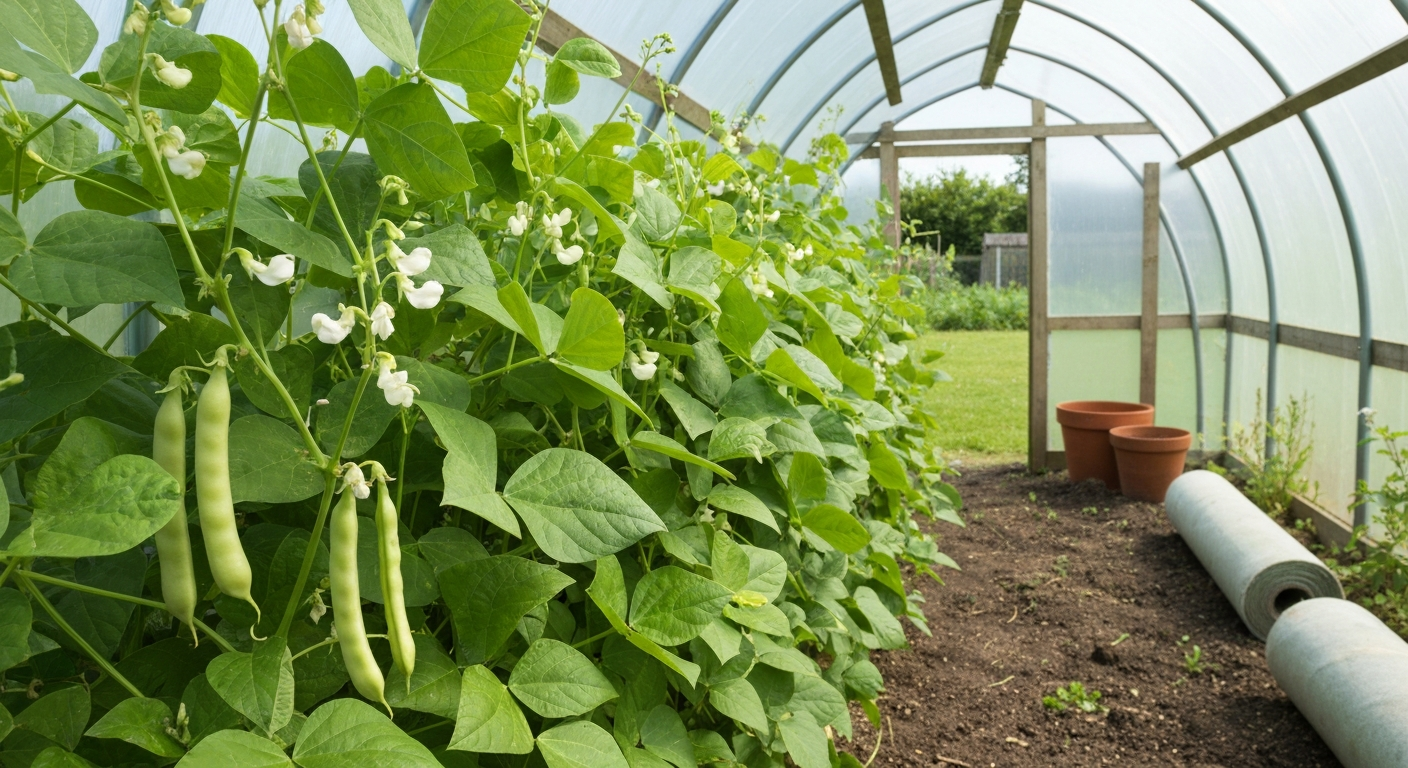
Yes, soya beans can be grown in the UK, but with real caveats depending on where you are and what you want from them. As edamame (harvested green), they are genuinely achievable for most growers in southern and central England, particularly with a polytunnel or some fleece protection. As dry beans (harvested and dried for cooking), success becomes patchier north of the Midlands, and in Scotland or upland areas you are fighting a short, cool summer with limited growing degree days. The honest summary: edamame in a warm, sheltered spot or under cover, early-maturing varieties only, and you have a realistic chance. Dry soya across much of the UK is a more ambitious project.
Can Soya Beans Grow in UK? Varieties, Timing & Tips
James Hartwell
7 Aug 2026
Who should actually try growing soya in the UK?
This is not a fussy crop in the way that, say, aubergines are, but it does need genuine warmth and a long enough frost-free window to perform. The people most likely to get results fall into a few clear groups.
- Home gardeners with a polytunnel or south-facing sheltered beds in southern or central England, who want fresh edamame pods in late summer — this is your most realistic scenario.
- Allotment holders across England and Wales who are curious about non-traditional crops and are willing to experiment with varieties like Fiskeby V and accept that some years will be better than others.
- Smallholders in the south and east of England interested in growing dry soya for livestock feed or home use — field-scale success here is possible but not guaranteed every year.
- Plant enthusiasts and trial growers anywhere in the UK who enjoy pushing boundaries and keeping records — even in Scotland, small-plot trials have produced edamame in polytunnels, and the learning is worthwhile.
If you are in the Scottish Highlands, Pennines, or any exposed upland area above roughly 200 m, I would be straight with you: outdoor soya for dry bean production is very unlikely to succeed. You can still try edamame under cover, but set expectations accordingly. For most other UK regions, this is a crop worth attempting if you pick the right variety.
Which soya varieties actually work in UK conditions?
Soybean is a short-day crop, meaning it flowers when day length drops below a threshold. See Molecular breeding for improvement of photothermal adaptability in soybean (review, PMC) for details on photoperiod sensitivity and the major E genes that control flowering and maturity. That sounds helpful for the UK's long summer days, except it means most commercial varieties bred for North America or Asia are completely wrong for our latitude, they will keep on making leaves rather than pods until the season runs out of warmth. What you need are varieties from the very earliest maturity groups (MG 000 to MG 0) specifically selected for high latitudes, or edamame types bred for cool temperate use.
Edamame types
Edamame varieties are harvested green at around 70 to 90 days from sowing, before full seed maturity. Because you are not waiting for the pods to dry down, you sidestep the biggest challenge UK growers face: insufficient accumulated heat for full ripening. Varieties sold specifically as edamame (sometimes labelled as vegetable soybean) are generally your best bet for most UK growers. Look for anything described as early or short-season. Trial data from cool temperate North American sites comparable in summer temperatures to southern England show many edamame cultivars reaching harvest readiness in 75 to 95 days, achievable in a reasonable UK summer south of the Midlands.
Early-maturing dry soya types
For dry bean production, the Swedish-bred Fiskeby V is the variety name that keeps appearing in European high-latitude trials. See Soybean cropping in Sweden – influence of row distance, seeding date and suitable cultivars (Acta Agriculturae Scandinavica, 2021) for regional trial evidence that Fiskeby V and related Swedish lines are extremely early and cold‑tolerant. It was developed specifically for Scandinavian conditions and is genuinely cold-tolerant and extremely early-maturing. It is not widely sold in UK garden centres but can be sourced from specialist seed suppliers. Other early northern European lines tested in Ireland and Scotland perform better than standard commercial varieties, but Fiskeby V remains the benchmark if you want a dry soya crop in the UK without a polytunnel.
| Type | Typical days to harvest | Best UK use case | Polytunnel needed in north? |
|---|---|---|---|
| Edamame (vegetable soybean) | 70–95 days | Fresh pods, southern/central England and Wales | Helpful but not always essential south of Midlands |
| Fiskeby V (dry soya) | ~100–110 days | Dry beans, southern England smallholders | Strongly recommended north of Midlands |
| Standard MG 00–0 dry soya | 110–130 days | Experimental use in south only | Essential north of Midlands |
| MG I+ varieties | 130+ days | Not suitable for UK | Unsuitable even under cover |
What the UK climate actually means for soya growing
Soya development is driven by two things working together: accumulated heat above 10°C (growing degree days, or GDD) and day length. The UK has a steep north-south gradient in GDD, and the Met Office's historical climate data makes this clear. Southern England and the coastal south-west accumulate significantly more heat units across a season than northern England or Scotland. For soya, this matters because the crop uses base 10°C as its biological threshold, time spent below that temperature counts for nothing in terms of crop development.
Last frost dates are the other practical constraint. Across the south coast and low-lying southern England, last air frosts typically fall before the end of April. Across much of central and northern England, May frosts are common. In upland areas and Scotland, frosts can occur into June. Soya seedlings are frost-tender, so this directly controls when you can get plants safely into the ground outdoors.
Day length in a UK summer (16+ hours near the solstice) is actually longer than many soya varieties can handle without delaying flowering. This is why variety selection is so critical: the early-maturing types described above have been bred to flower despite long days, which normal soya simply will not do reliably in the UK.
Soil requirements
Soya does best in a free-draining loam with a pH between 6.0 and 6.8. Waterlogged or compacted soil is a quick route to failure, poor drainage stresses the roots and kills the nitrogen-fixing bacteria that make the crop worthwhile. If your soil sits wet over winter, raise beds or incorporate grit before sowing. Very acidic soils (below pH 6.0) impair nodulation even when you inoculate the seed, so lime acidic plots the autumn before. Avoid heavy starter nitrogen applications, because soya can fix its own nitrogen if you inoculate correctly (see below) and excess nitrogen discourages that process.
Inoculation: the step most UK growers skip
UK soils do not naturally contain the right species of bacteria (Bradyrhizobium japonicum) to nodulate soybean roots. Research published in 2023 from Scottish trials confirmed this directly: soya grown without inoculation produced minimal nitrogen fixation, while correctly inoculated plots fixed enough nitrogen to support the crop without mineral fertiliser. The practical upshot is that you need to coat your seed with a commercial Bradyrhizobium inoculant (products like LegumeFix are sold by UK suppliers) just before sowing. Do not leave inoculated seed sitting in the sun, sow it within a few hours of treatment.
When to sow: a regional calendar for UK growers
Sowing timing is probably the single biggest success factor. Too early and you risk cold-check, poor germination, and frost damage. Too late and you run out of summer before pods fill. The soil needs to be reliably above 10°C for the seed to germinate well, below that, germination is slow and patchy, and you invite rot.
| Region / Method | Earliest indoor/protected sow | Outdoor transplant / direct sow | Notes |
|---|---|---|---|
| South England (south of Midlands), outdoors | N/A | Late April to mid-May | After last frost risk; check soil temp is 10°C+ |
| Central England / Midlands, outdoors | N/A | Mid to late May | Frosts possible into May; wait for settled weather |
| North England / Wales, outdoors | N/A | Late May to early June | Short season: edamame only, early varieties essential |
| Scotland / upland areas, outdoors | N/A | Not reliably recommended | Frost risk too late; polytunnel strongly advised |
| Heated greenhouse (any region) | Late March to mid-April | Transplant out May–June | Sow in modules at 18–22°C; do not pot on too early |
| Unheated polytunnel (any region) | Mid-April | Leave in situ or transplant to beds | Advances season by 3–4 weeks vs. outdoors |
| Containers outdoors (south only) | N/A | Early to mid-May | Move under cover if frost forecast; 11L+ pot per plant |
A note on the Irish trial data: the Legumes Translated project sowed plots in Ireland on 22 May 2019 and 7 May 2020, and both years found that cool, wet May conditions affected emergence uniformity. This is a real-world reminder that late May sowing is safer than early May in most of the UK, even if it feels counterintuitive when you are worried about running out of summer.
How to sow soya beans: step by step
Direct sowing outdoors
- Wait until soil temperature at 5 cm depth has been above 10°C for at least several days — use a cheap soil thermometer, not the calendar.
- Prepare the seedbed to a fine tilth and remove weeds thoroughly, since soya seedlings are not competitive in the early weeks.
- Coat seed with Bradyrhizobium inoculant just before sowing, following the product instructions. Keep inoculated seed shaded and damp.
- Sow seeds 2.5 to 4 cm deep in rows 45 to 60 cm apart, spacing seeds 8 to 10 cm apart within the row. Thin to 10 to 15 cm after germination if you sowed thickly.
- Firm the soil gently over the seed and water in if the soil is dry.
- Cover with fleece or a cloche for the first few weeks after sowing to retain soil warmth and protect against late frosts.
Sowing in modules for transplanting
- Fill 7 cm or larger modules with free-draining seed compost. Larger modules cause less root disturbance at transplanting.
- Inoculate seed immediately before sowing. Press one seed per module to 2.5 to 3 cm depth.
- Keep at 18 to 22°C for germination, which typically takes 5 to 10 days. A heated propagator speeds this up considerably in March and April.
- Grow on in good light to keep seedlings stocky. Avoid over-watering, which encourages damping off.
- Harden off over 7 to 10 days before transplanting outdoors. Do not rush this step — cold-shocked seedlings set back weeks.
- Transplant when frost risk has passed and plants have 2 to 3 true leaves.
Growing in a polytunnel or greenhouse
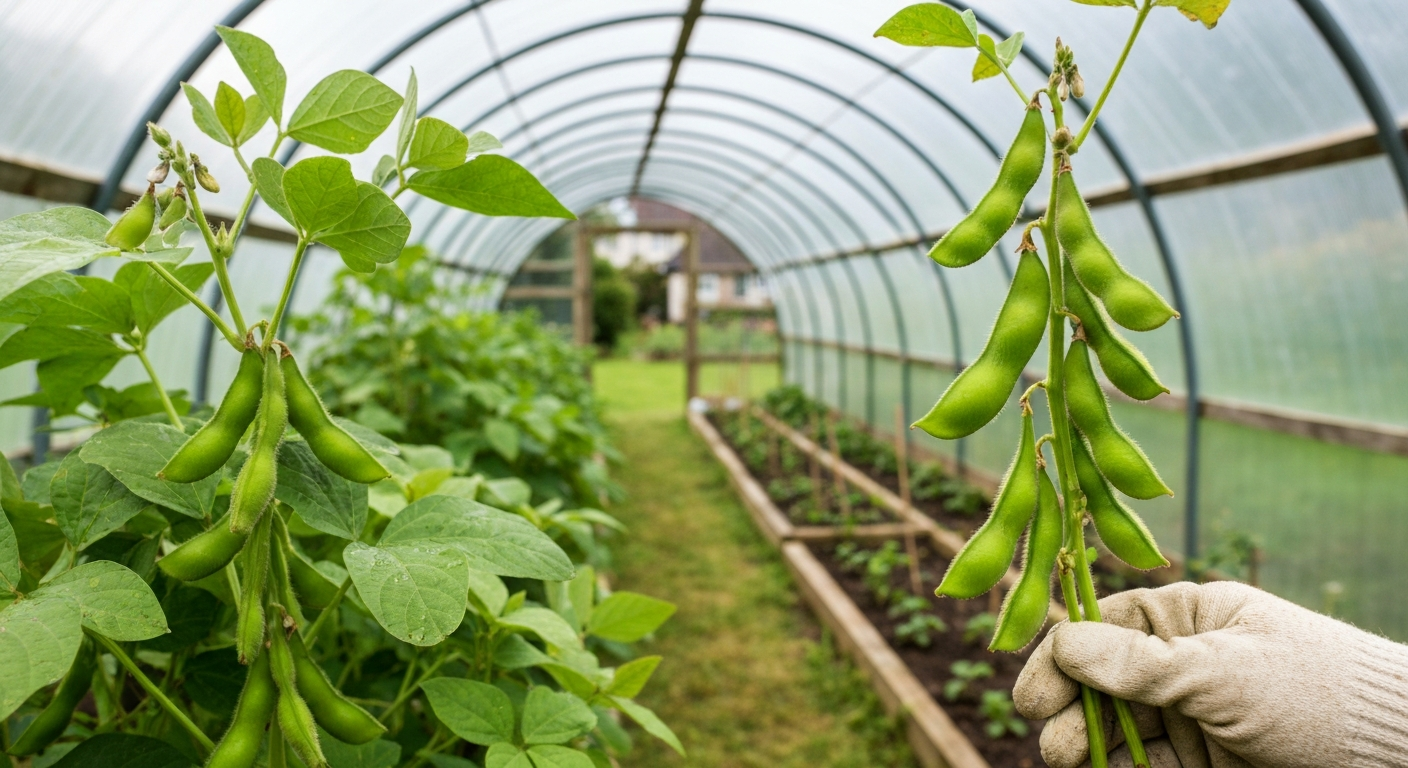
In a polytunnel, you can sow directly into beds from mid-April in most of England and Wales, gaining three to four weeks over outdoor sowing. Ventilation matters once temperatures climb above 30°C during pod fill, prolonged high temperatures during flowering can reduce pod set. Keep the sides open during warm days in July and August. Under a heated greenhouse, earlier starts in late March are feasible, but the plants will need good light and care to avoid leggy growth before conditions warm enough to move them to beds or larger containers.
Growing in containers
Container growing works for edamame, with the key constraint being pot size. Use a minimum of 11 litres (roughly 3 US gallons) per plant to avoid severe root restriction, which hammers yield. A free-draining compost mixed with perlite or horticultural grit suits soya better than dense potting mixes. Inoculate the seed as usual, the bacteria you introduce at sowing are just as important in a container as in the ground. Expect lower yields per plant than you would get in a well-prepared bed, but container growing does give you flexibility to move pots under cover if a late frost is forecast.
Spacing, layout and support
Most edamame and short-season soya varieties are bushy, self-supporting plants growing to 40 to 70 cm tall. They do not need staking in the way that climbing beans do, but in an exposed site or when grown in containers, a short bamboo cane per plant prevents wind rock. In beds, grow in blocks rather than long single rows if you can, it aids pollination and makes better use of limited space. The standard row spacing of 45 to 60 cm between rows and 10 to 15 cm between plants works well for most edamame varieties. For a small raised bed, aim for a roughly 15 cm grid spacing, which gives reasonable yield without overcrowding.
Watering, feeding and routine crop care
Watering
Consistent moisture matters most at two stages: germination and pod fill. During germination, keep the soil moist but not waterlogged. Once plants are established and flowering, dry spells will reduce pod set, so water at the base of plants in dry weather, aiming to keep soil consistently moist but never saturated. Container-grown plants need checking daily in warm weather as they dry out much faster than bed-grown ones.
Feeding
If you have inoculated correctly and your soil pH is in the right range, properly nodulated soya plants fix most of their own nitrogen. Avoid high-nitrogen feeds, which suppress nodulation. A balanced, low-nitrogen fertiliser at planting can help on genuinely poor soils, but the main nutrient needs are potassium and phosphorus for root development and pod fill. For container plants, a weekly liquid feed with a low-nitrogen tomato-style feed once pods begin to swell is a practical approach.
Mulching and weed control
Soya seedlings are poor competitors with weeds in the first four to six weeks. Keep beds well weeded by hand or hoe until the canopy closes. Once plants have branched and are 30 cm or more tall, they will shade out most weeds themselves. A mulch of straw or compost applied after the soil has warmed (not before, cold mulch delays soil warming in spring) helps retain moisture and suppress late-season weeds. Black plastic or weed-suppressing membrane laid before sowing can warm the soil earlier in the season, which is genuinely useful in colder regions.
Season extension tips
The single most effective thing you can do to improve soya success in the UK is extend the warm season at both ends. At sowing time, cloches, horticultural fleece, or black plastic over the bed can raise soil temperature by several degrees and allow earlier planting. At the end of the season, a polytunnel keeps plants warmer through September and into October, which can make the difference between plump filled pods and a disappointing half-developed crop. In practice, growers who manage to extend their effective season by even two to three weeks at each end dramatically improve their odds.
Pests, diseases and what to watch for
Soya does not carry the heavy pest load of some brassica or allium crops, but there are a few things worth knowing. Slugs are the biggest early threat, particularly in wetter northern and western areas, they will demolish seedlings fast in damp conditions. Standard slug control (traps, copper tape for containers, nematodes) applies here. Aphids can colonise young plants in warm periods and should be watched for, especially under cover. Botrytis (grey mould) is a risk in humid polytunnel conditions, ensure good airflow. Rabbits and pigeons will eat young plants given the chance, so netting is worth considering for open plots.
Harvesting: edamame vs. dry beans
For edamame, the harvest window is short and specific. Pods are ready when the beans inside have filled out and the pods feel firm and plump, but before they start to yellow, typically around 70 to 90 days from sowing depending on variety and season warmth. The pods should feel firm when squeezed. Harvest all pods on each plant at once, since the window lasts only a few days before the beans become starchy and lose their sweetness. Cook fresh edamame within 24 hours of picking for best flavour, they deteriorate quickly.
For dry beans, leave the pods on the plant until they have yellowed, dried down, and the beans rattle inside. In a UK summer this usually happens from September into October for the earliest varieties. If wet autumn weather threatens to rot the pods before they fully dry, pull the entire plant and hang it upside down in a dry, airy shed to finish drying. Shell the beans once fully dry and crisp, then store in a sealed jar in a cool, dark place. Properly dried soya beans store well for a year or more.
Realistic yields and honest troubleshooting
In a good southern England year, a well-grown edamame plant in fertile soil can produce 30 to 50 pods. In a poor, cold summer or on a north-facing site, you might get 10 to 20. Container plants typically yield less than bed-grown plants. For dry beans, yield is harder to estimate at small scale because so much depends on whether the season was warm enough, in a marginal year, pods will be present but thin and poorly filled. This is the honest reality of growing a subtropical crop in Britain.
The most common failures I see reported: sowing too early into cold soil (leads to rotting seed and patchy germination), skipping inoculation (plants grow but produce little because nitrogen fixation fails), choosing the wrong variety (long-season types that never flower properly), and not watering during pod fill in dry spells. Each of these is preventable with the steps described above.
When to consider a different bean instead
If you are after reliable pulse crops in UK conditions, soya is not the easiest option. For a more reliable pulse option in UK gardens, see can you grow cannellini beans in uk for practical guidance on growing cannellini beans here. For a related discussion of growing other bean types in Britain, see Can you grow butter beans in the UK? for advice on climate suitability, season-extension and variety choice. Butter beans, cannellini beans, and chickpeas each come with their own regional caveats, chickpeas in particular need dry warmth that most of the UK struggles to deliver, but some options are more forgiving than soya for northern growers. If your main goal is a productive edible legume crop and you are north of the Midlands without protected growing space, runner beans, French beans, or borlotti types will almost certainly outperform soya in yield and reliability. Soya is worth growing for the novelty, the fresh edamame experience, and the educational value of the nitrogen-fixing process, but it is not yet a crop to rely on as a staple in most UK gardens.
Where to find soya bean seed in the UK
Edamame seed is increasingly available from mainstream UK seed suppliers in spring catalogues. Search specifically for 'edamame' or 'vegetable soybean' rather than 'soya bean' to find varieties selected for vegetable use. Fiskeby V and similar early dry-soya lines are less common in garden retail but are stocked by specialist heritage seed suppliers and some organic seed companies. Bradyrhizobium inoculant can be purchased from UK legume seed suppliers and some online agricultural wholesalers, buy fresh stock each season as viability declines with age and heat exposure.
FAQ
Can soya beans (soybeans/edamame) be grown successfully in the UK?
Yes — but with regional caveats. Soya can be grown successfully on a small scale in much of the UK provided you match early‑maturing, short‑day or day‑neutral cultivars to your local season length and use season extension (polytunnel, fleece, cloches) in cooler/northern/upland areas. Success depends on accumulated heat (growing‑degree‑days), avoiding late frosts, and choosing varieties bred for short seasons (evidence from UK/Scandinavian trials and temperate PNW/European extension work). In southern and coastal lowland England outdoor success is most reliable; in most of Wales, northern England, Scotland and uplands, protected cultivation or very early cultivars are recommended.
Which types and varieties are recommended for UK small growers (edamame vs dry soya)?
For UK smallholders choose either vegetable‑soy (edamame) or early‑maturing dry soy types. Look for very early/low maturity group lines or cultivars bred for northern Europe (examples in trials include Scandinavian ‘Fiskeby’ derivatives and early edamame lines used in PNW trials). Edamame cultivars selected for short seasons (70–100 days in cool climates) are best for green‑pod harvest; select early dry‑bean varieties if you plan to mature seed on the plant. Avoid late‑maturing commercial grain types bred for North America unless in heated protected conditions.
When and how should I sow soya beans outdoors in the UK?
Sow outdoors when soil temperatures are reliably above ~10°C and the risk of air frost has passed — typically late April–May in southern lowlands, later in northern/upland areas. Sow seed 2.5–4 cm deep. For edamame: plant spacing about 8–15 cm within the row and 45–60 cm between rows (single rows or blocks). For dry beans, space plants slightly wider to improve airflow. In cool springs delay sowing until soil warms or use cloches/polytunnel to avoid poor emergence.
How should I sow and grow soya in containers, polytunnels and heated greenhouses?
Containers: use pots ≥11 L (~3 US gallons) per plant or larger troughs with free‑draining potting mix; keep soil warm and well watered. Polytunnel/unheated greenhouse: sow earlier than outdoors (April onward) and use to protect from late cold spells; ventilation is crucial in warm spells. Heated greenhouse: you can grow later‑maturing varieties and get faster growth — monitor daylength sensitivity (short‑day breeders may flower early if nights are long). In all protected situations inoculate seed if soil lacks soybean rhizobia.
What soil, light, temperature and daylength conditions do soybeans need?
Soils: well‑drained loam, pH ~6.0–6.8, fertile but avoid high starter mineral N to encourage nodulation. Light: full sun. Temperature: base temperature for development ~10°C; warm days and nights speed development and pod fill — cool weather delays flowering/pod set. Daylength: soybean is short‑day/photoperiod sensitive; flowering and maturity depend on cultivar photoperiod response, so pick early/maturity‑adapted varieties for long‑day UK summers or use protected cultivation to alter effective season.
Do I need to inoculate seed with Bradyrhizobium in the UK?
Yes if your soil has not hosted soybean before or tests indicate absence of soybean‑nodulating strains. UK research (Scotland) has shown many soils lack compatible bradyrhizobia; using a commercial peat inoculant (applied per manufacturer rates and sown promptly) is recommended to enable biological N fixation and reduce reliance on starter N.
Next Article
Can You Grow Butter Beans in the UK? Regional How-to Plan
Can you grow butter beans in the UK? Region‑by‑region verdict, best varieties, sowing dates & quick care tips.