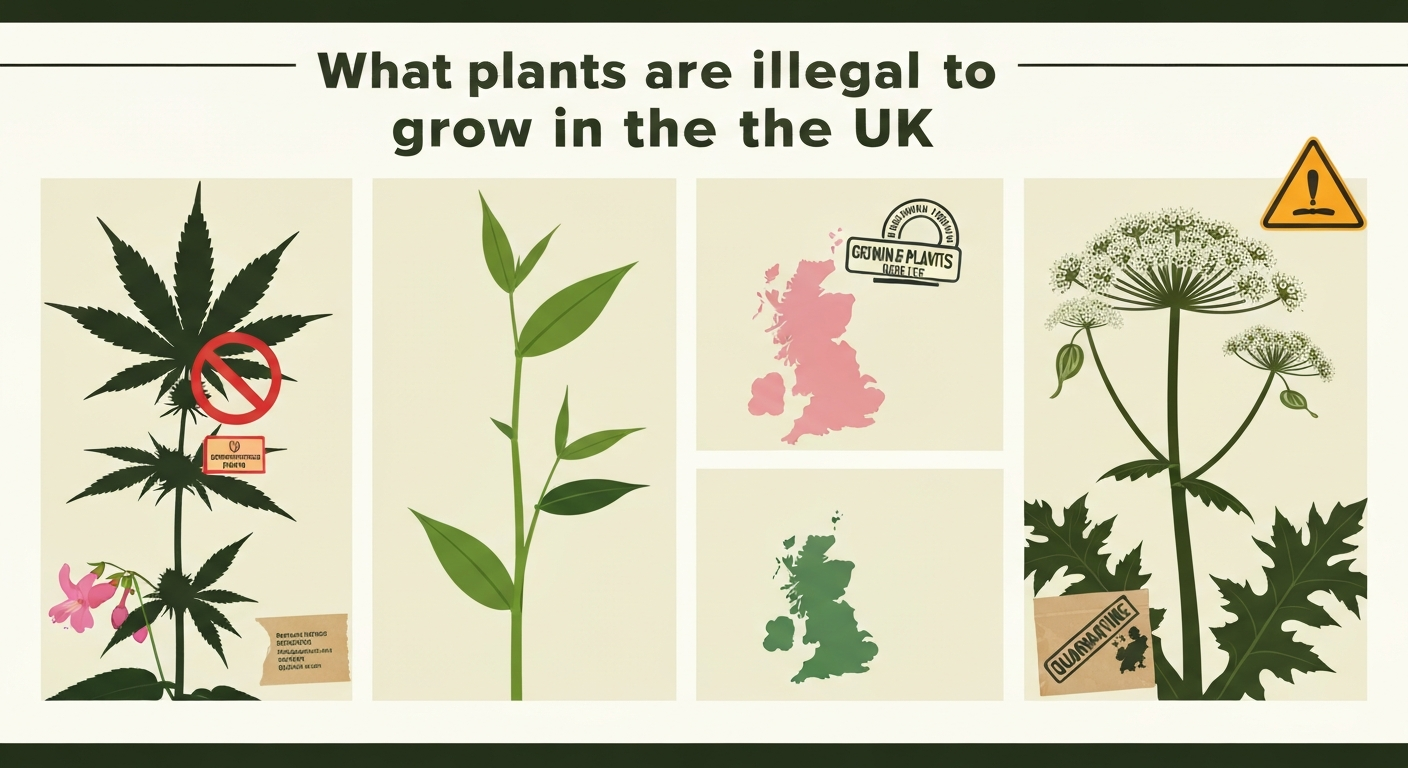
Yes, some plants are genuinely illegal to grow in the UK, and others sit in a legal grey area that can catch gardeners out. The clearest examples are cannabis (illegal to cultivate without a Home Office licence), and a group of invasive species including Japanese knotweed, Himalayan balsam and giant hogweed, which are legal to grow in a contained garden but illegal to allow to spread into the wild. On top of that, certain imported plants and seeds need permits or phytosanitary certificates before they can legally enter the country. Most plants you will ever grow in your life fall nowhere near any of these rules, but it is worth knowing where the lines are before you experiment with anything unusual.
What Plants Are Illegal to Grow in the UK: Quick Guide
James Hartwell
5 Aug 2026
What the law actually covers
UK plant law sits across several different pieces of legislation, and they each do different things. There is no single 'banned plant' list. Instead, the law targets three main areas: controlled drugs (plants that can be used to produce psychoactive substances), invasive non-native species that cause ecological damage, and plant-health controls that govern what can cross UK borders. Understanding which category applies to a plant you are curious about is the first step, because the rules and consequences are quite different in each case.
- Controlled drugs legislation (Misuse of Drugs Act 1971): makes it an offence to cultivate certain plants without a licence, most notably cannabis.
- Wildlife and Countryside Act 1981 (Schedule 9): makes it an offence to plant, or cause to grow in the wild, a list of non-native invasive species.
- Invasive Alien Species (Enforcement and Permitting) Order 2019: sets out a permitting regime and enforcement powers for invasive non-native species under a retained UK framework.
- Plant health and import controls (APHA): regulate which plants and seeds can be brought into Great Britain, requiring phytosanitary certificates, pre-notification or CITES permits for certain species.
- Environmental Protection Act 1990 (duty of care): covers disposal of invasive plant material, which can be classified as controlled waste.
Cannabis and controlled drug plants: where the law draws the line
Cannabis is the plant most people think of when this topic comes up, and the law here is unambiguous. Section 6 of the Misuse of Drugs Act 1971 makes it a criminal offence to cultivate a cannabis plant in the UK. This applies regardless of the number of plants, the intended use, or whether the variety is marketed as 'low-THC' hemp. The Crown Prosecution Service is clear on this: growing cannabis is a prosecutable offence, and it is treated seriously.
There is a legal route for cultivation, but it is not available to hobbyists. The Home Office Drugs and Firearms Licensing Unit (DFLU) issues domestic controlled-drug licences under the Misuse of Drugs Regulations 2001, which allow certain organisations to cultivate cannabis for medicinal, research or manufacturing purposes. Home Office drug‑licensing guidance and the government cannabis factsheet explain that cultivation or possession of controlled parts of the cannabis plant generally requires a Home Office controlled‑drugs licence under the Misuse of Drugs Regulations Home Office drug‑licensing guidance and the cannabis factsheet. Applicants must meet strict requirements including DBS checks, secure premises and detailed record-keeping. This is a commercial and scientific licensing pathway, not something a home gardener can access.
CBD products have muddied the waters for a lot of people. Some cannabis-derived products are exempt from certain rules or classified as licensed medicinal products, but that does not make cultivation legal. Growing the plant, in any form, still requires a Home Office licence. If you are unsure about a particular seed product or CBD variety being marketed online, the safest approach is to contact the DFLU directly before you plant anything.
Cannabis is the main plant in this category that a UK gardener is likely to encounter, but the Misuse of Drugs Act covers several other plants. Opium poppy (Papaver somniferum) is widely grown ornamentally and seed is sold freely, and cultivation in small quantities for ornamental purposes has historically not been prosecuted, but it is technically a controlled plant. The legal position is nuanced and I would not want to overstate the risk for someone growing a handful of ornamental poppies, but it is worth being aware of the framework.
Invasive plants: Japanese knotweed, Himalayan balsam and giant hogweed
The invasive species rules catch more gardeners off guard than the drug-plant legislation, mostly because the plants themselves are not obviously dangerous or illicit. Japanese knotweed, Himalayan balsam and giant hogweed all appear in Schedule 9 of the Wildlife and Countryside Act 1981. Under section 14 of that Act, it is an offence to plant any of these species, or to cause them to grow in the wild. The key phrase is 'in the wild': having Japanese knotweed on your land is not in itself an offence, but allowing it to spread beyond your boundary or dumping contaminated soil is.
Japanese knotweed
Japanese knotweed (Fallopia japonica, also listed as Reynoutria japonica) is the species most UK landowners have heard of, and for good reason. It spreads aggressively from even tiny fragments of rhizome, can cause structural damage to buildings and hard surfaces, and is notoriously difficult to eradicate. If you have it on your land you are not legally obliged to remove it, but you must prevent it spreading. If it spreads to a neighbour's land or into a watercourse or natural habitat, you could face enforcement action. The Environment Agency's Code of Practice on managing knotweed on development sites also makes clear that contaminated soil and plant material is controlled waste under the Environmental Protection Act 1990. It must be transferred by a registered waste carrier and disposed of at an authorised facility, such as a licensed landfill. You cannot simply bag it up and put it in a skip or compost it.
Himalayan balsam
Himalayan balsam (Impatiens glandulifera) is a tall, pink-flowered annual that looks cheerful but spreads prolifically along riverbanks and in damp habitats. It is also a Schedule 9 species. Planting it in your garden is not a criminal act in and of itself, but causing it to establish in the wild is an offence. Given how easily it self-seeds, keeping it genuinely contained is difficult, which is why most conservationists recommend not growing it at all. Many volunteer groups run annual balsam-bashing events to pull it before it seeds.
Giant hogweed
Giant hogweed (Heracleum mantegazzianum) is worth treating with serious caution beyond the legal angle. Its sap causes severe phototoxic burns that can result in lasting scarring. It is also a Schedule 9 species and must not be planted or allowed to spread into the wild. If you find it on your land, contact the Environment Agency, Natural England (or their devolved equivalents) or your local council for guidance on safe removal, which typically involves wearing full protective clothing and following specific disposal routes for the plant material.
| Plant | Schedule 9 listed? | Can you grow it in a garden? | Key legal risk | Disposal route |
|---|---|---|---|---|
| Japanese knotweed | Yes | Not an offence, but spread must be prevented | Allowing spread; fly-tipping contaminated soil | Licensed waste carrier to authorised facility |
| Himalayan balsam | Yes | Technically legal but inadvisable | Causing it to establish in the wild | Controlled waste rules apply |
| Giant hogweed | Yes | Technically legal but dangerous and inadvisable | Causing it to establish in the wild | Protective clothing required; professional removal advised |
| Cannabis | No (Misuse of Drugs Act) | No, without a Home Office licence | Criminal offence under section 6 MDA 1971 | N/A |
Bringing plants, seeds and soil into the UK: what you need to know
Post-Brexit plant-health controls have tightened considerably, and this is an area where a lot of enthusiastic gardeners unknowingly break the rules. The Animal and Plant Health Agency (APHA) and its Plant Health and Seeds Inspectorate regulate what can enter Great Britain. Imports from non-EU countries generally require a phytosanitary certificate from the exporting country and pre-notification through the Import of Products, Animals, Food and Feed System (IPAFFS). See the government guidance 'Import plants and plant products from non‑EU countries to Great Britain – GOV.UK' for current rules on phytosanitary certificates, APHA inspections and IPAFFS pre-notification. For some consignments, APHA inspection at the point of entry is also required.
Soil is a particular concern. Bringing soil into Great Britain from most countries is prohibited or heavily restricted because it can carry soil-borne pests and diseases. Many plant imports must be bare-rooted or in approved growing media. If you buy plants from abroad and they arrive with soil attached, that is a plant-health issue that could result in the consignment being destroyed.
CITES (the Convention on International Trade in Endangered Species) adds another layer for certain ornamental and tropical species. APHA is the UK CITES licensing authority. Many cycads, some orchids and a range of other plants require import and export permits before they can legally be traded. You can check CITES listings via the Species+ database or the GOV.UK CITES permit service. Buying a CITES-listed plant from a UK nursery that already holds the right documentation is fine, but importing one yourself from outside the UK without the correct permits is not.
Within Great Britain, certain regulated plants must be accompanied by a UK plant passport when moved commercially. This mostly affects nurseries and professional growers rather than home gardeners moving a cutting from one part of their garden to another, but it is relevant if you sell or swap regulated species.
How to check whether a plant is regulated
The honest answer is that there is no single database where you can type in a plant name and get a definitive legal status. You need to check across a few sources depending on what type of regulation you are worried about. Here is how I approach it.
- Start on GOV.UK and search for the plant name alongside terms like 'invasive species', 'controlled drug', or 'plant health'. The government guidance pages are authoritative and reasonably up to date.
- For invasive species, check the GB Non-Native Species Secretariat (NNSS) website. It holds risk assessments, species factsheets and the current Schedule 9 list. The PlantTracker and INNS Mapper tools also let you report sightings.
- For controlled drugs and cultivation licences, the Home Office DFLU page on GOV.UK explains which plants are controlled and how to apply for a licence if you have a legitimate reason.
- For imports, check APHA's plant health pages on GOV.UK. The Plant Health Information Portal and IPAFFS system are the official routes for pre-notification and authorisation.
- For CITES-listed species, use the Species+ tool linked from the GOV.UK CITES permit page to check whether a species is listed under Appendix I, II or III and what documentation is needed.
- For invasive plant disposal and waste obligations, the Environment Agency (in England), SEPA (Scotland) and Natural Resources Wales publish guidance on controlled-waste rules for contaminated material.
- If you are still unsure, contact Natural England (England), NatureScot (Scotland) or Natural Resources Wales directly. They field enquiries about Schedule 9 licences and site-specific guidance.
Growing tender and tropical plants in the UK: what is actually realistic
Legality aside, a big part of the question behind 'what can I grow in the UK' is really about climate. The UK is a challenging place for tropical and tender species, but it is far from hopeless if you understand the hardiness rating system and what your local conditions actually offer. The RHS uses a scale from H1 (tropical, requires heated glasshouse year-round) to H7 (hardy in the coldest parts of the UK, including upland Scotland). Most tropical and exotic plants sit at H1a, H1b or H1c, meaning they need frost-free or warm conditions to survive. See our guide to tropical plants you can grow in the UK for species recommendations and care tips.
| RHS Hardiness Rating | What it means | Where it can survive outside | Examples |
|---|---|---|---|
| H1a | Heated glasshouse only (above 15°C) | Nowhere outside in the UK | Tropical palms, many orchids |
| H1b | Heated glasshouse (5–15°C minimum) | Nowhere outside year-round | Areca palm, many tropicals |
| H1c | Frost-free glasshouse or very sheltered coastal spots | Isles of Scilly, very mild SW Cornwall only | Some tender succulents |
| H2 | Cool greenhouse, unheated in mild areas | Outdoors in very mild SW England in good years | Bougainvillea, some citrus |
| H3 | Half-hardy: protect in cold winters | Outdoors summer; south coast with shelter year-round | Tree ferns, agapanthus |
| H4 | Hardy in most of UK with some exceptions | Most of England and Wales reliably | Yucca gloriosa, many palms |
| H5–H7 | Fully hardy across the UK | Everywhere including Scotland uplands | Most native and cottage-garden plants |
Microclimates make a substantial difference, and I cannot stress this enough. A south-facing walled garden in Devon operates in a genuinely different climate from an open garden in the East Midlands, even if they are technically in the same country. Urban heat islands mean a London garden will often get away with plants that would struggle ten miles out of the city. Before you write off an exotic species as impossible, think about what your specific plot actually offers: aspect, wind exposure, drainage, frost pocket risk and proximity to a wall or structure that radiates heat overnight.
Can specific tropical plants actually grow outside in the UK?
Areca palm
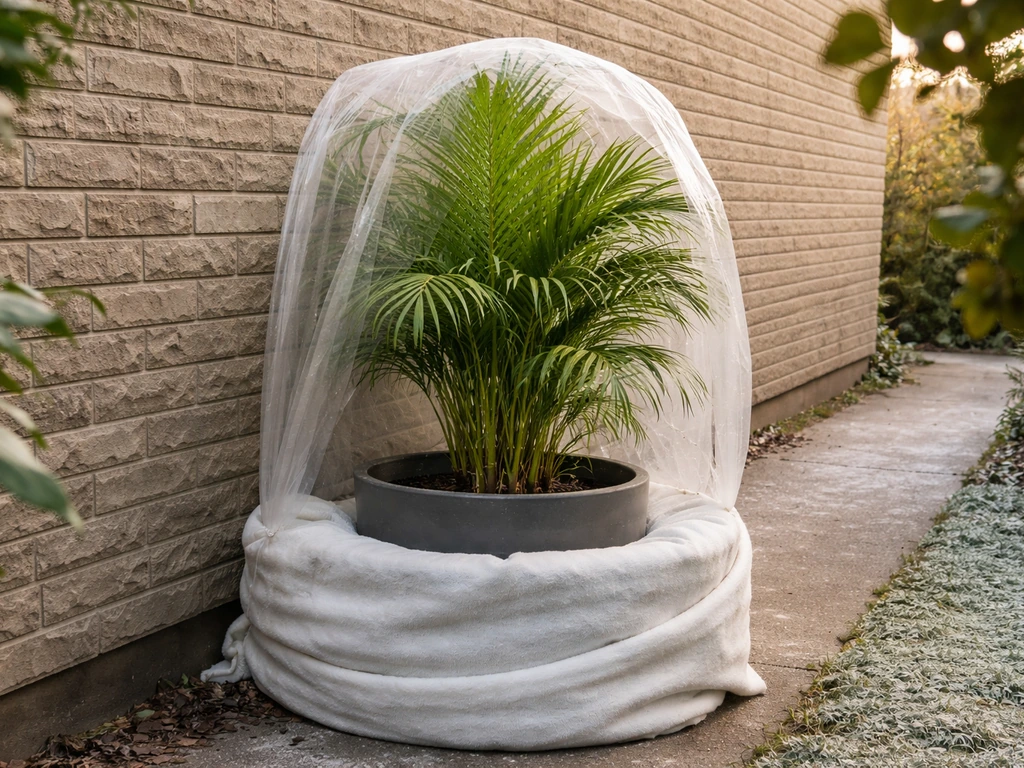
Areca palm (Dypsis lutescens) is rated H1b by the RHS, which means it needs a heated glasshouse with a minimum temperature of around 10–15°C to survive a UK winter. Outside, it will not tolerate frost at all. Even on the Isles of Scilly or in a very sheltered Cornish garden it is marginal, and most years it would be damaged or killed by winter cold. As a houseplant or in a warm conservatory it is excellent, thriving in bright indirect light with good humidity. Moving it outside in summer (once nighttime temperatures are reliably above 15°C) is feasible, but it comes back inside in September. If you want a palm that genuinely lives outside year-round in most UK gardens, Trachycarpus fortunei (the Chusan palm) is rated H4 and is far more reliable.
Money plant
The term 'money plant' covers several species, but in UK garden centres it usually refers to Crassula ovata or, in some contexts, Pilea peperomioides. Crassula ovata is rated H1c at best, meaning it needs frost-free conditions and will not survive a UK winter outside in any region except perhaps the very mildest Cornish or Channel Island spots. Outside in summer it does well, enjoying full sun, but it must come in before the first frost. Pilea is strictly an indoor plant in the UK. Neither is a problem from a legality standpoint, and both are widely available. They just cannot live outdoors year-round in Britain. See can money plants grow outside in the UK for detailed guidance on growing Crassula and Pilea outdoors.
Yucca
Yucca is one of the more successful 'exotic-looking' plants for UK outdoor growing, and it is where I would direct anyone who wants a bold, architectural plant without the headache of winter protection. Yucca gloriosa and Yucca filamentosa are both rated H4, meaning they are hardy across most of England and Wales and can cope with temperatures down to around -10°C. In sheltered London gardens and along the south coast they can look spectacular year-round. In Scotland or exposed northern sites they need more protection, ideally against a south-facing wall. The main failure mode I have seen is not cold but wet: yuccas need sharp drainage, and sitting in waterlogged clay over winter will rot the crown faster than any frost.
Other tropical and tender plants: realistic expectations
Most genuinely tropical plants (bananas, cannas, tree ferns, some gingers) occupy a middle ground in UK conditions. Musa basjoo, the hardy banana, is rated H4 and can survive outside if the crown is mulched heavily before winter, though the leaves die back completely. Dicksonia antarctica (tree fern) is H3 to H4 depending on the source and is grown successfully in milder parts of the UK, particularly the west coast where Atlantic rainfall suits it. Cannas are H3 and need the rhizomes lifting and storing frost-free in most regions outside the far south-west. If you are interested in the broader world of tropicals that can be pushed in UK conditions, the range is wider than most people expect, but it involves matching species to your specific region rather than treating the whole country as one growing zone.
Hardy alternatives worth considering
If you want the look of tropical planting without the maintenance overhead, there are genuinely hardy alternatives for most effects. Melianthus major gives huge, architectural grey-green foliage and is H3 to H4. Fatsia japonica is fully hardy (H5), evergreen and gives a bold, jungle feel in shaded spots where most exotics would struggle. For a palm effect without the frost anxiety, Trachycarpus fortunei is reliably H4 and has been grown successfully as far north as Edinburgh in sheltered spots. For more ideas on hardy species, see our dedicated guide to plants that will grow anywhere in the UK. Phormium (New Zealand flax) is H4 and provides strong, spiky form in a range of colours. These are the plants I come back to when a dramatic design brief meets a limited budget for winter protection.
Sourcing plants legally and handling regulated species responsibly
Buying from reputable UK nurseries is almost always the safest route. Established nurseries handle plant-health compliance, hold any necessary licences and are unlikely to sell you something that creates a legal problem. The risk area is online marketplaces and international seed suppliers, where plants or seeds can arrive without the required phytosanitary documentation, or where a listing might not accurately describe what is in the packet.
If you discover an invasive species like Japanese knotweed on land you own or manage, the responsible steps are: do not disturb or move it unnecessarily (fragmentation spreads it), do not compost it or put it in general waste, contact a specialist contractor or your local council for advice on treatment or removal, and if material needs to be removed from site, use a registered waste carrier with experience in knotweed disposal. You can report sightings of Schedule 9 invasive species using the PlantTracker app or the INNS Mapper tool, which feeds into the national NNSS database.
If you think you have imported a plant that may need documentation you did not obtain, contact APHA's Plant Health and Seeds Inspectorate promptly. Proactively engaging with the regulator is a much better outcome than being found in breach of plant-health import rules. The Plant Health Information Portal on GOV.UK is the starting point for most import-related enquiries.
FAQ
Quick answer: are any plants illegal to grow in the UK?
Short answer: yes — some plants are illegal or tightly controlled to grow in the UK, but most garden plants are fine. Illegal or restricted categories include (a) controlled drugs (for example, cultivating cannabis without a Home Office licence is an offence under the Misuse of Drugs Act 1971), (b) certain non‑native invasive species (it is an offence to plant or otherwise cause to grow in the wild plants listed in Schedule 9 of the Wildlife and Countryside Act 1981), and (c) plants subject to plant‑health, import or CITES controls that require permits or phytosanitary paperwork. For ordinary ornamental, vegetable and houseplants there is normally no general prohibition.
What do you need to watch for: controlled drugs?
Controlled drugs: some plant species (notably cannabis) produce controlled substances. Cultivating cannabis without the appropriate Home Office controlled‑drugs licence is an offence. The Home Office issues licences for specific, regulated purposes (for example medicinal manufacture or research) and publishes application guidance. If you are uncertain about a plant that may produce a controlled substance, check Home Office guidance and do not assume an unregulated cultivation is lawful.
What are regulated invasive or ‘noxious’ plants and why are they restricted?
Invasive/non‑native species listed under Schedule 9 of the Wildlife and Countryside Act 1981 are restricted because they can damage wildlife, waterways and property. Section 14 makes it an offence to plant or otherwise cause these species to grow in the wild. Common examples gardeners and landowners must avoid releasing into the wild include Japanese knotweed, Himalayan balsam and giant hogweed. Even if you grow such species in a garden, you must take steps to prevent their spread to surrounding land and watercourses.
What plant‑health, import and CITES controls should I be aware of?
Plant‑health controls: many imports and some domestic movements of plants are regulated. Imports from outside the UK often need phytosanitary certificates, pre‑notification and/or APHA authorisation; certain plants require UK plant passports for movements within GB. CITES: some rare/tropical species (certain cycads, many orchids and other endangered plants) need CITES permits for import or export. Always check APHA/Defra and GOV.UK pages for current rules before importing or moving regulated species.
Where can I check official rules, licences and permissions?
Authoritative sources: GOV.UK and the relevant regulators. Key contacts include Home Office (Drugs & Firearms Licensing Unit) for controlled‑drug licences; APHA/Defra Plant Health and Seeds Inspectorate and the Plant Health Information Portal for import and movement authorisations and CITES permits; Environment Agency / Natural Resources Wales / SEPA for disposal and waste licensing issues; and Natural England for licences affecting protected sites. Use those official GOV.UK pages to confirm requirements and apply for licences — the guidance pages and application forms are published there.
Do I need a licence to grow cannabis for medicinal or research purposes?
Yes — cultivating cannabis for medicinal manufacture, research or other controlled purposes normally requires a Home Office controlled‑drugs licence. The Misuse of Drugs Regulations and Home Office guidance set out the application process, eligibility checks and any fees. This is a formal regulatory regime; consult the Home Office guidance and apply through their published route if you believe you have a legitimate, licensable purpose.
Next Article
Can Areca Palm Grow Outside UK? Practical Guide
Yes, but only in sheltered warm spots. Learn UK frost limits, microclimates, planting, and overwintering for outdoor are