
Yes, you can grow taro (Colocasia esculenta) in the UK, but it needs real effort and the right setup. It is a tender tropical crop rated H1B by the RHS, meaning it will not survive a British winter outdoors and needs temperatures of at least 21°C to thrive. In practice that means starting corms indoors in spring, growing through summer in a warm, sheltered spot or under cover, and either harvesting the corms before autumn frosts or lifting and overwintering the plants somewhere frost-free. If you are in Cornwall, the Scilly Isles, or a sheltered urban garden in the South, you have a genuine shot at small but usable corm harvests. If you are in the Midlands or further north, a polytunnel or greenhouse pretty much becomes essential. Scotland and exposed upland areas are very difficult territory for edible corm production, though the plants can still make a striking summer ornamental.
Can You Grow Taro in UK? Growing Guide for British Gardens

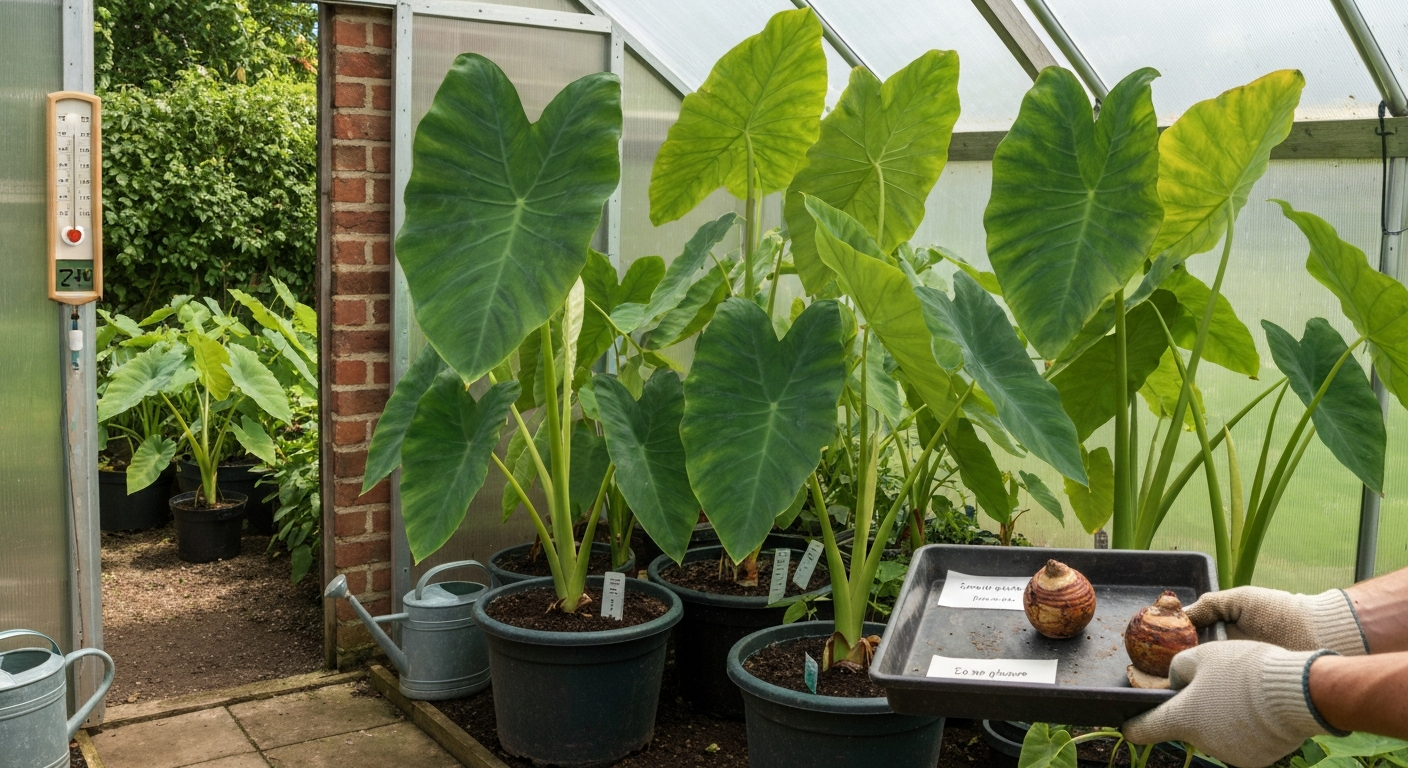
How realistic is it in your part of the UK?
Taro's optimal growing temperature is 21–28°C and its base temperature for corm development (the point below which useful growth essentially stops) sits around 17°C. The UK rarely sustains those conditions for long outdoors, but it is not hopeless either. The key is understanding what your specific location actually offers, rather than thinking of 'the UK' as one climate.
South and Southwest England
This is where taro has the best realistic chance outdoors. Cornwall, Devon, the Channel Islands, and sheltered coastal gardens in Dorset and Hampshire have long frost-free windows, mild winters, and occasional summer temperatures in the low 20s. You are still below taro's ideal, but with a south-facing wall, deep mulching, and a warm summer you can expect reasonable vegetative growth and modest corm development, especially with eddoe types. Do not expect Hawaiian-scale harvests, but harvestable small corms are achievable in good years.
Midlands and East Anglia
Outdoors here, you are pushing it. Summer temperatures are often just about adequate, but the season is shorter, nights drop quickly in late August, and frost can arrive well before harvest maturity in an average 7–9 month growing cycle. Growing in containers that you can move under cover, or using a polytunnel, turns this from a gamble into a reasonable proposition. Unheated polytunnels reliably add 4–9°C to night-time minimums and extend the growing window at both ends of the season, which makes a meaningful difference when taro needs sustained warmth. Protected cultivation trials (strawberry) report that polytunnels raise soil and air temperatures and reduce evapotranspiration, lowering crop water demand (Evapotranspiration-Based Production Functions and Water Productivity of Strawberry under Mulching and Protected Cultivation) blank" rel="noopener noreferrer">Polytunnel effects on soil temperature and ET — protected cultivation trials (strawberry).
North England and Uplands
Outdoors in Yorkshire, Lancashire, Cumbria, and any upland site, edible taro cultivation is largely not viable without protected growing. The season is simply too short and too cool for corms to bulk up adequately. You can grow taro as a summer ornamental in a warm sheltered spot and it can look spectacular, but do not expect much in the way of harvestable corms unless you have a heated greenhouse. A polytunnel helps, but without supplementary heat through cool northern summers, results will be variable and often disappointing.
Scotland
Honest answer: Scotland is not taro country for edible corms. West Coast locations benefit from the Gulf Stream and occasionally mild winters, but summer heat accumulation is rarely enough to bulk corms worth harvesting. A heated greenhouse or polytunnel with a dedicated heating system could work, but at that point you are spending considerably more energy than the crop is worth. As an ornamental container plant in summer, taro is perfectly doable and looks fantastic on a Scottish patio from June to August.
Urban microclimates
Cities deserve a special mention. Urban heat islands in London, Bristol, Manchester, and Birmingham can raise ambient temperatures by 2–5°C over surrounding rural areas, which is genuinely significant for a crop as temperature-sensitive as taro. A south-facing walled courtyard or rooftop garden in central London can behave almost like the Southwest coast climatically. If you are urban, factor your microclimate in generously; it can push you into a more optimistic category than a simple north-south split would suggest.
Before you start: a quick reality check
Run through this checklist honestly before buying corms. It will save you wasted effort and money.
- Do you have a frost-free spot (indoors, greenhouse or polytunnel) to start corms in March or April at around 21–30°C?
- Can you give plants a growing site that gets consistent sun and is sheltered from cold north and east winds?
- Is your summer reliably warm enough to sustain daytime temperatures above 17°C for at least 5–6 months? (South and Southwest: yes; North: borderline without cover)
- Do you have a frost-free space to overwinter lifted corms or pot-grown plants between October and April?
- Can you water consistently through summer? Taro wants steady moisture, especially in containers or raised beds, and it shows stress quickly if allowed to dry out.
- Are you prepared for a 7–10+ month commitment from sprouting to harvest — longer than most UK vegetables?
- Have you considered that calcium oxalate in raw taro makes it toxic and itchy to handle, so you need to know how to prepare it safely?
If you answered no to the first three questions, a polytunnel or greenhouse is almost certainly necessary for edible corm production rather than ornamental use.
What you actually get from growing taro in the UK
The most obvious reward is the corm itself: a starchy, earthy root used across South Asian, West African, East Asian, and Caribbean cooking. Dasheen-type taro produces one large central corm, while eddoe types cluster smaller corms around a main corm and are generally more manageable for UK conditions. The flesh is nutty, slightly sweet, and dense, with a texture somewhere between potato and chestnut once properly cooked. It is a genuinely interesting ingredient and has real culinary value once you get your hands on a decent harvest.
Beyond the corm, the young leaves are also edible when thoroughly cooked (they must be cooked to neutralise calcium oxalate, which causes severe irritation if eaten raw). In some cuisines the leaves are as prized as the root. In a UK context, the leaves also work as a visual feature: the large, velvety, elephant-ear leaves are genuinely spectacular and make taro worth growing as an ornamental even if your corm harvest is modest. Gardeners growing other tropical-feel crops alongside taro, such as yams, will find the visual effect of mixing these large-leafed plants is quite dramatic on a sheltered patio or in a polytunnel. For guidance on a related plant, see our can you grow indigo in the UK guide.
Picking the right variety for UK conditions
Not all taro is the same. There are hundreds of cultivars globally and the main distinction for UK growers is between dasheen and eddoe types. Dasheen (also called wetland taro) grows large, produces one main corm, needs high heat, humidity and fertile soil, and has the longest growing season. It is the harder option in UK conditions. Eddoe (also called Chinese taro or upland taro) produces multiple smaller corms per plant, is slightly more tolerant of cooler and drier conditions, and tends to mature a little faster. For most UK growers, eddoe types are the practical choice.
When selecting, prioritise cold tolerance and shorter maturity windows. Look for varieties described as maturing in 6–8 months rather than 10–12, since UK warm seasons are simply too short for the latter without a heated greenhouse. Ornamental colocasia cultivars (purple stems, black leaves) are widely available in the UK as houseplants or pond marginals and will grow vigorously, but their corm yield and eating quality are often secondary to their appearance. If edible production is your goal, source named culinary eddoe corms from specialist Caribbean or Asian grocery suppliers or trusted edible plant nurseries.
| Type | Corm size | Cold tolerance | Season length | Best for UK use |
|---|---|---|---|---|
| Dasheen (wetland) | Large, single main corm | Lower — needs sustained heat and humidity | 10–14 months typically | Heated greenhouse or polytunnel, South/Southwest only outdoors |
| Eddoe (upland/Chinese taro) | Many small corms per plant | Slightly higher — tolerates drier, cooler spells | 6–9 months typically | Best all-round choice for UK; polytunnel or sheltered South/Southwest |
| Ornamental Colocasia cultivars | Small, variable | Variable | As per parent species | Ornamental use; some are edible but yield is not the focus |
Where to find healthy corms to grow
Sourcing is one of the most practically tricky parts of growing taro in the UK. The best starting point for edible eddoe corms is a Caribbean or South Asian grocery shop. Eddoe corms are commonly sold as a root vegetable and are perfectly viable as planting material, provided they are fresh, firm, and showing signs of an emerging shoot or healthy dormant bud. Reject anything soft, shrivelled, or mouldy. A firm corm with a visible bud eye is ideal. Larger supermarkets occasionally stock eddoe, but greengrocers serving West Indian, Sri Lankan, or Chinese communities are a more reliable source.
For named ornamental or culinary varieties, specialist UK tropical plant nurseries and some online edible plant retailers stock colocasia corms and pot-grown plants in spring. Big Plant Nursery, Edulis, and a handful of other specialist suppliers have historically stocked taro for UK gardeners. Buying pot-grown plants in May or June gives you a head start but comes at a higher price. Avoid buying unnamed corms described purely as 'colocasia' without any further information if you specifically want edible yield rather than ornamental effect.
On the legal and biosecurity side: taro is not subject to any import restrictions when bought as a food vegetable in UK shops, but bringing plant material in from abroad yourself may require phytosanitary certificates depending on the country of origin. Stick to UK-sourced corms or named UK nursery stock and you will not have any issues. Do not be tempted to accept cuttings or corms sent from overseas friends without checking current APHA rules, as biosecurity enforcement around plant material has tightened considerably.
Which growing system suits you?
There is more than one way to grow taro in the UK and each approach has a genuinely different cost-benefit profile. Knowing which suits your situation before you start is worth the five minutes of thought.
| System | Pros | Cons | Best suited to |
|---|---|---|---|
| In-ground outdoors | Low cost, no infrastructure, good for large plants with natural root spread | Fully weather-dependent; risky north of a line from Bristol to The Wash; hard to overwinter without lifting | South/Southwest England; sheltered urban gardens; warm coastal microclimates |
| Containers | Moveable — can start under cover and bring inside before frost; controllable watering; manageable scale | Limited root volume restricts corm size; needs frequent watering and feeding; large pots are heavy | All regions; especially good for urban/patio growers and beginners |
| Polytunnel or greenhouse | Adds 4–9°C to night minimums; extends season significantly; enables reliable corm harvest in Midlands and North | Cost and space investment; can get very humid (disease risk if ventilation is poor) | Midlands, North England, Scotland for edible production; any region for maximising yield |
| Aquatic/pond marginal bed | Consistently moist root zone; taro naturally thrives in wet conditions; ornamentally impressive | Little or no harvestable corm from pond shelf culture; mainly ornamental; waterlogging early in season causes rot | Ornamental use; sheltered ponds in South/Southwest; naturalistic or wildlife gardens |
If you can only do one thing to improve your chances, it is this: use a container system that lets you start warm and move plants outside once settled weather arrives, then bring them back under cover by September. That single flexibility makes the difference between a reasonable harvest and losing the whole crop to an early autumn frost.
Getting the soil, drainage and water right
Taro wants fertile, moisture-retentive soil with decent structure, a slightly acid to neutral pH of around 5. The CGIAR/IBPGR manual "Descriptors for Taro (Colocasia esculenta), CGIAR/IBPGR manual" lists detailed soil texture classes, organic-matter and soil pH sections and is the standard international reference for taro soil and site parameters used in agronomy and breeding work Descriptors for Taro (Colocasia esculenta) — CGIAR/IBPGR manual. 5–6.5, and consistent moisture without prolonged waterlogging. The FAO cites optimal soil depth of 50–150 cm for field crops, which tells you it roots deeply when given the chance, so large deep containers or well-prepared in-ground beds reward the effort. Organic matter content of 5% or above is ideal, which in practice means digging in generous quantities of well-rotted compost or leafmould before planting. British soils that are heavy clay will need substantial organic matter added to improve drainage at the top layer while retaining moisture lower down; very sandy soils need bulking up with compost to retain moisture.
For containers, a mix of good-quality peat-free multipurpose compost combined with about 20–30% garden loam (or a John Innes No. 3 base) gives the moisture retention taro wants without becoming anaerobic. Avoid pure potting compost on its own in large pots as it tends to shrink and dry out unevenly. A 30–40 litre container is about the minimum useful size for a single plant if you want to harvest decent corms; bigger is better.
Watering is one area where taro diverges from most UK vegetable crops. Keep the soil consistently moist throughout the growing season, particularly during active vegetative growth in summer. Letting the pot or bed dry out significantly causes stress and stunts corm development. That said, cold waterlogged soil early in the season (before plants are established and actively growing) is a fast route to corm rot. The practical rule is: keep moist but never cold and saturated in spring. Once plants are in full leaf and summer temperatures are up, consistent high moisture levels are actively beneficial. Research from field trials backs this up: frequent irrigation improved corm yields, though there is some evidence that slightly reducing water late in the season (when you are trying to maximise corm bulking rather than leaf production) can concentrate energy into the storage organ.
For aquatic or pond shelf culture, plant into heavy aquatic compost in a wide basket or mesh pot, anchor the crown 1–3 cm below the water surface, and use aquatic fertiliser tablets rather than liquid feeds that would pollute the water. This system works best purely as an ornamental approach; the corms in pond culture are rarely worth harvesting and the constant saturation is not ideal for corm quality, though the plants will grow large and look spectacular.
Feeding through the growing season matters more than most gardeners expect. Taro is a hungry crop. Weekly liquid feeds with a balanced fertiliser during active growth (June to August), switching to a lower-nitrogen, higher-potassium feed from late August to encourage corm development rather than leaf production, mimics what professional growers do and produces noticeably better results than feeding ad hoc. Organic liquid feeds such as seaweed extract or comfrey liquid work well alongside compost-enriched beds.
If you are comparing taro's water and soil requirements to other tropical root crops worth trying in the UK, it sits in an interesting middle ground. Yams also want warmth and long seasons but tolerate drier conditions than dasheen taro. If you want a direct comparison, see our guide on whether you can grow yams in the UK for tips specific to that crop and how it differs from taro can you grow yams in the UK. Other warm-climate crops like indigo or cotton are also regularly attempted by UK growers chasing something unusual from their polytunnel space, and each brings its own set of site and soil trade-offs. If you're curious about cultivating other exotic edibles in Britain, see our guide on growing amla in the UK.
FAQ
Can you grow taro (Colocasia esculenta) in the UK at all?
Yes — but only with season extension or protected-culture in most of the UK. Taro is a tender, warmth‑loving aroid; optimal air temperatures are about 21–28 °C and it prefers high humidity and reliably warm soils. In the UK it is usually grown as a summer patio/container plant, in polytunnels/greenhouses, in pond/marginal beds, or started under cover and lifted for winter. In the warmest microclimates of southern/coastal England with a very sheltered site and mild winters some cultivars (and large, well‑mulched crowns) may persist outdoors, but this is the exception rather than the rule.
How does suitability vary by UK region and microclimate?
Verdict by region: - Southern/coastal England (especially sheltered, urban heat‑island sites): feasible outdoors as a marginal risk in very warm summers; treat as marginal hardy and expect to lift in most years. - Central England and Wales: feasible with polytunnel/greenhouse or containers moved under cover for winter. - Northern England, Scotland, Northern Ireland: generally not feasible outdoors; use greenhouse, heated start, or containers moved indoors. Microclimate factors that help: south‑facing walls, shelter from cold winds, urban heat islands, proximity to large bodies of water, and placement in sunniest, warmest spots. Use local GDD and frost dates to judge likely success.
Which growing methods work best in the UK?
Four practical options: 1) Large containers (pots/half‑barrels): very flexible — start tubers indoors, grow outside in summer, bring under cover before cold. Use large volume (30+ L per plant), fertile mix and keep moist. 2) Polytunnel/greenhouse: gives season extension and higher yields; unheated tunnels still raise night minima by several °C. Double layers or added thermal mass improve winter carryover. 3) Aquatic/marginal pond beds: good for warmth at root zone and humidity; plant in heavy media on pond shelves or in marginal planting baskets. 4) In‑ground (outdoor beds): only for the warmest sheltered UK sites and short seasons; cover with fleece/low tunnels and mulch heavily; still usually lifted for winter.
When should I plant taro in the UK and how long until harvest?
Start tubers indoors in late winter/early spring (Feb–Apr) in a warm place (ideally 25–30 °C for rapid sprouting). Plant out after all risk of frost (late May–June typical) or move into polytunnel/greenhouse earlier. Corm initiation can occur 1–4 months after planting; main corm bulking and harvest commonly 6–12+ months after planting depending on temperature and cultivar. Use growing‑degree days (GDD) with a base around 17 °C to predict bulking — warmer seasons reach harvest size faster. In containers and tunnels you can often harvest in the first autumn for small corms, with larger yields if left a full season or overwintered under protection.
What soil, watering and feeding do taro need in UK conditions?
Soil: fertile, high organic matter, friable loam with pH ~5.5–6.5. For ponds use heavy coarse media. Watering: keep soil consistently moist during establishment and bulking; avoid cold, waterlogged soils early or late in the season which cause rots. Frequent watering or irrigation (several times weekly in warm weather) maintains growth; some controlled reduction late season can favor corm bulking over excessive foliage. Feeding: regular balanced, nitrogen‑rich feed during vegetative growth (weekly liquid feeds or slow‑release granules); reduce nitrogen late in season to encourage storage. Incorporate plenty of compost/mature manure before planting and side‑dress with compost midseason for best yields.
Which varieties or types should I choose for the UK?
Two broad types: dasheen (large single corms, needs more heat) and eddoe (many smaller cormels, slightly more cold‑tolerant). For UK trials pick varieties known to bulk under cooler conditions or marketed as patio/temperate types; favour vigorous, fast‑maturing cultivars if season length is limited. Choose plants sold as disease‑free seed corms from reputable suppliers. If uncertain, try eddoe or named temperate‑trial cultivars first, and use container or tunnel culture to mitigate risk.
Can You Grow Cotton in the UK? Practical Guide for Gardeners
Can you grow cotton in the UK? Practical regional guide with varieties, season-by-season care, harvest and realistic-yet