
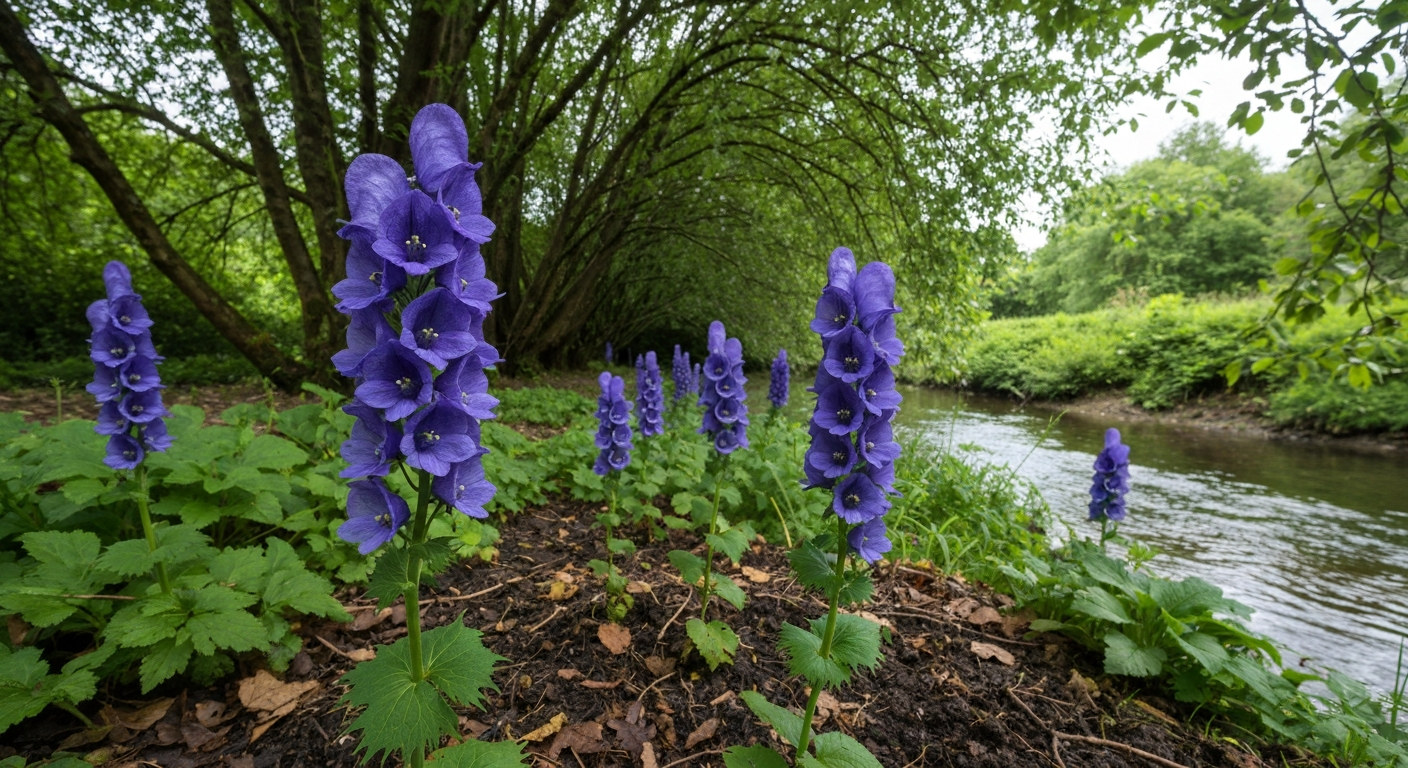
Wolfsbane (Aconitum spp.) does grow in the UK, both in the wild and in gardens, but its truly native presence is surprisingly limited. The native form, Aconitum napellus (monk's-hood), is considered Nationally Scarce in Britain, concentrated in south-west England and southern Wales, mainly on shaded riverbanks and damp woodland edges. Most plants you encounter elsewhere, in hedgerows, on waste ground, or naturalised along streams, are almost certainly garden escapes or deliberate introductions rather than true wild natives. In a garden context, the picture is much rosier: Aconitum cultivars are fully hardy across the UK and genuinely easy to grow if you give them moisture-retentive soil and a bit of shade.
Where Does Wolfsbane Grow in the UK? Guide for Gardeners
James Hartwell
4 Aug 2026
Can you grow wolfsbane in a UK garden?
Yes, and without much drama. Aconitum carries an RHS hardiness rating of H7, which means it will survive the coldest winters Britain can throw at it, including the Scottish Highlands. It is a native of cool, moist European mountain and woodland habitats, so our climate actually suits it rather well. This isn't one of those marginal tropical experiments where you're hoping for a warm winter; wolfsbane is a proper, reliable UK hardy perennial. The main caveat is that it needs moisture. It will struggle in free-draining, sandy soils in a hot south-facing spot during a dry summer, particularly in East Anglia or the south-east where summer drought is increasingly common. In the wetter north and west, Wales, the Lake District, Scotland, Cornwall, it positively thrives with minimal fuss. Even in drier areas, you can make it work with a decent mulch, some shade, and a watering regime during dry spells.
Should you actually grow it? The responsible gardener's verdict
This is where a moment of honest reflection matters. Wolfsbane is extraordinarily toxic, every part of the plant, including pollen and soil residue, contains aconitine, one of the most potent plant poisons known. Skin absorption through handling is a real risk, not just a theoretical one. Children and pets are particularly vulnerable. That said, tens of thousands of UK gardeners grow Aconitum without incident every year, and the RHS recommends several cultivars. The key is treating it with appropriate respect: always wear gloves when handling the plant (including deadheading and dividing), wash hands and tools thoroughly afterwards, and be very deliberate about where in the garden it is planted. A border where children or dogs play unsupervised is not the right spot. A shaded, cool corner of an adult-managed garden where the tall spires of violet-blue flowers can be appreciated from a slight distance? That's a different matter entirely. As for the legal position: growing Aconitum as an ornamental is perfectly lawful. What is restricted in the UK is its sale or supply as a herbal medicine, all Aconitum species appear on the government's list of banned or restricted herbal ingredients, meaning you cannot legally sell or supply them for medicinal use. Growing them in your garden as ornamentals sits well outside that restriction.
Safety basics before you start
- Always wear gloves — thick gardening gloves, not thin latex — when handling any part of the plant.
- Wash hands, forearms, and any tools that have contacted the plant thoroughly after working with it.
- Never handle wolfsbane if you have cuts or grazes on your skin; aconitine absorbs through the skin.
- Keep children and pets away from the plant; all parts are toxic if ingested and the roots can be mistaken for other plants.
- Do not compost cuttings or roots in an open heap where pets may dig. Double-bag garden waste containing Aconitum and bin it.
- Wolfsbane roots look similar to horseradish and other edible roots. Never forage any plant you cannot identify with absolute certainty.
- If someone ingests any part of the plant or experiences tingling, numbness, or nausea after handling it, call 999 or NHS 111 immediately.
- Do not grow it near vegetable beds or herb gardens where confusion with edible plants is possible.
Where does wolfsbane actually grow wild in the UK?
The wild picture for Aconitum in Britain is genuinely complex. The Botanical Society of Britain and Ireland (BSBI) treats Aconitum napellus in Britain as Nationally Scarce, probably present in fewer than 100 hectads (10km grid squares). The truly native populations are concentrated in south-west England, particularly Devon, Somerset, and parts of Gloucestershire, and in southern Wales, especially around Monmouthshire and Gwent. See the blank" rel="noopener noreferrer">Monmouthshire Rare Plant Register (BSBI / local RPR PDF) for local records and status notes on Aconitum napellus in Monmouthshire and Gwent. These are genuine relict native occurrences on shaded, damp riverbanks and woodland stream margins. Beyond those south-western strongholds, most records are now assessed as garden escapes or neophytes (plants introduced relatively recently and naturalised). Plant Atlas 2020 (BSBI) re-assesses many Aconitum napellus aggregate records as likely modern introductions and treats Aconitum napellus agg. as a neophyte for mapping and status purposes Plant Atlas 2020 — BSBI (Project introduction / status notes). The Plant Atlas 2020 project, the most comprehensive mapping of British flora in a generation, reclassifies many previously-assumed native occurrences as introductions for this reason.
A second species worth knowing is Aconitum lycoctonum (yellow wolfsbane or wolf's-bane in the strict sense), including the subspecies vulparia. This is recorded in parts of Scotland and the Borders, there are vice-county records for the Berwickshire area, and again its status as native versus introduced is often debated at the local level. In Scotland more broadly, Aconitum occasionally appears naturalised along burns and wooded ravines, but these are almost always introductions rather than wild natives. In Northern Ireland, Aconitum is not considered native at all.
The habitats wolfsbane prefers in the wild
Understanding where wolfsbane occurs naturally tells you a lot about what it wants in a garden. In its native south-western English strongholds, it grows on shaded stream and river banks where the soil stays consistently moist and cool, often under alders, willows, or mixed deciduous canopy. The soil in these sites tends to be humus-rich, slightly acidic to neutral, and never dries out. You also find it on damp meadow edges and floodplain margins where there is enough shade to prevent the soil baking dry in summer. Upland and moorland habitats are less characteristic for native British populations, though the species is more of an upland plant on the European continent. The recurring theme across all these habitats is permanent moisture combined with at least partial shade, conditions that map neatly onto the wetter, cloudier parts of the UK.
Which varieties are best for a UK garden?
The good news for gardeners is that there are plenty of excellent Aconitum cultivars that have been trialled and proven in British conditions, several carrying the RHS Award of Garden Merit (AGM). The species most commonly grown and best adapted to UK gardens include Aconitum napellus (the native monk's-hood), Aconitum carmichaelii (autumn-flowering, from China, very reliable), and the hybrid Aconitum x cammarum. The lycoctonum group (yellow-flowered wolfsbane) is less commonly grown but perfectly viable.
| Variety / Cultivar | Flower Colour | Height | Flowering Period | AGM? | Notes |
|---|---|---|---|---|---|
| Aconitum 'Bressingham Spire' | Deep violet-blue | 90–100cm | July–August | Yes | Compact, self-supporting, ideal for mixed borders |
| Aconitum × cammarum 'Bicolor' | Blue and white | 100–120cm | July–August | Yes | Striking two-tone flowers; may need light staking |
| A. carmichaelii (Arendsii Grp) 'Arendsii' | Lavender-blue | 120–150cm | September–October | Yes | Autumn-flowering; good for extending season |
| A. carmichaelii (Wilsonii Grp) 'Kelmscott' | Pale lavender-blue | 150–180cm | September–October | Yes | Very tall; needs staking; impressive in large borders |
| A. carmichaelii 'Spark's Variety' | Deep violet-blue | 120–150cm | August–September | Yes | Reliable and widely available |
| Aconitum 'Stainless Steel' | Pale steel-blue | 100–120cm | July–August | Yes | Unusual pale colour; good for white/silver schemes |
| Aconitum napellus (species) | Blue-violet | 100–150cm | June–August | No | The native/wild type; naturalises well in damp spots |
| Aconitum lycoctonum ssp. vulparia | Pale yellow | 80–120cm | June–July | No | Yellow wolfsbane; more unusual; shade-tolerant |
For most UK gardeners, the AGM cultivars are the safest bet because they have been evaluated for reliable performance in British conditions. 'Bressingham Spire' is particularly good if you want something that doesn't need staking. If you want autumn colour and interest later in the season, the carmichaelii group is hard to beat, it's a genuinely useful plant for filling that September-October gap when many perennials are already over.
Growing requirements at a glance
| Requirement | Wolfsbane Preference | Notes for UK Gardeners |
|---|---|---|
| Soil type | Clay, loam, chalk or sand tolerated | Best in deep, humus-rich loam; amend sandy or compacted soils with garden compost |
| Soil pH | Acid, neutral or alkaline (pH 5.5–7.5) | Tolerant of most UK soil pH; not very sensitive |
| Drainage | Moist but well-drained | Will not tolerate waterlogging or drought; the critical balance |
| Aspect | Full sun to partial shade | Partial shade preferred, especially in southern/drier regions; full sun only in reliably moist soils |
| Hardiness | H7 (RHS) — fully hardy | Survives the coldest UK winters including Scotland; no protection needed |
| Moisture | Consistently moist | Mulch annually to retain moisture; water during dry spells, particularly in the south-east |
| Spacing | 45–60cm apart | Allows good air circulation and prevents fungal issues |
| Light | Partial shade ideal | Dappled shade under deciduous trees mimics native habitat well |
How to plant and propagate wolfsbane: a step-by-step checklist
There are three main routes to getting wolfsbane established in your garden: buying nursery plants or plugs (the easiest), dividing established clumps, or growing from seed (the most testing). Here is how each works in practice.
From nursery plants or plugs
- Buy from a reputable UK nursery or garden centre, ideally in spring (April–May) or autumn (September–October). Wear gloves from the moment you handle the plant.
- Choose a spot with partial shade and reliably moist soil. Avoid south-facing, free-draining beds unless you can guarantee consistent watering.
- Dig in generous amounts of garden compost or leaf mould before planting to improve moisture retention.
- Plant at the same depth the plant was growing in its pot. Firm in gently and water well.
- Space plants 45–60cm apart to allow air circulation.
- Apply a 5–8cm mulch of garden compost, bark, or leaf mould around (not touching) the crown to conserve moisture.
- Water regularly through the first growing season until established.
By division of established clumps
- Divide in autumn (October–November) or late winter (February–March) when the plant is dormant. Autumn is generally preferred.
- Wear thick gloves and eye protection. Wash tools, gloves, and hands thoroughly after the job.
- Lift the entire clump carefully with a fork. The tuberous roots are brittle, so work slowly.
- Separate the clump into sections by hand or with a clean, sharp spade. Each section needs at least one visible growth bud.
- Replant divisions immediately at the same depth. Do not allow the roots to dry out.
- Water in well and mulch. Divided plants typically re-establish quickly and flower well the following season.
From seed
- Aconitum seed has complex morphophysiological dormancy and requires cold stratification to germinate reliably. Do not expect quick results.
- Sow fresh seed in autumn (September–October) into modules or small pots of gritty, moist seed compost. Fresh seed germinates more readily than stored seed.
- Place pots outside or in an unheated cold frame over winter. The natural cold period (at least 8–12 weeks below 5°C) provides the stratification needed.
- Germination typically occurs in late winter to early spring (February–April) but can be erratic — some pots may not show seedlings until the following year, so do not discard them.
- Alternatively, mix seed with damp vermiculite in a sealed bag and refrigerate at 4°C for 12 weeks before sowing into warm compost in late winter.
- Prick out seedlings carefully once large enough to handle (wearing gloves). Grow on in a sheltered spot.
- Young plants will not flower in their first year. Expect first flowering in year two or three.
- Seed-raised plants may not come true to type from named cultivars; for a specific variety, always propagate by division.
Month-by-month growing calendar
| Month | Key Tasks |
|---|---|
| January | Dormant period. Check mulch is still in place. No action needed for established plants. Cold-stratify seed in the fridge if not already done. |
| February | Late winter division is possible now. Watch for first shoots emerging from the soil. Sow stratified seed into warm compost indoors. |
| March | New growth emerges. Top-dress with a balanced granular fertiliser (or blood, fish and bone). Watch for slugs — young shoots are vulnerable. |
| April | Plants growing actively. Plant out nursery-bought plants or plugs. Keep watered during any dry spells. Apply or refresh mulch. |
| May | Rapid growth. Check for aphid colonies on new growth. Stake tall varieties (carmichaelii types) before they get too tall. |
| June | Early-flowering varieties (napellus types) begin to flower. Deadhead spent spikes promptly to encourage secondary flowering. |
| July | Main flowering season for most varieties. Water during dry spells, especially in southern/eastern gardens. Continue deadheading. |
| August | Later-flowering types (carmichaelii group) begin to bloom. Collect seed from spent flower heads if you want to sow in autumn. |
| September | Autumn-flowering carmichaelii types at their peak. Begin thinking about division of established clumps. Sow fresh seed outdoors. |
| October | Ideal time for clump division. Top growth starts to die back. Apply a generous mulch over crowns as protection and moisture retention. |
| November | Cut back dead stems to near ground level. Ensure divisions are firmed in before first hard frosts. |
| December | Plants fully dormant. No action required. The mulch is doing its job. |
Routine care: feeding, staking, mulching and winter management
Wolfsbane is not a demanding plant once established, but a few regular habits will keep it performing well year after year. In early spring, as new shoots emerge in March, apply a top-dressing of a balanced slow-release fertiliser or a handful of blood, fish and bone per plant. Aconitum does not need rich feeding, it is not a gross feeder, but a modest annual nutrient boost on poorer soils makes a difference to flower quality and stem strength.
Staking is worth considering for the taller cultivars, particularly the carmichaelii Wilsonii Group types which can reach 150–180cm. I use metal link stakes or grow-through supports inserted in April before the plants get away, which lets the stems grow up through the support naturally. 'Bressingham Spire' and other compact forms usually manage without support in a sheltered spot, but a wind-exposed garden is a different story, an August gale will flatten an unsupported carmichaelii without mercy.
Mulching is probably the single most important maintenance task for Aconitum in UK gardens, especially in the south and east. A 5–8cm layer of garden compost, bark chips, or well-rotted leaf mould applied in late April keeps the root zone cool and moist through summer. Refresh the mulch each spring. In winter, the same mulch over the crown offers a small measure of frost protection for the tuberous roots, though it is rarely necessary given the H7 rating.
Deadheading spent flower spikes encourages secondary blooming on some varieties and tidies the plant considerably. Do this wearing gloves, cutting the spent spike back to a lateral shoot or to the base. In autumn, once the top growth has died back naturally, cut stems to within a few centimetres of the ground. You can do this in October or leave it until late February, both approaches work. Leaving the dead stems over winter provides some marginal habitat value for insects.
Pests, diseases and common problems
On the whole, wolfsbane gets off fairly lightly in the pest department, the very toxins that make it dangerous to humans and animals also deter most browsing insects and mammals. That said, a few issues are worth knowing about.
- Aphids: colonies can build up on new growth in spring. A strong jet of water or an organic insecticidal soap spray deals with them. Avoid systemic insecticides on a toxic plant that you are handling regularly.
- Slugs and vine weevil: young shoots in spring are vulnerable to slug damage, particularly in wet springs in the north and west. Slug pellets (ferric phosphate type for lower ecological impact) or nematode treatments work well. Vine weevil grubs can damage the tuberous roots; if plants collapse unexpectedly in summer, check for vine weevil in the root zone.
- Powdery mildew: common on plants in dry conditions or with poor air circulation. Improving moisture levels, avoiding overhead watering and giving plants adequate spacing reduces incidence. Remove affected leaves promptly.
- Fungal stem rot: more likely in waterlogged soils. Ensure drainage is adequate and do not mulch right up against the crown.
- Verticillium wilt: a soil-borne fungal disease that can cause plant collapse. Infected plants should be removed and disposed of in the bin (not composted). Do not replant Aconitum in the same spot for several years.
Microclimate tips for trickier UK regions
In the wetter, cooler north and west of the UK, wolfsbane practically grows itself. In Wales, the Lake District, most of Scotland and the south-west peninsula, the main challenge is occasionally needing to divide clumps that become too large rather than coaxing reluctant plants to perform. In Scotland, the plant is fully hardy everywhere, H7 means it will take -20°C without complaint, so even Inverness winters are no obstacle.
The more challenging regions are the south-east and East Anglia, where drier summers and lower rainfall can stress Aconitum significantly. Here, the priority is site selection: choose a north or east-facing border, plant in the lee of a hedge or wall that provides afternoon shade, and invest in the mulch regime described above. Planting near a downpipe, water butt, or in a low-lying part of the garden that retains more moisture can make a real practical difference. If you have light, sandy soil, dig in a substantial quantity of garden compost, not just a trowelful, before planting, and repeat-mulch every single year.
In urban gardens, the heat-island effect can exacerbate summer stress for Aconitum. A north-facing city courtyard can paradoxically be a better site than an open south-facing suburban garden, because the shade and retained humidity suit the plant's preferences better. Don't assume that because you're in the city you have a warmer microclimate that benefits all plants, for wolfsbane, cooler and shadier is almost always better.
A note on related plants that people sometimes search alongside wolfsbane
Wolfsbane often gets searched alongside other plants with a reputation for toxicity, folklore, or legal complexity. Mandrake (Mandragora officinarum) is another UK-adjacent species with a similarly dramatic reputation and its own set of cultivation challenges in British gardens. Burdock (Arctium lappa) is frequently found in similar damp, scrubby UK habitats to naturalised Aconitum, and is sometimes sought out by foragers, though obviously for very different reasons. If you're wondering where does burdock grow in the UK, it's common across Britain on damp hedgerows, waste ground and riverbanks. Liberty caps, which some users search in a similar 'where does it grow in the UK' context, are a completely different category of organism (a fungus, not a plant) with very different legal implications. For readers wondering about cannabis legality and cultivation in Britain, see can you grow 1 weed plant uk. These are plants and species that reward careful research before you go looking for them or handling them.
Safer alternatives if wolfsbane feels like a risk
If the toxicity of wolfsbane makes you uneasy, and that's a completely reasonable position, especially with young children or animals in the garden, there are alternatives that deliver a similar visual effect without the same hazard level. Delphinium gives you the same tall violet-blue flower spikes and is striking in a mixed border. Salvia nemorosa and its cultivars provide deep blue-purple flower spikes in a shorter, more manageable plant. Veronicastrum virginicum 'Fascination' offers architectural spires in pale blue. None of these are entirely without any caution (delphiniums are also toxic, though less acutely so), but they are more forgiving plants to have around. If what draws you to wolfsbane is the wild-garden, native-habitat aesthetic, then planting Aconitum napellus in a managed wilder corner of a large garden, well away from children and pets, remains a legitimate and rewarding choice for the right gardener in the right situation.
FAQ
Quick answer — can I grow wolfsbane (Aconitum spp.) in the UK?
Yes — several Aconitum species and cultivars grow well in the UK and many are sold for gardens. Wild native occurrences are limited and many records are garden escapes or introductions, but cultivated forms (A. napellus, A. carmichaelii, hybrids) are hardy and suit moist, partly shaded borders. Growing is feasible if you follow strict safety precautions because all parts of the plant are highly toxic.
Where does wolfsbane occur in the wild in the UK (regional summary)?
Native or long‑established populations are scarce and localised. BSBI and Plant Atlas 2020 show most genuine native/long‑term sites concentrated in south‑west England and southern Wales (and a few vice‑counties such as parts of Monmouthshire and some Border/Scottish localities for related taxa). Many other modern records outside those areas are assessed as garden escapes or recent introductions; distribution data are best checked on the NBN Atlas and Plant Atlas 2020 maps for hectad‑level detail.
Typical wild habitats for Aconitum in Britain?
Damp, shady, humus‑rich places: stream and river banks, damp woodland edges and glades, moist meadows and floodplain soils. Plants favour cool, moisture‑retentive soils and partial shade in the wild.
Garden‑feasibility verdict for UK gardeners?
Verdict: Feasible and often straightforward for amateur gardeners in most of Britain provided you meet soil and moisture needs and accept the toxicity risks. Choose AGM‑rated cultivars or reliable nursery stock, site them in cool, moist, partly shaded borders, and follow careful handling and disposal protocols. Avoid planting where children, pets or livestock have access.
Growing requirements (concise table in text)
Soil: deep, humus‑rich, moisture‑retentive but not waterlogged. pH: tolerates acid to alkaline. Light: partial shade to dappled sun; some cultivars tolerate more sun if soil remains cool. Moisture: consistently moist; mulch to conserve moisture. Hardiness: fully hardy (RHS H7) — suits most UK zones. Propagation: seed (cold stratification) or division in autumn/late winter. Common pests/diseases: aphids, powdery mildew, fungal stem rots, Verticillium; slugs/vine weevil can be issues for young shoots. Recommended cultivars: AGM Aconitum carmichaelii groups and selected A. × cammarum/napellus cultivars for British gardens.
Step‑by‑step planting and propagation checklist
1) Choose a sheltered, partly shaded site with cool, deep soil; avoid high‑traffic areas. 2) Prepare bed: fork in plenty of compost or well‑rotted leaf mould to increase humus and moisture retention. 3) Planting stock: use nursery divisions or plug plants for quicker results; pot‑grown plants can be set out in spring or autumn. 4) Planting depth: keep crown at soil level; firm in and water well. 5) Mulch 5–8 cm with leaf mould or compost to keep roots cool. 6) Propagation by division: lift and divide clumps in autumn or late winter, replant immediately. 7) Propagation by seed: sow fresh seed autumn or stratify (4–12 weeks cold, moist), then sow in spring; expect slow/erratic germination — be patient. 8) Support tall spikes in summer if windy. 9) Cut back in late autumn; leave some seedheads if you want self‑sown seedlings but avoid uncontrolled spread.
Next Article
When do liberty caps grow UK: season, habitats & safety
When do liberty caps grow UK: seasonal windows, habitats, ID tips, legal status, safety advice, no cultivation guidance