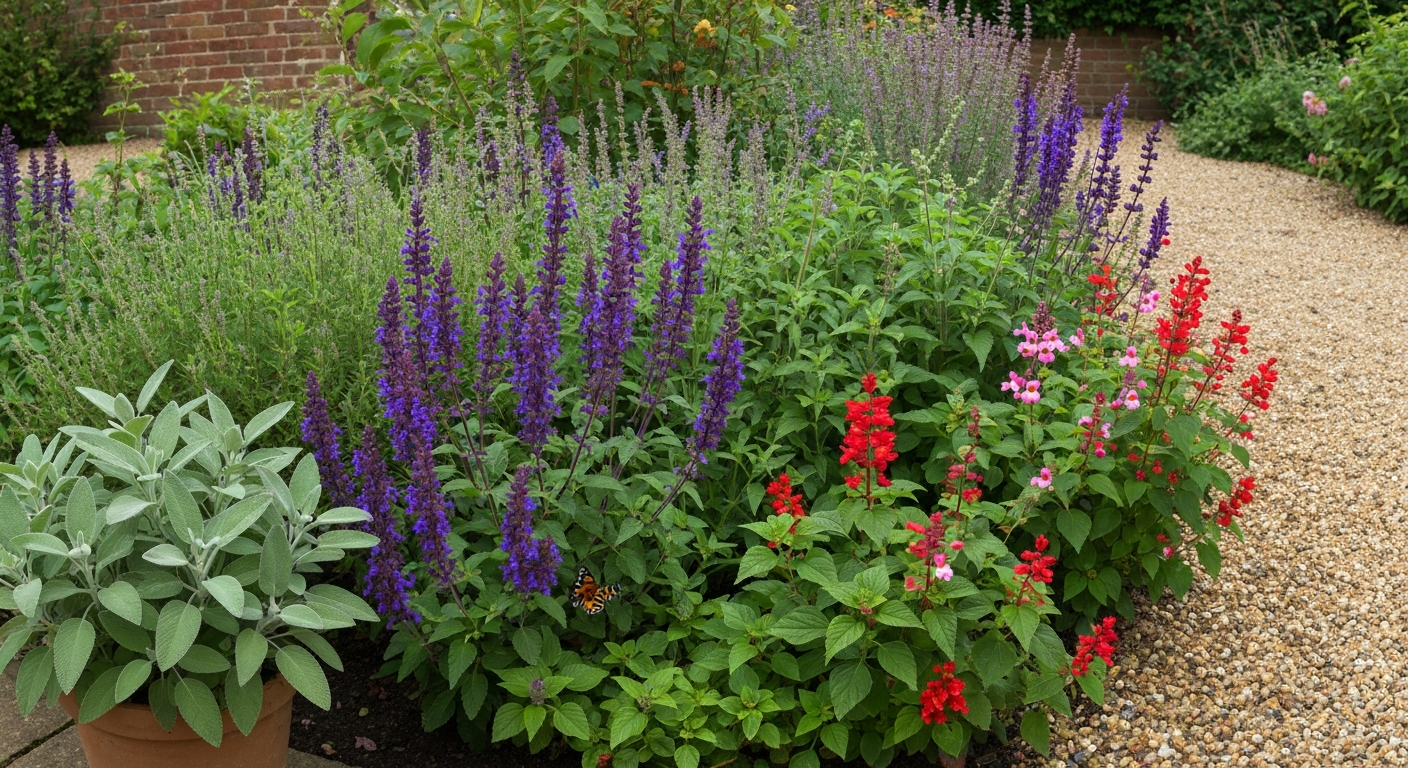
Yes, salvia absolutely grows in the UK, but which salvia and where you live makes an enormous difference. Culinary sage (Salvia officinalis) is a kitchen garden staple that most UK gardeners can grow reliably outdoors. Hardy ornamental species like Salvia nemorosa and S. pratensis are borderline bombproof in most British gardens. The trickier ones, Salvia splendens (that vivid scarlet bedding plant), Salvia hispanica (chia), and various Mexican or Andean shrubby salvias, need more careful handling depending on where you are. The good news is that with the right species choice, most UK gardeners can have salvias in bloom from late spring through to the first frosts.
Does Salvia Grow in the UK? Guide for Gardeners & Growers
James Hartwell
13 Aug 2026
Does salvia grow in the UK? What to expect by region
The UK's climate is genuinely varied, and salvias feel that variation keenly. In the south of England, along the coasts of Cornwall and Devon, and in sheltered London gardens, you can grow a far wider range of salvias outdoors than someone gardening in Northumberland or the Scottish Highlands. That said, even in colder parts of the UK, fully hardy species and cultivars will perform well year after year without any special treatment.
For a useful frame of reference, the RHS hardiness rating system runs from H1 (tender tropical) to H7 (hardy in the severest European continental climates). Most of the UK sits in the H4 to H5 range for practical purposes, but coastal sites and south-facing microclimates can comfortably extend that to H3 conditions in practice. As a rough guide: fully hardy salvias (H5-H7) will go in the ground anywhere in the UK with little fuss; semi-hardy or marginal species (H3-H4) are generally fine in England and Wales but need extra care in Scotland, the north of England, and exposed upland sites; tender types (H1-H2) need glass or container culture for overwintering almost everywhere.
- South England and coastal areas: largest range, most marginal species viable outdoors with shelter and good drainage
- Midlands and Wales: hardy and many H4 salvias fine; greggii/microphylla types benefit from wall-side planting and autumn mulch
- North England: stick to H5-H7 species for in-ground reliability; half-hardy types need cold frame or greenhouse over winter
- Scotland: fully hardy species only for in-ground planting; treat S. splendens and most shrubby Mexican types as annuals or greenhouse plants
Salvia groups explained: reliable, marginal, and tropical
The genus Salvia contains around 900 species, so lumping them all together as simply 'salvia' misses the point entirely. For practical UK purposes, I'd split them into three broad groups: the reliably hardy species you can grow anywhere in Britain, the marginal types that work well in sheltered southern gardens but need help elsewhere, and the tender or tropical types that really belong in pots or a greenhouse.
Group 1: Reliably hardy salvias
These are the ones you plant once and largely forget about, bar a tidy-up in spring. Salvia nemorosa (Balkan clary) carries an RHS hardiness rating of H7, meaning it will shrug off almost anything the UK can throw at it. Salvia pratensis (meadow clary) is equally tough at H7 and is actually native to parts of Europe, thriving in well-drained, sunny borders or even wildflower meadows. Salvia officinalis, the culinary sage most people know from the kitchen, sits around H5, hardy in most parts of the UK, though it really does sulk in cold, wet, poorly drained soils. Give it sharp drainage and a bit of shelter and you'll have it for years.
Group 2: Marginal salvias
This is where things get interesting. Salvia greggii (Texas sage or autumn sage) is rated H4 by the RHS, hardy through most of the UK in theory, but 'borderline' in the RHS's own words when sites are cold, exposed, or poorly drained. The broader greggii, microphylla and x jamensis group of shrubby Mexican salvias sits in this zone. They're spectacular plants with long flowering seasons and real drought tolerance once established, but a harsh wet winter in heavy clay soil will kill them. Shelter, grit, and a wall behind them makes all the difference.
Group 3: Tender and tropical salvias
Salvia splendens, the classic red bedding sage you see in municipal plantings, is rated H1c to H3 depending on the cultivar. Most of the UK treats it as annual bedding, bought in trays in late May, planted after the last frost, and composted in autumn. It's not worth trying to overwinter in most UK regions outdoors. Salvia hispanica (chia) is a subtropical Mexican annual that needs a long, warm season to flower and set seed, something the UK often can't reliably provide, particularly in the north. And the large-leaved Andean/tropical salvias seen in specialist collections need greenhouse culture almost everywhere in Britain.
RHS hardiness ratings and UK feasibility across regions
Understanding RHS hardiness ratings is one of the most useful things you can do before buying a salvia. Here's how the key ratings translate to real UK conditions, matched to some common species.
| RHS Rating | What it means in practice | Typical salvia examples | UK suitability |
|---|---|---|---|
| H7 | Hardy in severest European climates; frost to -20°C | S. nemorosa, S. pratensis | All UK regions, no protection needed |
| H5 | Hardy in most of the UK; frost to -10°C | S. officinalis and cultivars | Most UK regions; sharp drainage essential |
| H4 | Hardy through most of the UK; frost to -5°C | S. greggii, S. microphylla | England and Wales reliable; north/Scotland borderline, shelter needed |
| H3 | Hardy in coastal/sheltered areas; frost to -5°C | Some S. splendens cultivars, S. elegans | South and coastal UK only; elsewhere treat as annual or overwinter under glass |
| H1c–H2 | Tender; frost-free only | S. splendens (most), S. divinorum, Andean species | UK greenhouse/container only; plant out after last frost as annual |
One thing worth adding: microclimates can effectively bump a rating up by one band in practice. A sheltered south-facing wall in a Bristol garden with gritty, free-draining soil is a genuinely different environment to an open, exposed clay border in Leeds, even if both gardens are technically in H5 territory. When I've grown S. greggii against a south wall with a gravel mulch, it's sailed through winters that would have finished it in an open bed.
Realistic success likelihood for each salvia group
Culinary sage (Salvia officinalis)
High success rate across most of the UK, with one consistent caveat: it hates cold, waterlogged soil. Plant it in the sunniest spot you have, in well-drained or amended soil, and it will reliably grow, produce usable leaves, and live for several years. In my experience it's worth cutting it back hard in spring once established, as old leggy plants become woody and unproductive. Decorative cultivars like 'Purpurascens' and 'Icterina' behave similarly. Expected success rate in the south: very high. In the north on free-draining soil with shelter: still good. In exposed, heavy clay in Scotland: moderate at best.
Hardy ornamentals (S. nemorosa, S. pratensis)
These are about as worry-free as perennials get in the UK. Both species are H7-rated, tolerate a range of soils (though they prefer free-draining, moderately fertile ground in full sun), and come back reliably every year. S. nemorosa in particular has given us a wealth of excellent garden cultivars, 'Caradonna', 'May Night', 'Ostfriesland', that flower through June and July, and often again in late summer if deadheaded. Success rate: very high across all UK regions.
Salvia splendens (scarlet sage)
Completely reliable as annual summer bedding, bought as plug plants or raised from seed indoors in February-March and planted out after the last frost (usually late May in the south, early June in the north). It will flower prolifically all summer. Trying to carry it over winter in an unheated greenhouse is possible but rarely worth the effort unless you have heating, since it needs frost-free conditions and dislikes damp cold. Treat it as an annual and you'll always be satisfied. Success as a bedding annual: very high. As a perennial: low to moderate without heated glass.
Salvia hispanica (chia)
This is the tricky one. Chia is a subtropical annual from Mexico and Central America that needs a long, warm growing season to flower and produce seed. In southern England, a warm summer with an early indoor start (March under glass) can sometimes yield a harvest, but it's not a reliable crop in most of the UK. The short summer days in Britain don't favour seed production. Success for leaf growing or as an ornamental: moderate in the south. Success for seed harvest: low to moderate in the south, low elsewhere. If you're interested in growing aromatic or medicinal herbs from challenging climates, it's worth also checking whether ashwagandha is viable in the UK, another species where expectations need calibrating to British conditions.
Tropical and Andean salvias
Salvias like S. leucantha, S. confertiflora, and the large-leaved S. guaranitica types from South America are stunning plants but need either a heated greenhouse or annual bedding treatment in the UK. Some of the hardier guaranitica cultivars (like 'Black and Blue') can survive in the ground in very sheltered south-coast gardens, but don't count on it. If you enjoy pushing tropical-climate plants in the UK, you'll likely already know the challenges, similar to those covered in discussions of white sage in the UK, which requires comparable thinking about protection and microclimate. For related guidance on cultivating warm‑climate aromatic shrubs in Britain, see can you grow sandalwood in the UK. For related guidance on attempting other tropical crops in Britain, see our guide titled 'can you grow nutmeg in the UK.'.
Comparison table: hardy vs marginal vs tropical salvias
| Category | Example species | RHS rating | In-ground UK? | Overwintering | Ease of growing |
|---|---|---|---|---|---|
| Fully hardy ornamentals | S. nemorosa, S. pratensis | H7 | Yes, all regions | Leave in ground, cut back spring | Very easy |
| Culinary sage | S. officinalis | H5 | Yes, most regions | Leave in ground; avoid wet soil | Easy with good drainage |
| Marginal shrubby types | S. greggii, S. microphylla, S. x jamensis | H4 | South/sheltered only; borderline north | Mulch crowns; lift in exposed areas | Moderate — drainage and shelter key |
| Bedding/tender perennial | S. splendens | H1c–H3 | No — annual treatment only | Heated glass needed; usually treated as annual | Easy as annual, moderate as perennial |
| Chia (seed crop) | S. hispanica | H1c | No — under glass or warm south only | Annual — cannot overwinter outdoors | Challenging; short UK season |
| Tropical/Andean types | S. leucantha, S. confertiflora | H1–H2 | No — greenhouse only | Heated glass minimum | Difficult; specialist only |
Choosing the right salvia for what you actually want
For the kitchen
Go with Salvia officinalis and don't overthink it. For cooking, the straight species is perfectly good, but 'Purpurascens' (purple sage) adds ornamental value alongside the culinary use and is equally hardy. If you want a compact plant for a pot on a sunny patio, 'Evita Strong' is a good dwarf cultivar with an RHS H5 rating. All of them need the same thing: full sun, sharp drainage, and not too much feeding, rich, damp soils produce lush, flavourless leaves and shorten the plant's life.
For ornamental borders
S. nemorosa cultivars are the backbone of a reliable ornamental salvia planting. 'Caradonna' has deep violet spikes on near-black stems and reliably flowers June to July; deadhead it and you'll often get a second flush by September. 'May Night' is slightly shorter and more compact, good for smaller borders. For more informal, meadow-style planting, S. pratensis and its cultivars work beautifully with grasses and other prairie-style perennials, tolerating drier, less fertile soils well.
For drought tolerance
Once established, both S. officinalis and the greggii/microphylla group are genuinely drought-tolerant. Research into the physiology of S. officinalis confirms real adaptations to water stress, so once the root system is established in well-drained soil, these plants cope well with dry summers. That makes them a sensible choice for south-facing gravel gardens or dry, sunny slopes where other perennials struggle.
For late-season colour
The shrubby Mexican salvias, S. greggii, S. microphylla, and the hybrid S. x jamensis, are hard to beat for colour from August through to the first frosts. Varieties like 'Dyson's Joy' (pink-orange), 'Hot Lips' (white and red bicolour), and 'Stormy Pink' carry flowers well into October in sheltered gardens. Plant them in front of a south or west-facing wall, mulch the base in late autumn and they'll reward you with increasingly impressive displays each year as they bulk up. S. guaranitica 'Black and Blue' is another outstanding late-season plant in milder gardens, the deep indigo-blue flowers on tall stems are genuinely striking.
Where to source salvias in the UK
Availability is good across the board for most salvias in the UK. For hardy perennials and the best range of cultivars, Sarah Raven stocks a strong selection including 'Amistad', 'Caradonna', and jamensis hybrids, with plug plants available in spring. Crocus and Thompson and Morgan both carry good perennial salvia ranges as well as S. splendens bedding seed and plants. For more unusual cultivars of the shrubby Mexican group, specialist nurseries like Middleton Nurseries tend to carry a broader range than the big garden centres and often have better provenance information about hardiness.
For seed, Thompson and Morgan, Chiltern Seeds, and Dobies are all reliable UK sources. Salvia nemorosa and S. pratensis seed is widely available and straightforward to germinate. S. splendens seed is very widely available and easy to raise from an indoor sowing. Chia seed (S. hispanica) is available from health food retailers as well as seed suppliers, just be aware that some packs sold as 'food' chia may have lower germination rates than horticultural seed stock.
- Sarah Raven: strong range of hardy and half-hardy cultivars, plug plants in spring
- Thompson and Morgan: seeds and plants, S. splendens bedding, hardy perennials
- Chiltern Seeds: good for species seed including S. nemorosa, S. pratensis, S. hispanica
- Crocus: wide cultivar range, good plant descriptions with hardiness notes
- Middleton Nurseries: specialist shrubby salvias, good overwintering advice
- Local garden centres: reliable for common cultivars and S. splendens bedding in season
One quick note on cultivar choice: where you can, look for RHS Award of Garden Merit (AGM) varieties. These have been trialled in UK conditions and the AGM is a reasonable indicator that a cultivar genuinely performs rather than just looks good in a catalogue photo.
Planting dates and seasonal calendar for UK growers
Getting the timing right matters, especially for tender types. The UK's last frost dates vary considerably, typically mid-April in sheltered parts of the south coast and London, late April to early May for the Midlands and Wales, mid-May for much of northern England, and late May to early June in Scotland and upland areas. These estimates are based on long-term Met Office climate data rather than any single year, so treat them as probabilities rather than guarantees.
Hardy ornamentals and culinary sage (S. nemorosa, S. pratensis, S. officinalis)
Container-grown hardy salvias can go in the ground from mid-March onwards in the south, April in the Midlands and north, and April to May in Scotland. They're frost-hardy at planting size so you don't need to wait for the last frost. Divide established clumps in spring as growth resumes. Sow seed under cover in February-March for the current season's planting; seed-grown plants usually flower in their second year. Prune back hard in early to mid-spring once new shoots appear at the base, don't cut back in autumn, as the old stems provide some frost protection to the crown over winter.
Marginal shrubby salvias (S. greggii, S. microphylla, S. x jamensis)
Plant out from mid-May in the south; late May to early June in the Midlands; avoid planting out in the north until June if possible, these plants resent a late cold snap when newly planted. Take semi-ripe cuttings in late summer (August to September) as insurance. Don't deadhead heavily in autumn, the woody structure protects the crown. Mulch the crown with dry material (bark, grit, straw) in October before the first sharp frosts. In the north and Midlands, consider lifting pot-grown specimens into an unheated greenhouse or cold frame over winter, aim to keep them frost-free at around 2 to 5°C.
Salvia splendens and tender types
Sow seed indoors in late February to March at 18-21°C, germination is usually reliable within two weeks. Prick out into modules and grow on under cover, hardening off in late April to May. Plant out after the last frost risk has passed: mid to late May in the south, early June in the Midlands, mid-June in Scotland and the far north. These plants will not tolerate frost at any stage. To overwinter as a tender perennial, bring pots indoors before the first frosts in October and keep at a minimum of 7-10°C.
Salvia hispanica (chia)
For the best chance of success in the UK, start seed under glass in March at 18-21°C. Plant out into the sunniest available spot only once all frost risk has passed, no earlier than late May in the south. Even in a warm year, UK day length limits flower and seed production. In southern England, a south-facing wall or raised bed with cloches in early summer can help. In the north of England and Scotland, the odds of getting a meaningful seed harvest are low, you can grow the plant as an ornamental foliage annual, but expecting chia seeds is probably unrealistic.
Regional and microclimate notes
A south-facing wall is one of the most valuable assets you can use for marginal salvias. It captures and retains heat, creates a sheltered pocket, and keeps the base of the plant drier in winter, all three of the critical factors for overwintering shrubby Mexican species in borderline UK regions. If you don't have a south wall, a sheltered corner between two structures can achieve a similar effect. In exposed coastal gardens, the mild temperatures can actually help, but salt winds and exposure to wet gales can damage woody salvias; windbreak planting or fencing helps significantly. On heavy clay soils anywhere in the UK, raising the planting area by 15-20 cm and mixing in plenty of horticultural grit is a better investment than any other intervention you can make for marginal salvias. For another relevant comparison, see can you grow white sage in the uk.
| Task | South England | Midlands/Wales | North England | Scotland |
|---|---|---|---|---|
| Sow tender types indoors | Late Feb–early Mar | Early–mid Mar | Mid Mar | Mid–late Mar |
| Plant hardy salvias outdoors | Mid Mar | Apr | Late Apr | May |
| Plant out tender types | Mid–late May | Late May | Early Jun | Mid Jun |
| Take semi-ripe cuttings | Late Aug–Sep | Aug–Sep | Aug | Aug |
| Mulch marginal salvias | Late Oct–Nov | Oct | Sep–Oct | Sep–Oct |
| Prune hardy perennials | Early–mid Mar | Mid–late Mar | Late Mar–Apr | Apr |
FAQ
Does salvia grow in the UK at all?
Yes. Many Salvia species and cultivars grow well in the UK — from fully hardy perennial types to tender summer bedding. Success depends on picking the right species/ cultivar for your region and microclimate (soil, shelter, drainage) and following appropriate overwintering measures for marginal types.
Which Salvia species reliably succeed outdoors in most UK gardens?
Hardy species and groups that reliably succeed: Salvia nemorosa and related perennial hybrids (e.g., 'Caradonna'), Salvia pratensis (meadow sage), and Salvia officinalis (culinary sage) in well‑drained, sheltered sites. These are rated hardy by RHS for most UK regions when planted in suitable conditions.
Which salvias are marginal or need special care in the UK?
Semi‑woody/half‑hardy groups such as Salvia greggii, Salvia microphylla and many x jamensis hybrids are borderline in cold or exposed sites. They can survive in sheltered, well‑drained, sunny spots but benefit from winter protection (mulch, shelter) or lifting to containers in colder areas.
Which salvias are tender and best grown in greenhouse or as annuals?
Tropical or bedding types like Salvia splendens (scarlet sage) and many Andean/tropical salvias are tender and normally grown as bedding annuals or in containers/greenhouses in the UK. Grow them under glass or plant out only after all frost risk has passed.
How do RHS hardiness ratings map to practical UK planting advice?
Use RHS H‑ratings as a guide: H7/H6 (fully hardy) are safe in most UK gardens; H5–H4 (reasonably hardy to marginal) need good drainage and shelter in colder/exposed areas; H3–H1 (half‑hardy/tender) should be grown in pots/under glass or treated as annuals unless in very sheltered microclimates.
What soil, light and watering conditions do salvias generally prefer?
Most salvias favour full sun (minimum 6 hours), free‑draining soil and moderate fertility. Hardy perennials like slightly drier, well‑drained soils; culinary sage dislikes waterlogged heavy soils. Water young plants regularly until established; many salvias are drought‑tolerant once established and will suffer from overwatering in winter.
Next Article
Can You Grow Sandalwood in the UK? Feasibility, How-To
Can you grow sandalwood in the UK? Feasibility by region, step-by-step host, soil, propagation, timelines & legal advice