You can grow pine nut trees in the UK, but getting them to actually produce nuts you can eat is a very different matter. The honest verdict: in sheltered, mild parts of southern England and the Isles of Scilly, Pinus pinea (stone pine) and Pinus koraiensis (Korean pine) can establish well and eventually cone. For most of the UK though, you're looking at a long-term project measured in decades, not seasons, and yields will be modest at best. If your soil drains freely, you have a sheltered south-facing site, and you're patient, it's genuinely worth attempting. If you're in Scotland or the Midlands with heavy clay and exposed ground, go in with eyes open.
Can You Grow Pine Nuts in the UK? Practical Guide for Gardeners
James Hartwell
6 Aug 2026
Which pine species actually produce edible nuts?
Not all pines produce nuts worth eating. The commercially important species are Pinus pinea (Mediterranean or Italian stone pine), Pinus koraiensis (Korean pine), Pinus sibirica (Siberian pine), Pinus cembra (Swiss stone pine or Arolla pine), Pinus gerardiana (chilgoza), and the piñon pines of North America (Pinus edulis and Pinus monophylla). Of these, only a couple are realistic candidates for UK growing.
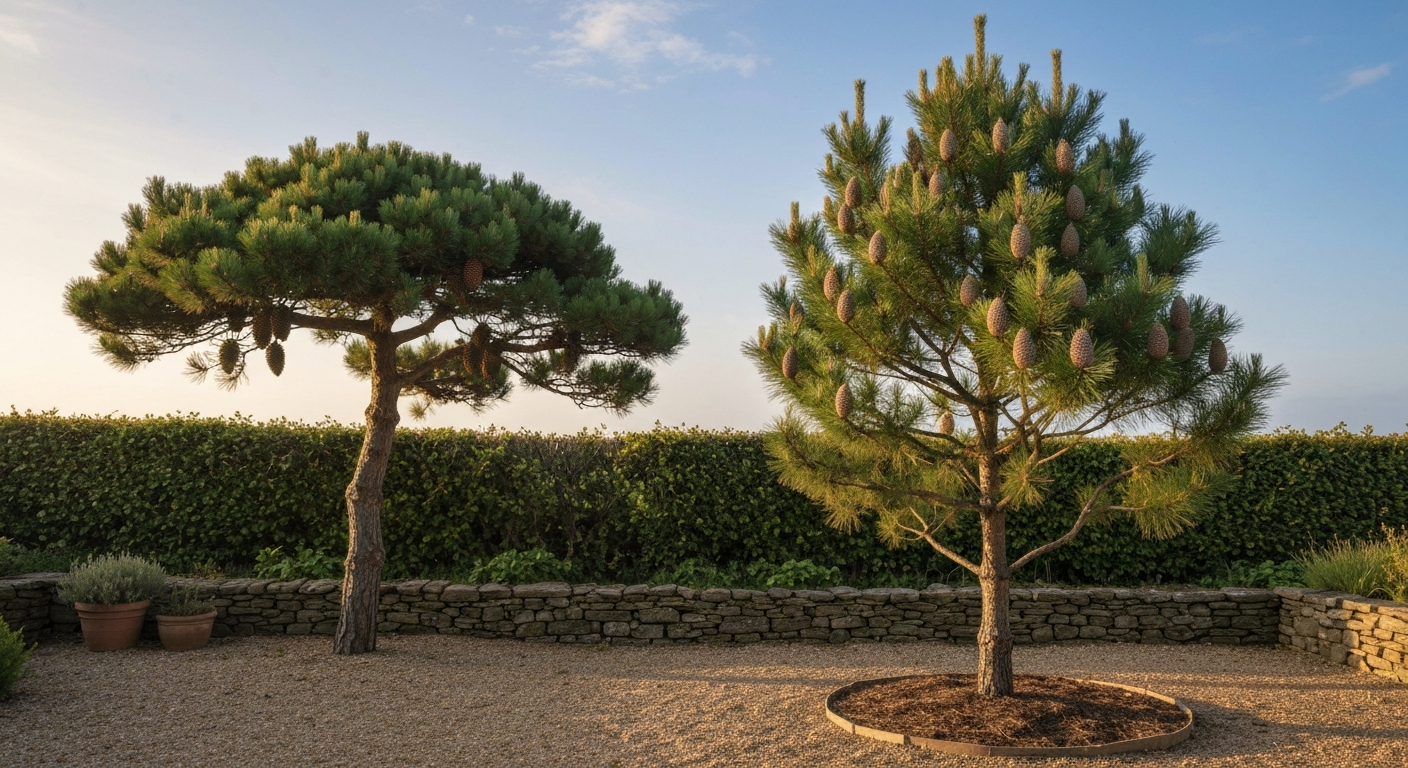
Pinus pinea is the one you see in Mediterranean landscapes with the classic umbrella canopy. Its cones can reach around 15 cm and take three years to fully ripen, and the kernels are among the largest of any commercial pine nut. It's grown at Kew, RHS Wisley and thrives at Tresco Abbey Gardens on the Isles of Scilly, which tells you a lot about its requirements: it wants warmth, sun and excellent drainage. Tresco Abbey Gardens, Gardens Illustrated (Feb 2026) documents mature Pinus pinea specimens at Tresco, confirming stone pine thrives in sheltered Scilly microclimates Tresco Abbey Gardens — Gardens Illustrated (Feb 2026). The RHS rates it as hardy across most of the UK, but 'hardy' means it survives winter, not that it'll produce cones reliably in a cool, wet summer.
Pinus koraiensis is the more interesting option for a wider range of UK sites. The RHS gives it full hardiness (H7, surviving below -20°C), and it's well represented in UK arboreta. Its seeds are triangular-ovoid, around 12 to 16 mm long, and are the major commercial pine nut of northeast Asia. The catch is time: the RHS lists its time to maturity at 20 to 50 years, and cone production in UK gardens tends to come at the later end of that range.
Pinus cembra is a beautiful cold-climate tree from the Alps and Carpathians, producing edible wingless seeds around 8 to 12 mm. It's very hardy but extremely slow-growing, with full maturity listed at over 50 years. It's more of a garden tree with eventual nut-producing potential than a practical crop. Pinus gerardiana (chilgoza) is a high-value nut in South and Central Asia but really wants hot, dry mountain conditions that the UK simply doesn't deliver. The piñon pines are North American desert species that need dry heat and are not suited to British rainfall and cloud cover. Realistically, for UK growers, the choice is between Pinus pinea and Pinus koraiensis.
| Species | Common Name | RHS Hardiness | Seed Size | Time to First Cones | UK Suitability |
|---|---|---|---|---|---|
| Pinus pinea | Stone pine / Italian stone pine | H5 (hardy in most of UK) | Large (up to 20 mm kernel) | 10–20 years | Southern England, coastal and sheltered sites |
| Pinus koraiensis | Korean pine | H7 (fully hardy, below -20°C) | 12–16 mm | 20–50 years | Most of UK with good drainage |
| Pinus cembra | Swiss stone pine / Arolla pine | H7 (fully hardy) | 8–12 mm | 50+ years | Possible but very slow; garden tree more than crop |
| Pinus sibirica | Siberian pine | H7 (fully hardy) | Similar to Korean pine | 20–40 years | Hardy but rarely trialled as UK nut crop |
| Pinus gerardiana | Chilgoza pine | H3–H4 (borderline) | Large, high value | 15–25 years | Not recommended for UK conditions |
| Pinus edulis / monophylla | Piñon pines | H4–H5 (varies) | Medium | 25+ years | Needs dry heat; poor UK performance expected |
Recommended cultivars and where to source them for UK conditions
There are no named nut-producing cultivars of Pinus pinea or Pinus koraiensis in wide UK horticultural trade the way you'd find with, say, a named apple. What matters more than cultivar name is provenance: trees or seeds sourced from northern-range populations (northern Spain, central France, or northern Italy for stone pine; or cultivated Korean pine stock rather than wild Siberian seed) tend to be better adapted to cooler, shorter seasons. When buying Pinus pinea from a UK nursery, ask whether the stock is container-grown and UK-raised. Imported bare-root Mediterranean stock planted straight into a British winter often struggles. For Korean pine, UK arboreta and specialist woodland nurseries are your best source. Avoid cheap, unlabelled conifer mixes: pine species can be mislabelled easily.
For Pinus cembra, specialist alpine and conifer nurseries carry it, and it's worth growing even if you never eat a nut from it. For smallholders genuinely interested in a nut crop rather than a garden specimen, Korean pine is the better long-term bet across a wider range of UK sites, while stone pine is the better bet if you're in a warm, sheltered southern garden and want to optimise for yield per tree.
Where in the UK is it actually feasible?
The UK is not one climate, and that matters enormously here. The Isles of Scilly and the sheltered coastal strips of south Cornwall are genuinely different from the East Midlands or Aberdeenshire. Met Office long-term averages (1991 to 2020) show that the Isles of Scilly record among the lowest frost-day counts and mildest January minima in the UK, and it's no coincidence that Tresco Abbey Gardens grows mature Pinus pinea there. South Cornwall, the Isle of Wight, sheltered parts of Devon, and the Channel coast of Hampshire and West Sussex offer the next best conditions for stone pine.
For Korean pine, the picture is more encouraging nationwide. Its full hardiness (H7) means it copes with Scottish winters, and trees are established in Scottish arboreta. However, cone and seed production depends on accumulated warmth through summer as well as winter survival, so the further north and west you go, the lower your realistic expectation of nut yield. Central and southern England give Korean pine its best chance at productive coning.
Microclimates can shift the picture significantly. A south-facing slope with a brick or stone wall behind it, protected from north and east winds by a shelterbelt, can be several degrees warmer than open ground just 50 metres away. Forestry Commission guidance on shelterbelts shows effective wind reduction extending 20 to 30 times the shelterbelt height downwind, which translates into real microclimate benefit. If you're serious about stone pine in the English Midlands or similar, building that microclimate artificially is how people make it work.
- Best for stone pine (Pinus pinea): Isles of Scilly, south and west Cornwall, coastal Devon, Channel coast of Hampshire and West Sussex, sheltered London gardens
- Best for Korean pine (Pinus koraiensis): most of England and Wales, sheltered lowland Scotland
- Marginal for both species: exposed upland England, most of Scotland, Northern Ireland (Korean pine still worth trying; stone pine not recommended)
- Microclimate boosters: south-facing walls, shelterbelt protection, frost-free hollows with good air drainage, urban heat islands
Getting the site and soil right
Drainage is the single most important factor. Both stone pine and Korean pine detest waterlogged roots, and poor drainage is consistently listed in silvicultural guides as a limiting factor for establishment and nut production. Stone pine in particular is a sandy, free-draining soil specialist: in the wild it grows on coastal dunes and rocky hillsides in southern Europe. It tolerates chalky or calcareous soils, but it will not tolerate standing water at any time of year. Korean pine is somewhat more tolerant of heavier soils but still needs reasonable drainage.
For most UK gardens with clay soil, the practical answer is to improve drainage before planting. This means either raising the planting area, incorporating grit and organic matter deeply, or choosing a naturally free-draining spot. Raised berms or mounds are a valid approach for smallholdings. Both species prefer a slightly acidic to neutral pH, broadly between 5.5 and 7.0. Stone pine tolerates higher pH than most conifers. Both species are sun-hungry: choose the most open, unshaded position available. Morning shade from trees or buildings is particularly damaging in the UK where sunshine hours are already limited.
Wind exposure is the other key variable. Young pines are vulnerable to desiccation from cold, dry winds in winter, and stone pine especially dislikes persistent Atlantic gales. A partial windbreak on the north and east sides gives significant protection without shading the tree. Avoid frost pockets (low-lying hollows where cold air collects on still nights) for stone pine, though Korean pine is robust enough to cope.
Planting: timing, spacing and first-year care
Plant container-grown pine trees in spring once the risk of hard frost has passed (late March to May for most of England and Wales), or in early autumn (September to October) when the soil is still warm enough for root establishment. Spring planting is generally safer for stone pine in marginal UK sites, giving the tree a full growing season before its first winter. Korean pine is robust enough for autumn planting across most of the UK.
For a genuine nut-producing planting, space trees at a minimum of 5 to 6 metres apart for stone pine and 4 to 5 metres for Korean pine if you're working with a small number of trees. Forest or orchard plantings would space more widely (8 to 10 metres is used in Mediterranean stone pine orchards), but home-scale growers are usually working in tighter conditions. Plant at least three to four trees to support adequate cross-pollination (more on that below).
At planting, stake the tree against wind rock for the first two years but avoid over-tight staking that prevents any trunk movement. Water well through the first summer, particularly during dry spells. Do not fertilise heavily in year one: strong shoot growth at the expense of root establishment is counterproductive. A light mulch of wood chip or gravel around the base, kept away from the trunk, helps retain moisture and suppress grass competition without impeding drainage.
Pollination and flowering: how many trees do you need?
Pines are monoecious, meaning each tree carries both male and female flowers (cones), so a single tree can technically self-pollinate. However, all the major edible pine species are predominantly outcrossing: pollen from another tree produces much better seed set than self-pollen. Wind carries pine pollen considerable distances, but research on Pinus species confirms that the majority of effective pollination happens within roughly 100 metres. An isolated specimen in a garden with no other pines nearby will set fewer, less-viable seeds than trees within a small group.
The practical recommendation for UK growers targeting nut production is to plant a minimum of three trees of the same species within close proximity, ideally within 50 metres of each other. Four to six trees give better insurance. For stone pine, cone production also depends heavily on accumulated heat in the year of pollination: UK summers simply deliver less heat than Mediterranean ones, which is another reason why yield expectations need to be scaled down from Mediterranean benchmarks.
Female cones in Pinus pinea take three full years to ripen from pollination. You'll see small developing cones well before they're ready: green first-year conelets are visible on trees in spring, but the same cones won't be harvestable until three years later. Korean pine cones mature over two years. This multi-year cycle means a late-frost event or poor summer in any one year can knock out that year's class of developing cones without affecting others at a different stage.
When to expect your first nuts, and how much you'll realistically get
I want to be straight with you here, because this is where most online guides quietly gloss over the awkward truth. Pinus pinea typically begins producing cones somewhere between 10 and 20 years after planting, and it's the shorter end of that range only in genuinely favourable conditions. In a UK garden that isn't in Cornwall or the Isles of Scilly, 15 to 20 years is a more realistic first-cone expectation. Korean pine is slower still: the RHS lists 20 to 50 years to maturity, and for a UK smallholding hoping for meaningful nut yields, 25 to 30 years before good cone production is an honest estimate. Pinus cembra, beautiful as it is, is essentially a multi-generational project.
When yields do arrive, the range from published research gives a useful frame. Korean pine in productive managed stands produces in the region of 100 to 300 kg of seeds per hectare per year, with large variation between mast years (heavy crop years) and off years. A productive individual tree can yield around 15 kg of seeds in a good year. Stone pine in Mediterranean production systems yields in the range of 170 to 320 kg per hectare of cones in productive stands, but cone-to-kernel ratios mean the actual nut yield is considerably lower. For a home-scale UK grower with a handful of trees, a realistic expectation in a good year once trees are mature is a few hundred grams to a kilogram or two of shelled nuts per tree, not every year but in the occasional mast year.
| Species | First Cones Expected | Yield per Tree (Good Year) | Yield per Hectare (Managed) | Masting Behaviour |
|---|---|---|---|---|
| Pinus pinea (stone pine) | 10–20 years (UK: 15–20 years realistically) | Variable; kernels per tree can be high in mature trees | 170–320 kg/ha cones (Mediterranean); lower in UK | Yes, strong year-to-year variation |
| Pinus koraiensis (Korean pine) | 20–50 years (UK: 25–35 years realistic) | ~15 kg seeds per tree in good years | 100–300 kg/ha seeds (managed NE Asian stands) | Yes, pronounced mast years |
| Pinus cembra (Swiss stone pine) | 50+ years | Low to moderate once mature | Not commercially trialled in UK | Yes |
Commercial pine nut growing in the UK is not viable for any of these species at present. The timescales, the climate limitations on yield, and the competition from cheap imported nuts (mainly from China and Mediterranean countries) make it economically impractical. As a home growing project, as part of a food forest, or as a long-term contribution to a smallholding's diversity, it's a different matter. If you plant Korean pines now, you or the next person to farm that land will harvest from them.
Harvesting and processing pine nuts at home
Knowing when cones are ready is the first challenge. Stone pine cones change from green to brown as they approach ripeness and will begin to open slightly when fully mature. In warmer climates, this is triggered by heat; in the UK, you may need to help the process along by bringing harvested cones indoors to a warm, dry spot. A few days in a warm shed or airing cupboard at around 30 to 40°C will cause the scales to open and the seeds to fall out. Do not leave cones on the ground: squirrels and other animals will find them first.
Once the seeds fall free, each seed still has a hard outer shell. For stone pine, this shell is harder than the thin papery wings of Korean pine seeds. Cracking them is a manual process at home scale: a rolling pin applied with moderate pressure across a clean surface will crack most without destroying the kernel inside. A proper nut cracker set to moderate pressure works well. After shelling, the kernels have a thin papery skin which is edible but slightly bitter. For culinary use, a brief dry pan-toast removes the skin and intensifies the flavour.
Pests, diseases and common reasons things go wrong
Pine trees in the UK face fewer serious pests than many fruit crops, but there are pitfalls. Red squirrels (if you're lucky enough to have them) and especially grey squirrels will strip developing cones before they're ripe. This is probably the single biggest practical obstacle to nut harvesting from garden trees, and there's no elegant solution beyond physical protection of individual cones or netting entire trees during the critical period.
Needle blight diseases, particularly Dothistroma septosporum (red band needle blight), are a real concern for some Pinus species in the UK and have caused significant damage in forestry plantations. Korean pine is listed as susceptible. Phytophthora root rots are a risk in poorly drained soils, which is another reason drainage is non-negotiable. Pine processionary moth (Thaumetopoea pityocampa) is an established and spreading pest in continental Europe but is still considered a quarantine pest in the UK; biosecurity when sourcing trees matters.
- Grey squirrels stealing developing cones: the most common cause of zero harvest from mature trees
- Waterlogging and Phytophthora root rot: usually fatal if drainage isn't sorted before planting
- Dothistroma needle blight: monitor Korean pine regularly and remove infected material promptly
- Wind rock in early years: causes poor root establishment and makes trees lean permanently
- Underestimating time to cropping: the most common expectation failure among new growers
- Planting a single isolated tree: dramatically reduces seed set due to pollen limitation
Container growing, sheltered spots and greenhouse options
Stone pine can be grown in a large container, and this is genuinely useful in marginal UK climates because it lets you move the tree to a frost-free position over winter or under glass during the coldest months. The limitation is obvious: a mature, cone-bearing stone pine is a large tree, and container growing means you're always working against root restriction. That said, if you're in the Midlands and determined to try, a large half-barrel or 100-litre pot on a sunny, sheltered patio will let you establish and maintain a small stone pine tree that might eventually produce a few cones. Use a gritty, free-draining compost mix (two parts loam-based compost to one part coarse horticultural grit) and repot every two to three years.
A cold greenhouse or polytunnel doesn't add much value for Korean pine, which is fully hardy. For stone pine, an unheated greenhouse or polytunnel in northern England provides real protection during severe winters and can extend the effective growing season, improving cone development. You would need a very large structure to accommodate a tree of any size, but overwintering young stone pines under glass for their first three to five years before planting out is a sensible approach in the north of England.
Realistic alternatives and related crops to consider
If you want edible nuts from the garden within a more reasonable timeframe, hazel (Corylus avellana) and sweet chestnut (Castanea sativa) are far more practical for most of the UK and begin cropping within five to seven years. For anyone interested in the broader question of what nuts you can grow in British conditions, there's a range of options worth exploring beyond pines. For a wider overview of nut species suited to British gardens, see Can you grow nuts in the UK Can you grow nuts in the UK?.
The sibling topics in this series are worth reading alongside this one. Peanuts (often called monkey nuts) are a genuinely interesting warm-season annual crop that can be trialled in southern England with some success in a good summer. Tiger nuts (the tubers of Cyperus esculentus, not a true nut) are easier to grow and faster to produce than any pine species. For practical growing advice, see the guide “Can you grow tiger nuts in the UK” (afc46873-b2e0-439d-838f-2a10f186219a). Niger seed, from Guizotia abyssinica, is another unusual crop question that comes up for UK growers interested in edible and wildlife-supporting plants. None of these are the same effort level as a 20-year pine project.
If the appeal of pine nuts specifically is the culinary flavour and you want to grow your own, I'd suggest planting two or three Korean pines now as a long-term project, enjoying them as landscape trees in the meantime, and supplementing with faster nut crops in the short and medium term. It's the most honest way to approach it: you might be harvesting pine nuts from those Korean pines in 25 to 30 years, and that's worth doing, but it's not a replacement for more immediate edible crops.
FAQ
Can you grow pine nuts in the UK?
Yes — but with important caveats. Several pine species that produce edible pine nuts will grow in parts of the UK; success depends on species choice, site and patience. In sheltered, mild coastal and southern microclimates (e.g. Isles of Scilly, south Cornwall, sheltered coastal Kent/Devon) and well‑sited inland warm/sheltered spots you can establish nut‑bearing pines. Expect long juvenility (years to first cones) and variable yields; large‑scale commercial production is unlikely without grouping trees, very favourable sites and decades of management.
Which pine species produce edible pine nuts and which are realistic choices for the UK?
Species that produce edible nuts: Pinus pinea (Italian/stone pine), Pinus koraiensis (Korean pine), Pinus cembra (Swiss stone pine), Pinus gerardiana (chilgoza), Pinus sibirica (Siberian pine), and several piñon pines (P. edulis, P. monophylla). Realistic UK choices: - Pinus pinea: most commonly planted in British gardens; does best in mild, sheltered, well‑drained sites (south/coast). - Pinus koraiensis: hardy and grown in UK arboreta; a good candidate where winters are cold but not extreme. - Pinus cembra: very cold‑tolerant but slow; possible in cooler UK uplands but slow to fruit. Chilgoza and Siberian pine are more specialist — possible in cooler sheltered sites but may need precise conditions and long timescales.
Where in the UK is it feasible to get usable pine‑nut crops?
Most feasible: sheltered, mild southern and southwestern coastal locations (Isles of Scilly, south Cornwall, southern Devon, sheltered south/coast Kent), sheltered south‑facing slopes, walled gardens and areas with maritime moderation and few late frosts. Possible but slower/less reliable: more temperate inland gardens with good shelter and well‑drained soils. Unlikely or very slow: exposed uplands, high frost‑risk areas and much of northern Scotland unless using extremely hardy species and accepting very long waits.
What site and soil conditions do nut‑producing pines need?
They prefer full sun and very free‑draining soils; many tolerate poor, sandy or calcareous soils. Avoid waterlogged or heavy clay soils. Stone pine particularly likes sandy/rocky, well‑drained sites and tolerates chalky soils. Good drainage, a warm sunny aspect and shelter from prevailing cold winds will significantly improve growth and cone set.
How long until the trees produce harvestable pine nuts and what yields can I expect?
Expect long lead times. Many nut pines take 7–20 years to begin producing cones, with full productive maturity often decades (10–50+ years depending on species). Several species (e.g. Pinus pinea) have multi‑year cone maturation cycles (commonly 2–3 years). Yields are highly variable and mast‑driven: home trees may give only a few hundred grams to a kilogram in early years; commercial, well‑managed stands in ideal climates produce substantially more (tens of kg per tree or 100s kg/ha in Mediterranean or East Asian production), but such figures are unlikely in UK gardens.
How many trees and pollination arrangements are needed?
Most pine species are monoecious and wind‑pollinated and are primarily outcrossing. Small plantings may be pollen‑limited; planting multiple trees (at least 2–3 of the same species, preferably several) increases seed set. Windborne pollen can travel but reliable pollination improves with nearby pollen sources (neighbouring mature pines or a small stand). Spacing depends on species but allow mature crown spread when planting.
Next Article
Will niger seed grow in the UK? Feasibility, sowing & harvest guide
Will niger seed grow in the UK? Clear yes/no, sowing, care, harvest, pests, yields and alternatives for UK gardeners.