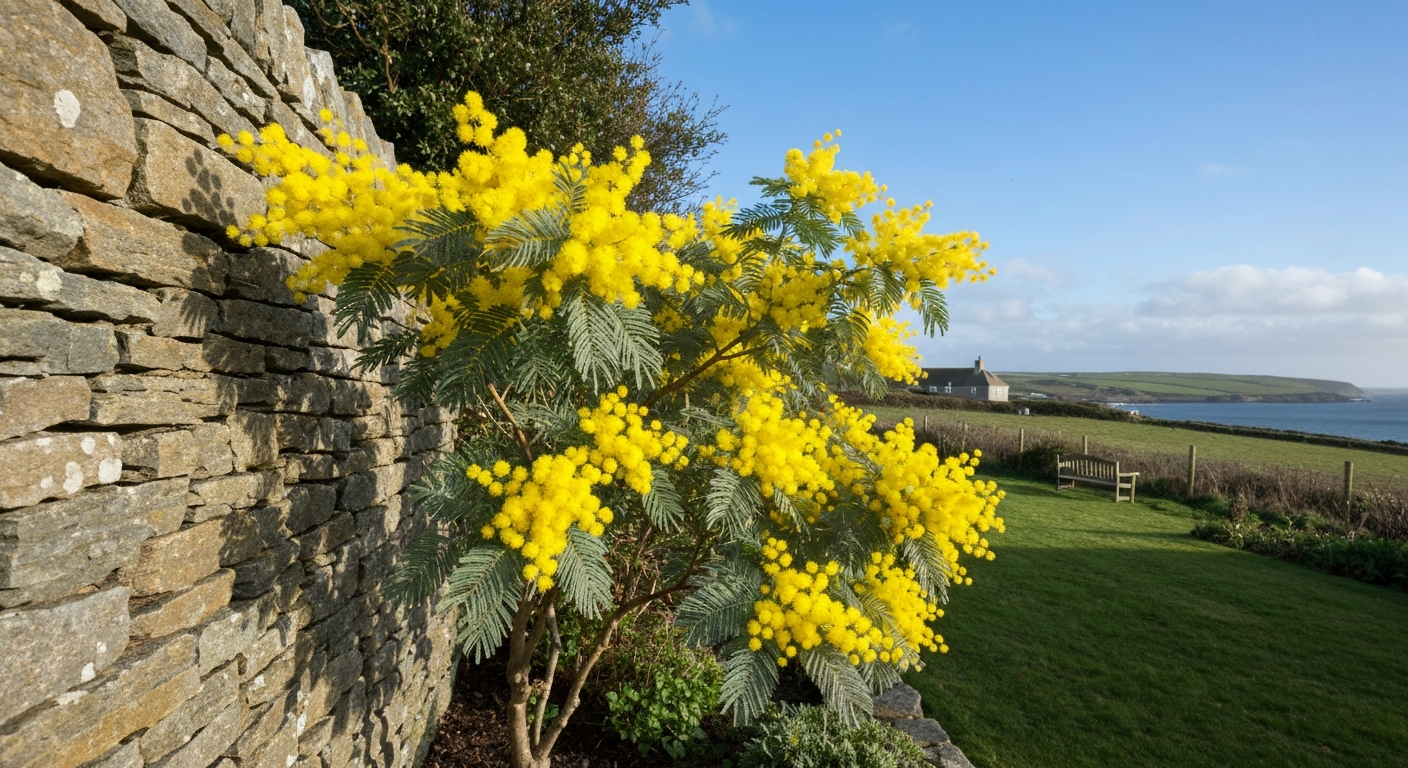
Yes, a mimosa tree can grow in the UK, but only in the right places and with the right species. If you're in Cornwall, the Isles of Scilly, coastal South Wales, or a sheltered urban spot in the South East, you have a genuine shot. Push further north or inland, and you're fighting the climate rather than working with it. The honest answer is: it's conditional, and which 'mimosa' you're planting matters enormously.
Will mimosa tree grow in UK? Practical guide, regions, care & protection

James Hartwell
15 Jul 2026
Which 'mimosa' do we actually mean?
This is where a lot of confusion starts. 'Mimosa' is a common name attached to at least two quite different trees in UK horticulture, and mixing them up will lead you to the wrong care advice and wrong expectations. The name also technically belongs to a separate genus entirely (Mimosa pudica, the touch-me-not plant), which is something else again.
The tree most UK gardeners picture when they say 'mimosa' is Acacia dealbata, the silver wattle. It's the one sold in florists every February, covered in tiny pompom-like yellow flowers. Kew's Plants of the World Online accepts this name, and the RHS lists it under both 'mimosa' and 'silver wattle' on its plant profile. It's native to south-eastern Australia and Tasmania, grows fast, and can reach 10 to 15 metres in mild UK spots given enough time.
The second tree is Albizia julibrissin, the Persian silk tree (sometimes called the pink silk tree). It has feathery, fern-like leaves similar to Acacia dealbata and produces fluffy pink flowers in summer. The RHS lists it simply as 'silk tree'. Historically it was classified as Acacia julibrissin, which is why the naming confusion persists. It's native to a broad band from Iran to China, and it's actually the hardier of the two in UK conditions.
Acacia dealbata vs Albizia julibrissin: the key differences
These two trees look vaguely similar in photos and share a common name in casual use, but they behave quite differently in a UK garden. Here's a direct comparison across the factors that matter most for UK growing.
| Feature | Acacia dealbata (silver wattle / mimosa) | Albizia julibrissin (silk tree) |
|---|---|---|
| Flower colour | Bright yellow, fragrant pompoms | Pale pink, silky tufts |
| Flowering season (UK) | Late winter to early spring (Feb–Apr) | Midsummer (July–Aug) |
| Foliage | Silver-grey, bipinnate, evergreen | Mid-green, bipinnate, deciduous |
| Mature height | 10–15 m (in mild UK sites) | 6–10 m |
| RHS hardiness rating | H3 (−5 to +1 °C) | H4 (−10 to −5 °C) |
| Soil preference | Well-drained loam or sand, neutral to acid | Well-drained chalk, loam or sand, acid to alkaline |
| UK regional fit | Coastal South West, Isles of Scilly, sheltered South | Most of England and Wales (sheltered sites) |
| Winter foliage risk | Evergreen leaves scorch or die in hard frosts | Drops leaves; dormant wood is more cold-tolerant |
The practical upshot: if you're in a genuinely mild spot and want those iconic yellow winter flowers, go for Acacia dealbata and accept the risk. If you're anywhere else in England or Wales and want a mimosa-style tree that's more likely to survive a cold snap, Albizia julibrissin is the safer bet. It's deciduous, so it loses its leaves but the dormant wood copes with temperatures down to around −10 °C, which covers most UK winters outside Scotland.
Climate, temperature and hardiness: what these trees actually need
The RHS hardiness scale runs from H1 (needs a heated greenhouse) to H7 (fully UK-hardy). Acacia dealbata sits at H3, which means it's rated for coastal and relatively mild parts of the UK, tolerating minimum temperatures of roughly −5 to +1 °C. The Australian National Botanic Gardens suggests it can cope with frosts down to about −7 °C in sheltered cultivation, which gives a little extra buffer, but that's the extreme edge. Any prolonged spell below −5 °C is likely to cause serious damage or kill the plant outright, especially if the soil freezes around the roots.
Albizia julibrissin is rated H4 by the RHS, meaning it's considered hardy through most of the UK, tolerating −10 to −5 °C. That's a significant step up in cold tolerance. It still wants a sheltered, sunny spot and doesn't like waterlogged winter soils, but it won't die every time a cold front comes through. The RHS specifies south- or west-facing sheltered positions for reliable performance.
Both trees need full sun and excellent drainage. Sitting in wet, heavy clay through a UK winter is a death sentence for either species, regardless of temperature. Acacia dealbata wants a neutral to slightly acid pH; Albizia is more forgiving and will tolerate chalky soils. Neither likes exposed, wind-swept sites. The wind strips moisture from evergreen Acacia leaves faster than roots can replace it in cold weather, causing 'wind scorch' that looks like frost damage but is actually desiccation.
Microclimates make a huge difference here. A south-facing walled garden in London or Bristol traps heat and raises night-time minimum temperatures, sometimes by several degrees compared to an open field nearby. That's not speculation: studies of urban canyon geometry confirm this effect. A degree or two of extra warmth on a cold January night can be the difference between a living and a dead Acacia dealbata.
Hardiness by species and UK region
| UK Region | Acacia dealbata (H3) | Albizia julibrissin (H4) |
|---|---|---|
| Isles of Scilly | Excellent — thrives outdoors year-round | Excellent — well within tolerance |
| Cornwall and Devon coast | Good in sheltered spots; some winter risk | Very good with a sunny, sheltered site |
| South Wales coast | Marginal — possible with wall protection | Good in sheltered, south-facing gardens |
| South East England (coastal) | Possible in walled/urban sites | Good — most sheltered gardens work |
| London (urban / walled) | Possible — urban heat island helps | Good — reliably hardy in most years |
| Midlands | High risk — most winters too cold | Marginal — cold winters cause dieback |
| North of England | Not recommended outdoors | Risky — needs exceptional shelter |
| Scotland | Not viable outdoors | Generally not recommended |
Regional suitability: where does it realistically work?
The Isles of Scilly are the gold standard for marginal exotics in the UK. Tresco Abbey Garden has grown subtropical and Mediterranean trees outdoors for over a century thanks to the Gulf Stream's influence, with Met Office data for St Mary's showing mean winter minimums that rarely drop below zero and almost no air-frost days in many months. The Met Office regional climate summary for Southern England documents markedly fewer frost days and milder winter minima on southern/coastal England than the UK interior, supporting RHS guidance that H3-rated plants are likely to survive in coastal/mild southern sites but not widely inland blank" rel="noopener noreferrer">Southern England: climate (Met Office regional climate summary). If you've ever been puzzled by photos of exotic trees growing in the UK without any protection, they were probably taken in Scilly.
Beyond Scilly, the best odds for Acacia dealbata are in Cornwall and coastal Devon, sheltered coastal gardens in South Wales, and walled or urban gardens in the South East. The further inland you go, the harder it gets. Average UK inland winters regularly push below −5 °C, which is the borderline for this species.
For Albizia julibrissin, the picture is better. Most of England south of the Midlands is plausible, and some sheltered spots in the North of England might work if you're willing to protect young plants. Scotland is a different story: even Albizia struggles when temperatures regularly hit −10 °C or below, and Scottish winters frequently do exactly that.
Quick regional checklist
- Isles of Scilly: both species, outdoors, no major protection needed
- Cornwall and coastal Devon: Acacia dealbata in sheltered spots; Albizia julibrissin widely suitable
- South Wales coast and Channel Islands: Acacia possible with south-facing wall; Albizia reliable
- South East England and London: Acacia in sheltered walled/urban gardens; Albizia generally fine
- Midlands and East Anglia: Acacia not worth attempting outdoors; Albizia marginal in best-case microclimates
- North of England: Acacia not viable; Albizia risky without substantial shelter
- Scotland: neither species reliably hardy outdoors; container-growing only
What to expect: flowering, growth and winter survival
Acacia dealbata is a fast grower. In a good year in a mild UK garden it can put on a metre or more of growth, and it will flower in its late winter window (February to April in UK conditions) once established, typically after two to three years. The flowers are fragrant, bright yellow, and genuinely spectacular. The catch is that a hard frost in February, right when buds are opening, can wipe out the flowers or tip-kill new growth. You can get years of brilliant flowering followed by a single harsh winter that sets the plant back by a couple of seasons.
Albizia julibrissin grows more moderately, reaching around 6 to 10 metres at maturity. It flowers in midsummer (July and August in the UK), which is actually an advantage: by the time it blooms, temperatures are warm enough to support reliable flowering. It needs a long, warm summer to flower well, though, and in a cooler northern UK summer it may produce sparse or no flowers. It goes fully deciduous in autumn and the bare branches look pretty stark through winter, but that dormancy is what protects it from cold damage.
Winter survival for both comes down to two things: drainage and shelter. A plant sat in waterlogged soil during a cold snap is far more likely to die than one in free-draining ground. The roots of Acacia dealbata are particularly sensitive to this combination. If you're gardening on heavy clay, you need to either improve it significantly or not bother with these trees.
How to plant a mimosa tree in the UK
Planting and soil
Good drainage is non-negotiable. If your soil holds water after rain, dig in grit or horticultural sand to improve the structure, or raise the planting area slightly. For Acacia dealbata, aim for a neutral to slightly acid pH (6.0 to 7.0). Albizia is more flexible and copes with chalky soils too. Avoid heavy clay without serious amendment. Neither tree needs rich, fertile soil: lean, well-drained ground actually encourages better root development and reduces the soft growth that is most vulnerable to frost.
- Do improve drainage in heavy soils before planting — dig in grit or coarse sand to at least 40 cm depth
- Do check soil pH with a basic test kit; adjust if needed before planting
- Do mulch around the base after planting to retain moisture and insulate roots
- Don't plant in a frost pocket or low-lying area where cold air settles
- Don't add high-nitrogen fertiliser — it promotes soft, frost-tender growth
- Don't plant in waterlogged ground under any circumstances
Siting tips
The single best thing you can do for either species in the UK is find the warmest, most sheltered spot in your garden. South- or south-west-facing walls are ideal: the masonry absorbs heat during the day and releases it overnight, raising the microclimate temperature by a few degrees. RHS Advice (Climbers: Training and Pruning) highlights planting against warm walls, using mulches and providing wind shelter or sheltered aspects to improve microclimates for marginal species RHS Advice recommends south‑ or west‑facing sheltered positions and using walls, mulches and wind shelter to improve microclimates for tender plants.. This is especially important for Acacia dealbata. Avoid exposed north- or east-facing sites where cold continental winds can cause desiccation damage on top of frost damage. If you're in an urban area, the urban heat island effect genuinely helps: city-centre gardens in London or Bristol record significantly fewer hard-frost nights than surrounding rural areas.
- Plant against a south- or south-west-facing wall or fence wherever possible
- Choose a site sheltered from north and east winds
- Urban walled gardens offer the best combination of warmth and shelter
- Avoid frost pockets, valley bottoms, or exposed hilltop sites
- Full sun is essential — at least 6 hours of direct sun daily in summer
Best planting windows
Plant in late spring once soil temperatures have risen and the risk of late frosts has passed, May to early June is ideal for most of the UK. This gives the tree a full growing season to establish its root system before its first UK winter. Autumn planting is sometimes recommended for trees generally, but for marginally hardy species like these, giving them a cold, wet winter before they've established is a real risk. If you're buying container-grown stock (which is the norm), keep it in a sheltered spot and harden it off for a few weeks before planting out.
- Choose your warmest, most sheltered spot and check drainage thoroughly before buying the tree
- Dig a hole at least twice the width of the root ball and to the same depth
- Improve drainage by forking in coarse grit if needed, especially on clay soils
- Tease out any circling roots gently and position the tree so the root flare sits at soil level
- Backfill with the original soil mixed with a little horticultural grit; firm in well without compacting
- Water thoroughly after planting and apply a 5 to 8 cm mulch of bark or gravel around the base, keeping it away from the stem
- Stake young trees in exposed sites for the first two seasons to prevent root rock
- Water regularly through the first summer — establishment drought stress weakens cold-hardiness going into winter
Winter protection and ongoing care
For Acacia dealbata in borderline locations, a few simple measures can make the difference between survival and loss. Before the first frosts, wrap the stem and lower branches loosely in horticultural fleece and heap a thick (10 to 15 cm) mulch of bark chips or straw around the root zone. This doesn't keep the top growth warm enough to survive a serious freeze, but it insulates the roots and the base of the stem, which is often the critical point. If the top growth is killed by frost but the roots survive, Acacia dealbata will often regrow from the base in spring.
Albizia julibrissin needs less fuss once established. A deep mulch over winter roots is still worthwhile, especially for young plants in their first two winters. After that, a healthy established specimen in a good site should be fine in most English winters without wrapping. If a very cold spell is forecast, a fleece jacket over younger plants as a temporary measure is quick and effective.
Pruning is best done after flowering (spring, after the Acacia has flowered, or late summer for Albizia). Avoid heavy pruning going into autumn: it stimulates soft new growth that is vulnerable to frost. Remove frost-damaged wood in spring once you can clearly see which wood is dead and which is recovering, new growth emerges from surprising places after a cold winter.
Container growing: a viable option for colder regions
If you're north of the Midlands, containers are the only realistic route to growing either species. For guidance on keeping small trees outdoors in Britain, see our piece on can bonsai trees grow outside in the UK. Both can be grown in large pots (at least 45 to 60 cm diameter), overwintered in a cool but frost-free greenhouse or conservatory, and brought outside for the warmer months. Acacia dealbata actually performs well this way, and the February flowers in a cold greenhouse are genuinely impressive. The downside is that container-grown specimens grow much more slowly and won't reach the dramatic proportions of an outdoor tree, but you'll get the leaves and flowers.
Use a loam-based compost (John Innes No. 3) mixed with extra grit for drainage, and feed sparingly during summer with a low-nitrogen, high-potassium fertiliser. Don't let containers sit in standing water. Repot every two to three years as roots fill the container. Moving these trees in and out each season is genuinely labour-intensive once they get large, so be realistic about how long you can manage it.
Troubleshooting common problems
- Frost damage (brown, crispy foliage): don't panic and don't prune immediately — wait until April or May to assess what has actually died, as new growth can emerge from the base or from apparently dead wood
- Failure to flower (Acacia dealbata): usually caused by a cold late winter killing flower buds just as they open, or by insufficient sun during the growing season — improve siting before giving up
- Failure to flower (Albizia julibrissin): most often due to insufficient summer heat — this tree needs warm summers to bloom reliably, which is why it performs better in the South East than the North
- Yellowing leaves: often overwatering or waterlogged soil — check drainage and reduce watering frequency
- Root rot: almost always caused by poorly drained soil in wet winters — this is fatal, and prevention (drainage improvement before planting) is the only cure
- Psyllid insects on Acacia: tiny sap-sucking insects cause leaf distortion on Acacia dealbata; treat with a suitable insecticide or tolerate minor infestations — healthy plants usually outgrow the damage
- Legginess and weak growth: often caused by insufficient sun or by planting in too rich a soil — move to a sunnier spot if possible, or cut back hard in spring to encourage bushy regrowth
Hardier alternatives if your site is too cold
If you're in the Midlands or further north and the cold statistics above have put you off, there are alternatives that give a similar feathery, exotic look without the frost anxiety. Gleditsia triacanthos (honey locust) and Robinia pseudoacacia (false acacia) both have similar bipinnate foliage and are genuinely UK-hardy. Robinia produces fragrant white flowers in early summer that give a faint nod to the mimosa aesthetic. Neither will give you that exact yellow-pompom-in-February moment, but they'll still be alive next spring.
It's also worth knowing that the question of which exotic or unusual trees can genuinely succeed in UK conditions is broader than just mimosa. For another example of a marginal exotic, see our guide on growing redwood trees in the UK for advice on suitability, siting and care. For a related question about very different exotics, see can baobab trees grow in the UK for guidance on their suitability and requirements. Questions about other challenging species, like whether baobab trees or balsa trees can survive UK winters, come up a lot, and the answers follow similar logic: species-specific hardiness ratings, regional climate, microclimate quality, and soil conditions all feed into the same decision framework.
Should you try it? A decision checklist
Before spending money on a mimosa tree, work through these questions honestly. The more 'yes' answers you get, the better your odds.
- Are you in Cornwall, the Isles of Scilly, coastal South Wales, or a sheltered part of the South East or South West? (For Acacia dealbata: essential. For Albizia julibrissin: most of England and Wales is workable.)
- Do you have a south- or south-west-facing wall or sheltered walled area to plant against?
- Is your soil free-draining, or are you willing to improve drainage before planting?
- Can you guarantee at least 6 hours of direct sun daily in summer?
- Are you prepared to apply winter fleece and root mulch in colder years?
- If growing in a container, can you realistically move the pot to frost-free shelter each winter?
- Are you choosing Albizia julibrissin if you're outside the warmest UK regions, rather than Acacia dealbata?
If you're ticking most of those boxes, a mimosa tree is a genuinely achievable goal in the UK, and a well-sited specimen in full late-winter flower is one of the most dramatic things you can grow in a British garden. If several of those are 'no', save yourself the heartbreak and either grow it in a container or try one of the hardier lookalikes instead. That's not giving up; it's just gardening with the climate rather than against it.
FAQ
Quick answer — Will a mimosa tree grow in the UK?
Conditional. ‘Mimosa’ in UK gardening usually means Acacia dealbata (silver wattle) or sometimes Albizia julibrissin (silk tree). Acacia dealbata is marginally hardy (RHS H3) and will reliably grow only in the mildest coastal/sheltered parts of the UK (Isles of Scilly, parts of Cornwall, warm coastal Sussex/Kent, very sheltered urban sites). Albizia julibrissin is slightly hardier (RHS H4) and can succeed across much of southern and some central England in a sheltered, sunny spot, but both need good siting and winter protection in colder areas.
Which species are people referring to as ‘mimosa’ and why does it matter?
Common-name confusion: ‘‘Mimosa’ can mean different trees. In UK horticulture Acacia dealbata is commonly sold as ‘mimosa’ or ‘silver wattle’ and has very mild‑winter requirements. Albizia julibrissin is often called ‘silk tree’ (historical synonyms include Acacia julibrissin) and is somewhat hardier. Knowing which species you have matters because hardiness, flowering time and frost tolerance differ.
What are the key climate and hardiness needs?
Acacia dealbata: RHS hardiness H3 (approx −5 to +1 °C). Likes full sun, well‑drained soil, sheltered, frost‑free or very mild winter sites; flowers late winter–early spring if winter minima are mild. Albizia julibrissin: RHS hardiness H4 (approx −10 to −5 °C). Prefers full sun, well‑drained soil, a sheltered, south/west facing position; tolerates colder UK winters than A. dealbata but young growth can be damaged by late frosts.
Practical map: hardiness vs UK regions (simple table)
Hardiness | Typical UK suitability Acacia dealbata (H3) | Isles of Scilly, very mild Cornish coasts, sheltered parts of SW England, coastal SE England microclimates, sheltered urban walls Albizia julibrissin (H4) | Much of southern England (coastal and inland sheltered spots), some parts of central England in warm sheltered sites; less reliable in northern/Scottish inland areas Notes: microclimate matters more than county lines — sheltered south/west walls, urban heat‑islands and coastal exposure extend the viable area.
What realistic expectations should I have for flowering and survival?
Acacia dealbata: may flower well (bright yellow, late winter–early spring) in mild coastal sites; in cooler sites it may suffer winter dieback and fail to flower. Albizia julibrissin: can flower reliably in southern/sheltered sites from mid‑ to late summer; frost can damage shoots and reduce flowering the following year. Neither species is truly evergreen in cold winters and both can suffer top dieback after hard frosts.
Actionable one‑page care plan (planting to pruning)
Site: full sun, very sheltered (south/west aspect preferred), well‑drained soil. Planting: plant in spring or autumn in a large hole with organic matter; avoid waterlogged spots. Watering: establish with regular watering first 2 years; drought tolerant once established. Feeding: light spring feed (balanced fertiliser or compost). Pruning: minimal—remove dead/damaged wood after frosts; shape after flowering for A. dealbata (late spring) and in late winter/early spring for A. julibrissin. Mulch: winter mulch to protect roots. Protection: use fleece/temporary shelters for A. dealbata in marginal years; for potted specimens move to frost‑free shed.
Next Article
Can Baobab Trees Grow in the UK? Indoor Guide to Success
Can baobab trees grow in the UK? Learn indoor greenhouse care, soil, light, watering, winter dormancy, and success steps