Most acers in the UK start pushing their first leaves somewhere between late March and early May, depending on which species you have, where in the country you are, and what the winter just handed you. State of the UK Climate 2023 (Met Office / International Journal of Climatology), air/ground frost statistics & regional variation notes that The Met Office / State‑of‑UK‑Climate reporting shows large spatial variation in frost occurrence across the UK (1991–2020 climatologies): annual average days of air frost range from <10 days in warm Cornwall areas to >100 days on Scottish high ground; overall air/ground frosts have declined in recent decades but late spring frosts remain possible regionally State of the UK Climate 2023 (Met Office / International Journal of Climatology) — air/ground frost statistics & regional variation. In the warmest parts of southern England, field maple (Acer campestre) and Norway maple (A. platanoides) can show green tips as early as late March in a mild year. In northern England or Scotland, the same trees might not stir until mid-to-late April, and on exposed upland ground you can still be waiting in early May. Japanese maples (A. palmatum) tend to be a touch later than the native and European species, which is actually a blessing given the UK's habit of throwing a sharp frost at you right when you least expect it.
When Do Acers Grow Leaves in the UK? Timetable & Care Guide

Why timing matters more than you might think
Knowing when your acer is likely to leaf out is not just a bit of trivia for plant nerds. It has real, practical consequences for how you manage the tree through spring. First, budburst timing dictates when new growth is exposed to late frost. Freshly opened leaves and expanding buds are far more vulnerable to cold than dormant tissue, and even a light frost around 0 to -2°C can scorch tender new foliage. A hard late frost at -4 to -5°C can strip an entire tree brown overnight. Second, the budburst window is when root activity and nutrient demand ramp up sharply, so it tells you when to start watering and feeding in earnest. Third, if you need to do any light corrective pruning, late winter (before buds swell) is the safer window. Miss it, and you are cutting into active growth and potentially stressing the tree at its most energetic moment. Finally, if you are buying and planting a new acer, knowing regional budburst timing helps you plan hardening-off and establishment without gambling against a frost.
First leaves by UK region: a quick reference
These ranges are based on long-term phenology records, including the Woodland Trust's Nature's Calendar dataset (which has been tracking budburst for species including field maple and sycamore since 2000), combined with Met Office regional climate data. They cover a typical year. In an unusually warm spring, add a week or two earlier; in a cold, late spring, add a week or two later.
| Region | Typical first-leaf window | Notes |
|---|---|---|
| South England and sheltered coastal sites | Late March to mid-April | Urban heat island sites (London, Bristol) often hit the earlier end |
| Midlands and East Anglia | Early to mid-April | More continental-style springs; late cold snaps not unusual |
| North England | Mid to late April | Yorkshire Dales, Pennines; exposed gardens towards the later end |
| Scotland (lowland) | Late April to early May | Glasgow and Edinburgh urban sites slightly earlier than rural |
| Scotland (upland and Highland) | Early to mid-May | Frost risk extends well into May on high ground |
| Coastal (mild SW: Cornwall, Devon, Pembrokeshire) | Mid-March to early April | Atlantic influence suppresses hard frosts; earliest in UK |
Which acers leaf out first? Early vs mid vs late species
Not all acers move at the same pace. The native and naturalised European species tend to break bud earlier than the ornamental Asian ones, which is useful to know because it affects frost risk very differently. Japanese maples are prized partly because their later leafing often sidesteps the worst of March frosts, though a sharp April frost can still catch them. Here is a rough ranking for UK conditions.
| Species | Common name | Relative leafing order | Typical UK first-leaf month |
|---|---|---|---|
| Acer platanoides | Norway maple | Early | Late March to mid-April |
| Acer campestre | Field maple | Early to mid | Late March to mid-April |
| Acer pseudoplatanus | Sycamore | Mid | April to early May |
| Acer saccharinum | Silver maple | Mid | Early to mid-April |
| Acer rubrum | Red maple | Mid | Early to mid-April |
| Acer palmatum | Japanese maple | Mid to late | Mid-April to early May |
| Acer japonicum | Full moon maple | Mid to late | Mid-April to early May |
| Acer griseum | Paperbark maple | Late | Late April to mid-May |
| Acer shirasawanum 'Aureum' | Golden full moon maple | Late | Late April to mid-May |
Sycamore (A. pseudoplatanus) budburst is reported as occurring around April to May at monitoring sites including the BIFoR FACE woodland site in Staffordshire, which matches what Nature's Calendar citizen-science records show across the wider UK. Norway maple consistently leads the pack in gardens I have watched. Japanese maples, especially the laciniatum (dissectum) group, tend to be the last to move and the most cautious about it, which is a trait worth appreciating.
The biology behind budburst: why your acer is not just waiting for sunshine
Acers do not simply wake up when it gets warm. The timing of budburst is controlled by a sequence of environmental cues that the tree uses to avoid leafing out too early and getting caught by a late frost. Understanding this sequence takes a lot of the mystery out of why some years your acer surprises you with an early flush, and other years it sits there looking stubbornly dormant well into April.
Chilling: the winter debt that must be paid
Before any spring warmth can trigger budburst, the tree needs to have accumulated sufficient cold exposure over autumn and winter. This is called the chilling requirement, and it is essentially the tree's mechanism for confirming that winter has genuinely passed. Temperatures between roughly 0 and 7°C are most effective at accumulating chill units. In a normal UK winter, most common acers meet their chilling requirement comfortably by January or February. The important implication is that if winters become progressively milder (and the Met Office data confirms air frosts have declined in recent decades across the UK), incomplete chilling can increase the heat required to trigger budburst, making timing less predictable rather than simply earlier.
Temperature forcing: the heat that pulls the trigger
Once dormancy is released through chilling, the tree starts accumulating warmth. This is measured as growing degree-days (GDD), which is simply the sum of daily mean temperatures above a base threshold (commonly 5°C for temperate trees). Research on sycamore (A. pseudoplatanus) puts the thermal-time requirement to budburst at around 342 degree-days (base 5°C), though this varies with how much chilling was received and the precise model used. The practical takeaway: temperature forcing is the dominant driver of when your acer will leaf out in any given spring.
Photoperiod: the fine-tuning signal
Daylength plays a secondary but real role. Experimental work on A. pseudoplatanus specifically shows that bud swelling responds to both temperature and photoperiod, with daylength influencing the onset and duration of swelling while temperature controls the rate of growth once swelling is underway. Photoperiod acts as a safety catch in some species, preventing a premature response to a warm January spell when days are still short. Its importance varies by species, which is partly why the early-leafing Norway maple (less photoperiod-constrained) can race ahead of Japanese maples in a warm March.
How to predict your own acer's budburst using degree-days
You do not need a science lab to use degree-days in the garden. The maths is simple and the results are genuinely useful. Here is a practical rule of thumb for UK gardeners.
- Start counting on 1 February (a reasonable proxy for when chilling requirements are broadly satisfied for most UK acers in a typical winter).
- Each day, note the mean air temperature (max + min divided by 2). Subtract 5°C. If the result is negative, record zero. If positive, record that number.
- Add each day's value to a running total. This is your accumulated growing degree-days (GDD) above a 5°C base.
- For sycamore (A. pseudoplatanus), first green tips typically appear around 300 to 380 GDD (base 5°C) from 1 February. Use 342 as your working target.
- For Norway maple and field maple, expect budburst slightly earlier, roughly 250 to 320 GDD from 1 February in most years.
- For Japanese maple (A. palmatum), expect budburst later, around 380 to 450+ GDD, especially in cooler northern gardens.
- When your running total approaches the species target, start monitoring daily for bud swell.
This is a practical approximation, not a precise model. A warm March can compress the timeline significantly compared with a cold, grey one. But tracking GDD gives you a way to compare seasons and build your own local record over time, which becomes more valuable than any general published figure.
Microclimate: why your neighbour's acer might be two weeks ahead of yours
Garden-scale variation in budburst timing is real and can be striking. Research published in the Proceedings of the Royal Society B found that light pollution alone was associated with earlier tree budburst across the UK, with urban trees responding to artificial light as well as warmth. Light pollution is associated with earlier tree budburst across the United Kingdom (Proc. R. Soc. B, 2016) Light pollution is associated with earlier tree budburst across the United Kingdom (Proc. R. Soc. B, 2016).. Beyond that, a south-facing wall or a sheltered corner behind a hedge creates its own mini warmth trap that can advance budburst by days to weeks compared with an open, north-facing or frost-hollow position. Conversely, a low-lying garden where cold air pools on still, clear nights can experience hard frosts even when temperatures nearby stay above zero, and this delays and exposes newly leafing acers to more frost risk.
- South-facing walls and fences: reflect heat, reduce frost exposure, advance budburst by up to 1 to 2 weeks
- Urban gardens (heat island effect): consistently earlier than rural sites at similar latitude
- Frost pockets (hollows, valley bottoms, walled enclosures with no drainage): cold air pooling delays leafing and increases late-frost damage risk
- Exposed coastal sites: Atlantic influence moderates temperature extremes; mild SW coastal gardens are the earliest in the UK
- Canopy shelter from taller trees: acers planted in dappled shade warm up more slowly in spring, slightly delaying budburst
- Heavy, cold, wet clay soils: slow to warm, slightly delaying root and shoot activity versus free-draining soils
What to look for: reading the buds before the leaves arrive
Being able to recognise the stages of budburst lets you time your care actions properly, spot frost damage early, and track your degree-day predictions against what the tree is actually doing. There are no images here, but these descriptions are specific enough that you will recognise each stage once you start looking.
- Stage 1, bud swell: The bud changes shape from a hard, tight, pointed form to a visibly rounder, fatter profile. The bud scales (the small overlapping protective leaves) are still closed but no longer pressed tight. The bud feels slightly softer to a gentle touch. This is the first visible sign that forcing temperatures are accumulating.
- Stage 2, bud scale separation: The scales begin to separate at the tip. A thin line of lighter tissue is visible between scales. At this point the bud is already more frost-vulnerable than in full dormancy.
- Stage 3, green tip: The first flash of green tissue is visible at the bud tip, either as a tiny point of leaf or as a swollen green mass between parting scales. This is the classic 'green tip' that phenologists record as budburst. From here to open leaf can be as fast as 3 to 5 days in warm weather.
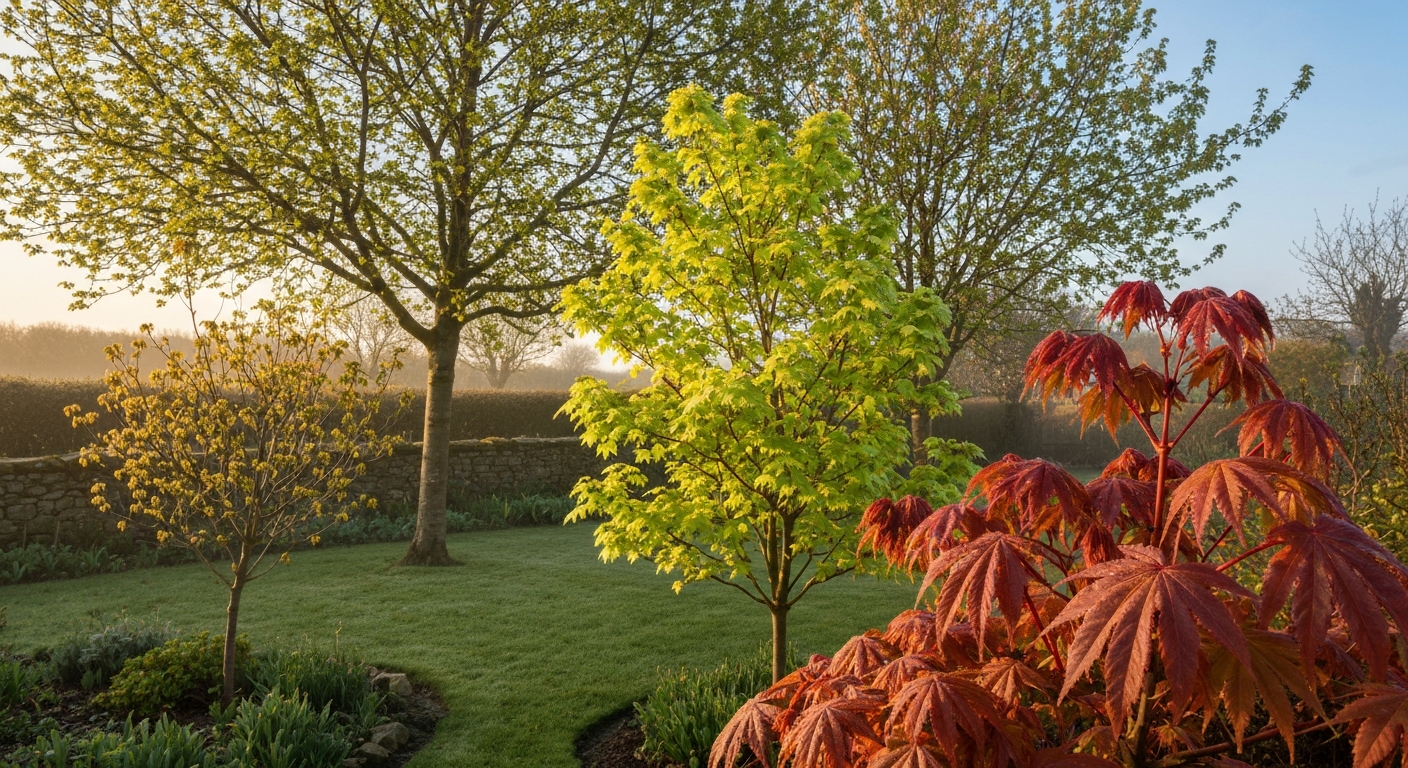
- Stage 4, leaf emergence: Folded leaves begin to push out from the bud. In Japanese maples these emerge tightly folded and often have a distinctive reddish or coppery tint before greening up. In Norway maple and field maple, the leaves emerge more quickly and are often already pale lime-green at emergence.
- Stage 5, leaf expansion: Leaves flatten and expand to full size. This is when photosynthesis really kicks in and nutrient demand peaks. Frost damage at this stage appears as brown or black scorching on leaf margins or the entire lamina within 24 to 48 hours of a frost event.
Tracking budburst in your garden: degree-day logs and useful tools
The simplest tracking system is a notebook and a min-max thermometer (or a cheap digital weather station). Record daily max and min temperatures from 1 February, calculate the mean, subtract 5, add to your running total if positive. Note the date against each budburst stage when you observe it. After two or three seasons, you will have a personalised picture of your site that is more useful than any regional average.
If you want a digital approach, the Woodland Trust's Nature's Calendar recording platform is the most directly relevant UK tool. It lets you record first-leaf and budburst events for named species, and your data feeds into the long-term national phenology record. For temperature data, the Met Office Weather Observations Website (WOW) has crowdsourced station data down to garden level across the UK. The Gardeners' World app has a basic planting-calendar function, though it does not do GDD calculations. For a proper degree-day accumulator, the Royal Horticultural Society's website and AHDB (Agriculture and Horticulture Development Board) publish degree-day tools aimed at UK growers that you can adapt for tree phenology.
Detailed regional timetable with degree-day cues
| Region / site type | Typical first-leaf months | Approximate GDD to budburst (base 5°C from 1 Feb) | Key notes |
|---|---|---|---|
| South England and warm urban sites | Late March to mid-April | 250–350 GDD by late March to mid-April | London urban gardens often lead; SW coastal gardens earliest nationally |
| Central England and East Anglia | Early to mid-April | 300–380 GDD typically reached in April | More continental springs; cold easterlies can delay despite calendar date |
| North England (Yorkshire, Lancashire, NE) | Mid to late April | 350–420 GDD; heat accumulates more slowly | Pennine and upland sites towards later end; valley bottoms variable |
| Lowland Scotland (Glasgow, Edinburgh, Fife) | Late April to early May | 380–440 GDD; often not reached until late April | Urban sites 5–10 days earlier than rural equivalents |
| Upland and Highland Scotland | Early to mid-May | 440–500+ GDD; may not be reached until May | Frost risk extends into late May; later species only recommended |
To read this table: find your broad region, then track your GDD accumulation from 1 February using local temperature data. When your running total approaches the GDD range shown, start daily bud monitoring. The calendar month range tells you roughly when that GDD threshold tends to be reached in a typical year. In an early spring (warm February or March), GDD accumulates faster and the calendar date comes earlier; in a late spring, the reverse.
Species and variety timing: what to expect from your specific acer
Acer palmatum (Japanese maple)
Japanese maples are mid-to-late leafers, which is one of the reasons they are so popular in UK gardens despite not being native. Most cultivars in southern England will show green tips in mid-to-late April, with full leaf expansion by early May. In the north, expect late April to mid-May. Early cultivars include 'Osakazuki' and 'Bloodgood', which tend to move a few days ahead of the species average. Later and more cautious cultivars include the dissectum (laciniatum) group, whose finely cut leaves emerge later and expand slowly. These are among the most frost-cautious acers you can grow, but once frost does hit open leaves, the fine lobes show damage very visibly.
Acer campestre (field maple)
Field maple is the only acer native to England, and it is reliably early. Expect first leaves in late March to mid-April across southern England, and April to early May in the north. It is one of the hardier hedgerow trees in the UK and copes well with a wide range of soils. The Woodland Trust's Nature's Calendar has some of the longest budburst records for this species in the UK, making it one of the best-documented acers for phenological tracking.
Acer pseudoplatanus (sycamore)
Sycamore leafs out in mid-April in the south, late April to early May further north and at elevation. It is extremely hardy and tolerates coastal exposure and high ground better than most acers. Its GDD threshold to budburst is around 342 degree-days (base 5°C) from 1 February in research models. It is often unfairly maligned as a weed tree, but in a large garden or hedgerow context it is genuinely tough and fast-growing.
Acer platanoides (Norway maple)
One of the earliest acers to leaf out in the UK. In southern England, late March is realistic in a warm spring. It produces flowers before or alongside first leaves, which is a useful identification clue. The yellow-green flowers appear as the buds break and are visible even before the leaves expand. Hardy throughout the UK including most of Scotland.
Acer rubrum and Acer saccharinum (red and silver maple)
Both are North American species that perform reasonably well in UK conditions. Red maple (A. rubrum) is valued for its very early spring flowers (often before leaves), while silver maple (A. saccharinum) leafs out in early to mid-April across most of England. Both are hardy to at least -20°C and cause few establishment problems in UK gardens, though silver maple has brittle wood and does not suit exposed sites.
Acer griseum (paperbark maple)
A late leafer and a slower grower, paperbark maple typically does not push first leaves until late April to mid-May. This caution is useful in frost-prone gardens. It is genuinely hardy across the UK but performs best in a sheltered spot with well-drained soil.
Late-frost risk: when your acer is at its most vulnerable
Late frosts are the single biggest threat to acers at budburst, and the UK's climate is reliably unreliable on this front. Met Office data (1991-2020 climatology) shows annual air frost days ranging from fewer than 10 in mild coastal Cornwall to over 100 on Scottish high ground. Even with the overall decline in frost frequency in recent decades, late spring frosts remain a genuine risk across most of the UK. A frost in late April or early May, when many acers are at peak leaf expansion, can cause severe cosmetic damage or, in young or newly planted trees, real setback.
Newly opened leaves and expanding buds are far more frost-sensitive than dormant tissue. Light frosts around 0 to -2°C can scorch tender new foliage; temperatures of -4 to -5°C during leaf expansion can kill leaves outright, turning them brown or black within 24 to 48 hours. The risk is highest just after green-tip stage, when the protective bud scales have fully parted but the leaf is not yet hardened off.
| Region | Approximate last air frost (average year) | Late frost risk at budburst time |
|---|---|---|
| Cornwall and mild SW coastal | March / early April | Low: budburst and last frost often coincide but rarely serious |
| South and SE England | Mid-April | Moderate: April frosts possible and can catch early leafers |
| Midlands and East Anglia | Late April | Moderate to high: cold easterlies extend risk into May in some years |
| North England | Late April to mid-May | High: coincides closely with peak budburst period |
| Lowland Scotland | Mid to late May | High: late May frosts are not unusual; coincides with Japanese maple leafing |
| Upland Scotland and high ground | May or later | Very high: protect or choose very hardy, late-leafing species only |
Practical frost protection: what actually works
You do not need expensive kit to protect acers from late frosts. The key is acting quickly when a sharp night is forecast, because the damage window is narrow. RHS guidance is clear that two layers of horticultural fleece give roughly 2°C of protection compared with a single layer, which is often enough to make the difference between cosmetic damage and none at all. Here is a practical checklist.
- Monitor forecasts from late March onwards: look for nights with clear skies and low wind, which are the classic setup for radiation frost regardless of the daytime temperature
- Use horticultural fleece (two layers for temperatures forecast below -1°C): drape loosely over the canopy of smaller trees and secure at the base to trap warmth; remove in the morning to avoid heat buildup
- For pot-grown Japanese maples: move pots against a house wall or into an unheated greenhouse or shed on frost nights; terracotta pots lose heat faster than glazed or plastic ones, so wrap the pot itself in bubble wrap or hessian through cold spells
- Water the soil around the base of the tree the evening before a frost: moist soil retains heat better than dry soil and releases it through the night, raising air temperature slightly at ground level
- Cold frames and cloches work for very small or young trees: position them to cover the canopy without crushing new growth
- If you are siting a new Japanese maple, avoid frost pockets: plant against a sheltered wall or behind a hedge that breaks cold air flow without trapping it
- Do not fertilise with high-nitrogen feed just before or during a frost-risk window: lush, sappy growth is more frost-susceptible than steady, hardened growth
- After a frost event: do not prune frost-damaged leaves immediately; wait 2 to 4 weeks to assess what is dead versus what will recover; many acers push new growth from below damaged tissue
What to do the moment your acer starts leafing out
Budburst is the signal to shift gear in your acer care. Here is a practical to-do checklist for the week buds break and the fortnight following.
- Watering: start regular watering if soil is dry, especially for pot-grown trees; the root system is now actively pulling moisture and drought stress at this stage sets back the whole season's growth
- Feeding: apply a balanced, slow-release granular fertiliser (e.g. fish, blood and bone or a specialist ericaceous slow-release feed for Japanese maples) around the root zone now; avoid high-nitrogen liquid feeds that push soft, vulnerable growth
- Mulching: apply a 5 to 8 cm layer of composted bark or garden compost around the base, keeping it clear of the trunk; this retains moisture, suppresses weeds, and moderates soil temperature fluctuations during the unpredictable weeks of spring
- Pruning: if you missed the late-winter window, do not prune now; wait until the tree is in full leaf and you can clearly see any dead, crossing or damaged wood; light corrective pruning in summer (after June) is lower risk than cutting into active early growth
- Frost monitoring: keep fleece accessible for at least 4 to 6 weeks after first leaf in the north and midlands, 3 to 4 weeks in the south
- Check for pests: aphids and scale insects begin moving in spring; inspect the undersides of new leaves and the base of buds; a strong jet of water removes most infestations without chemicals
- Avoid disturbance: do not attempt to transplant or repot at full budburst unless absolutely necessary; if repotting a container acer, the ideal time is just before bud swell, not after
Monitoring after first leaf: how long to keep watching
First leaf is not the end of the vulnerable period, it is roughly the middle of it. Keep a close eye on your trees for at least 3 to 6 weeks after first green tips, because this is when frost risk and growth demand both peak simultaneously. For gardeners in the north and Scotland, this watch period extends into late May in most years. Once leaves are fully expanded and have been out for 2 to 3 weeks, they begin to harden off and become progressively more resilient. Remove fleece and other coverings once consistent overnight temperatures stay reliably above 2°C in your area and daytime temperatures are consistently above 10°C.
Record-keeping pays off significantly with acers. Note down the date of first green tip each year, the GDD accumulated by that date, and any frost damage events. Even a simple spreadsheet or paper notebook entry of 'GDD at budburst / frost damage yes/no / new growth recovered' gives you a three- or four-year picture that is genuinely predictive for your specific site and species.
Your acer budburst cheat-sheets
1. Predicting budburst
- From 1 February, record daily max and min temperature
- Calculate daily mean: (max + min) / 2
- Subtract 5°C base; record as 0 if negative
- Add to running GDD total
- Target: ~300 GDD for Norway/field maple, ~342 GDD for sycamore, ~400+ GDD for Japanese maple
- When within 20 GDD of target, begin daily bud checks
2. Protecting against late frost
- Check overnight forecast daily from late March through May (north: through late May)
- On frost-risk nights: drape two layers of fleece, water soil base, move pots to sheltered spot
- Remove coverings each morning to prevent overheating
- Do not feed with high-nitrogen fertiliser before frost risk has passed
- After frost: wait 2 to 4 weeks before assessing and pruning damaged tissue
3. Budbreak care
- Start regular watering as buds break, especially pot-grown trees
- Apply slow-release balanced fertiliser around root zone
- Mulch 5 to 8 cm deep, keeping clear of trunk
- Postpone pruning until full leaf or summer
- Inspect new growth for aphids and scale
- Keep frost protection to hand for 4 to 6 weeks post-budburst
Further reading and next steps
Acers are among the most reliably growable ornamental trees across virtually all UK regions, including Scotland and northern England, which is more than can be said for many trees that get equal attention in gardening media. If you are exploring other trees with trickier UK climate feasibility, it is worth considering how British conditions compare for species like acacia, which does grow in milder parts but faces hard limits in the north, or carob, which is marginal at best. For details on whether acacia trees grow in the UK, see do acacia trees grow in UK. Do carob trees grow in the UK? The short answer is that carob is marginal in Britain, it can succeed in the warmest, most sheltered sites in southern England but is unreliable elsewhere. For the specific case of warm‑climate fruit trees, see can date trees grow in the UK for guidance on feasibility and site requirements. Hickory is another one worth checking if you are interested in nut-producing hardwoods for UK conditions. If you want more on that, see does hickory grow in the UK for suitability and site advice. For acers specifically, the practical next steps are to identify your species or cultivar, establish your region's typical last-frost date, and start tracking GDD from next February. Two or three seasons of your own records will tell you more about your specific garden than any generalised guide. For readers curious about other climate-sensitive plants, see our guide Can coca leaves grow in the UK.
Quick answers to common questions
Can acers grow in the UK? Yes, and most common species grow very well here. Field maple is native to England. Sycamore is naturalised and thrives without any assistance across the whole country. Japanese maples are reliable garden plants throughout most of the UK with basic frost protection in the north. Even the more ornamental species like paperbark maple and full moon maple are genuinely hardy in British conditions.
When should you prune acers in the UK? Late winter, before buds swell, is the preferred window. For Japanese maples specifically, mid-summer (June to July) is also acceptable and some growers prefer it because the tree is in full active growth and wounds heal quickly. Avoid pruning in autumn or at budburst.
How do you reduce frost damage to acers? Site choice is the biggest factor. Avoid frost pockets, plant in a sheltered position, and for Japanese maples consider growing in containers so they can be moved on frost nights. Two layers of horticultural fleece give around 2°C of protection on sharp nights and are the most practical intervention for established garden trees.
Are some acer varieties hardier than others? Yes. Field maple and sycamore are the toughest, tolerating upland UK sites with ease. Norway maple is also very hardy. Japanese maples vary by cultivar: upright forms are generally hardier than the finely dissected (laciniatum) cultivars, which are more vulnerable to frost scorch on new growth even though the plants themselves survive cold winters without problem. Acer griseum and Acer palmatum 'Sango-kaku' (coral bark maple) are considered among the more reliably hardy ornamental forms for northern UK gardens.
FAQ
When do acers (maples) typically grow leaves in the UK?
Most Acers in the UK break bud and produce first leaves between March and May. Exact timing depends on species/variety, region (warmer south & urban areas earlier; high ground & Scotland later), and year-to-year weather. Long-term UK citizen-science records (Nature’s Calendar) and monitoring (Met Office summaries, BIFoR reports) show a broad March–May window with interspecific and regional variation.
How do species differ (which Acers are early vs late leafing)?
Common examples: Early: Acer campestre (field maple) often March–April; A. palmatum (some Japanese maple cultivars) commonly late March–April in sheltered sites. Mid: A. pseudoplatanus (sycamore) typically April–May. Later: larger/leathery-leafed or upland varieties and some A. saccharum cultivars can be late April–May. Cultivar differences are important—some A. palmatum cultivars leaf earlier or later than others. Use variety-specific notes for exact timing.
How do UK regions typically differ (quick regional month ranges)?
Regional quick guide: South & lowland England: broadly late March–early April to mid April. Midlands & Wales: early April to mid/late April. Northern England & lowland Scotland: mid/April to late April/early May. Upland Scotland, high ground & exposed sites: late April to May. Urban/sheltered microclimates can advance these ranges by days–weeks.
What environmental cues trigger budburst and leaf growth?
Three main cues: 1) Winter chilling (accumulated cold) — releases endodormancy and reduces subsequent heat requirement. 2) Temperature forcing (accumulated warm days / growing degree days) — primary proximate driver for bud swelling and burst. 3) Photoperiod (daylength) — species-dependent modifier that can restrict too-early leafing and fine-tune sensitivity to warmth.
Can you give practical degree‑day (GDD) guidance to predict Acer budburst?
Thermal-time (GDD) estimates vary by species and base temperature. Published examples: A. pseudoplatanus ~340 GDD (base 5°C) to budburst; other Acer spp. reported between ~300–450 GDD depending on base temp and study. Rule of thumb for gardeners: after a typically chilled winter, expect budburst once you accumulate a few hundred degree-day units above about 0–5°C; warmer winters may increase the heat requirement. Use local GDD calculators or apps and choose a base temp (commonly 0–5°C) and species-appropriate threshold.
How do microclimate and site factors change timing?
Microclimate effects (urban heat island, south-facing walls, shelter from wind, canopy position) can advance budburst by days to weeks. Frost hollows, north aspects and exposed upland sites delay leafing. Light pollution and sheltered planting sites are associated with earlier budburst in UK studies. Always adjust predictions for your specific garden location.
Do Acacia Trees Grow in the UK? Conditions and How-To
Yes, but only in sheltered, sunny spots or pots. Learn UK conditions, planting steps, winter care, and common failure fi