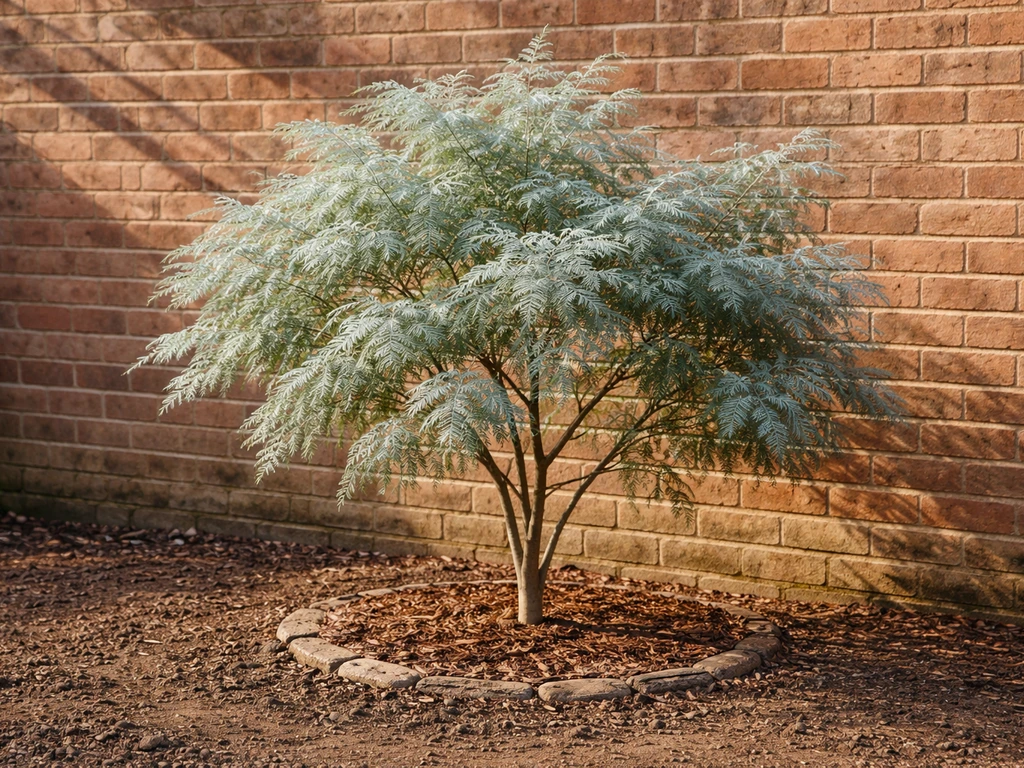
Yes, acacia trees can grow in the UK, but only some of them, only in certain places, and with a fair bit of help. If you're in the mild South West, a sheltered coastal garden, or a well-protected spot in southern England, you can grow Acacia dealbata (the silver wattle, also sold as mimosa) outdoors and even get it to flower reliably.
Do Acacia Trees Grow in the UK? Conditions and How-To
James Hartwell
9 Jul 2026
Anywhere colder or more exposed, you're looking at container culture with winter protection, or accepting that you might lose it in a hard winter. It's not a tree you can just plant and forget about in most of the UK. Whether carob trees can thrive outdoors in the UK depends heavily on local conditions, because they are sensitive to cold and wet winters plant and forget about.
Quick answer: can you grow acacia in the UK?
The honest answer is: conditionally yes. Acacia dealbata is the species you're most likely to find at UK garden centres, and it's the one most commonly attempted outdoors. It will survive mild UK winters without much fuss as long as temperatures don't drop below around -5°C.
The RHS rates it as H1c to H3 territory depending on the clone and conditions, which means it ranges from a plant that technically needs frost-free overwintering all the way to one that can just about cope with brief frosts in a sheltered spot. The BBC Gardeners' World advice is blunt: it's not fully hardy in the UK.
Thompson & Morgan puts it more practically: grow it outdoors in mild parts of the country, and in containers elsewhere so you can move it under cover for winter. That's a fair summary.
UK climate match: hardiness, cold tolerance, and why it matters
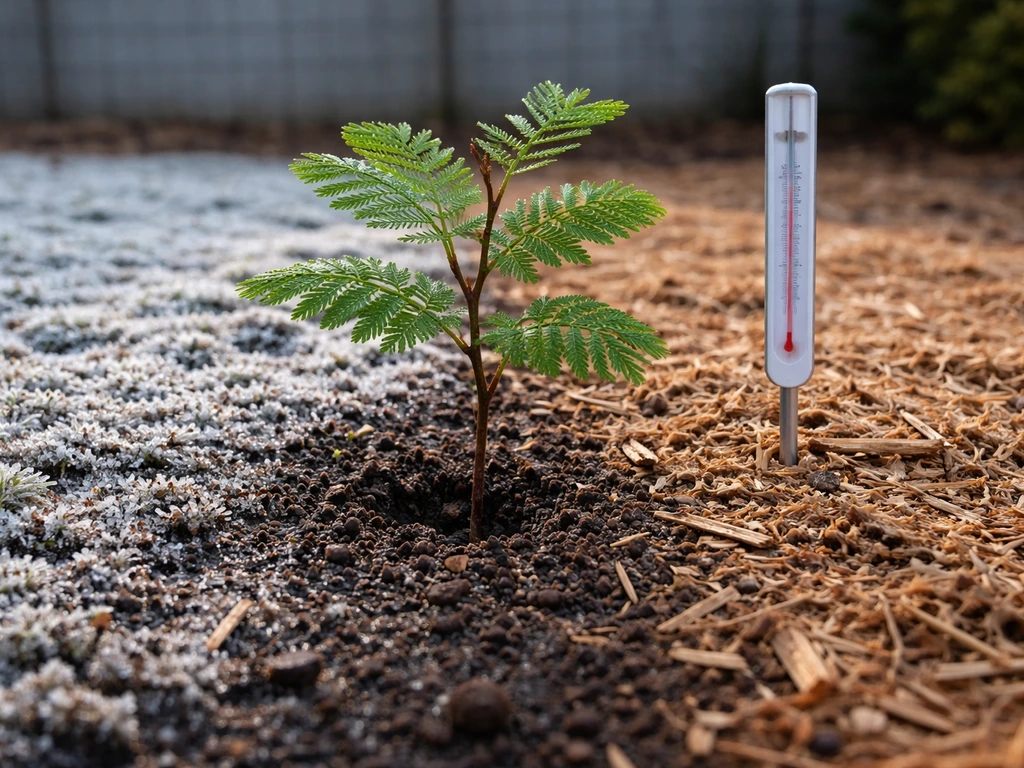
The UK's RHS hardiness rating system goes from H1a (tropical, needs a heated greenhouse) through to H7 (fully hardy anywhere in the UK). Most acacias sit at H2 to H3, meaning they're fine above freezing but start to struggle once temperatures dip significantly below zero. Acacia dealbata is generally rated H2 to H3, tolerating short cold spells down to roughly -5°C before tissue damage becomes serious. That sounds manageable, but UK winters are unpredictable. A relatively mild December can be followed by a brutal cold snap in February that takes temperatures down to -8°C or -10°C in inland areas, and that's enough to kill or severely damage even a well-established specimen.
Frost isn't the only issue. Wet cold is worse than dry cold for most acacias, because these are plants from Australia and South Africa that evolved in free-draining, often quite dry conditions. The combination of persistent cold, waterlogged soil, and damp air that UK winters typically deliver is genuinely hostile to them. Wind makes it worse still, stripping moisture from leaves and accelerating frost damage. So when you're assessing whether acacia will work for you, you're not just looking at minimum temperature: you're looking at the whole winter package.
Where acacias succeed in the UK
The South West of England is the most reliable region for outdoor acacia cultivation. Cornwall, Devon, and coastal parts of Dorset and Hampshire regularly record mild enough winters that Acacia dealbata can establish as a garden tree. The Isles of Scilly are in a different league entirely. Coastal Wales and parts of the West of Scotland benefit from the Gulf Stream's influence and can be surprisingly mild, though wind exposure is often a bigger limiting factor there than frost. Cities also help: the urban heat island effect means a sheltered garden in London or Bristol typically stays a degree or two warmer than the surrounding countryside, which can be the difference between a plant surviving or not.
A good microclimate matters more than the broad regional picture. A south-facing wall that absorbs heat during the day and radiates it overnight, a garden with dense shelter from prevailing westerlies, or a slope that drains cold air downhill all make a real difference. Sheffield Botanical Gardens has an Acacia dealbata growing in their Mediterranean Climate Garden, and that tells you something useful: it's possible in the Midlands if the microclimate is right, but it's being managed as a special case, not a standard planting. The further north or east you go, the more you're relying on engineering the perfect conditions.
How to grow acacia in the UK: practical steps
Choosing your site
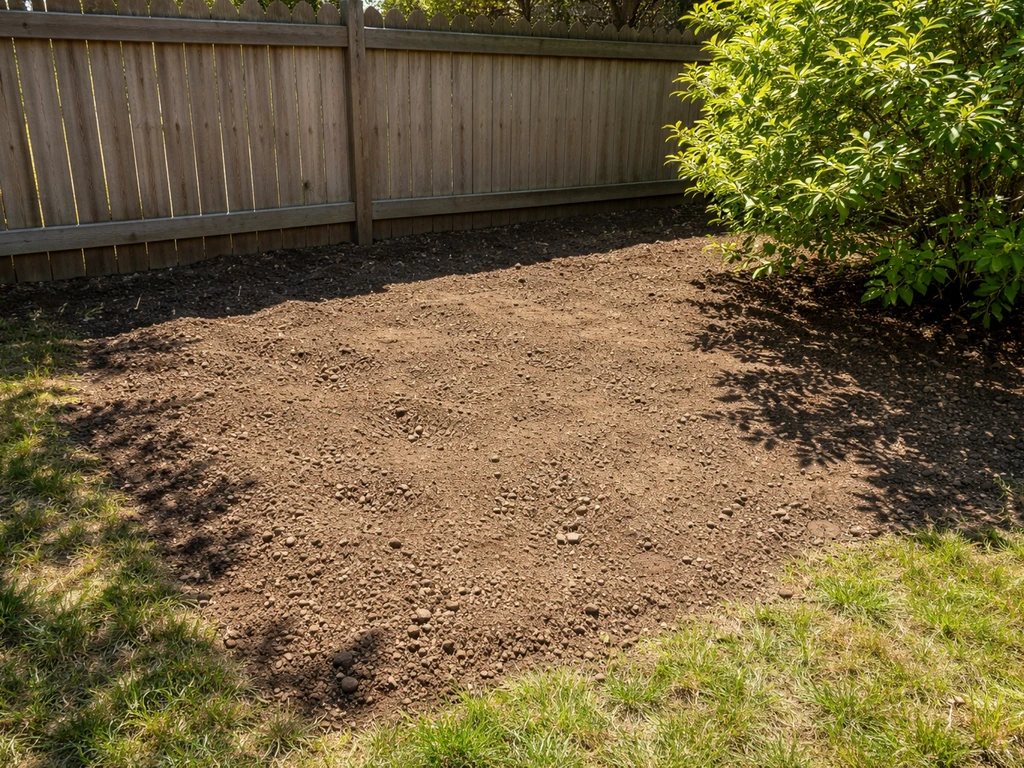
Full sun is non-negotiable. Acacias need as much direct sunlight as possible, especially in the UK where we're already working with shorter day lengths and lower sun intensity than their native range. A south or south-west facing position against a wall is ideal for outdoor planting. Shelter from cold easterly winds is just as important, because acacias are shallow-rooted and wind-rock can damage the roots over winter when the plant is already stressed. Good drainage is essential: if your soil is heavy clay, either improve it heavily with grit and organic matter before planting, or don't bother with outdoor planting at all.
Planting in the ground
- Plant in late spring or early summer, not autumn. This gives the tree a full growing season to establish before its first UK winter.
- Dig a wide, relatively shallow planting hole rather than a deep one. Acacias resent waterlogging at the base and planting too deeply is a common cause of root and crown rot.
- Work in grit or sharp sand generously if your soil holds water. Aim for a well-drained, slightly acid to neutral pH (around 6.0 to 7.0).
- Stake the tree firmly for the first couple of years to prevent wind-rock, but don't tie it too tightly: some movement encourages stronger root development.
- Water well after planting and during the first summer, then ease off. Established acacias are reasonably drought-tolerant and prefer drier conditions.
- Apply a deep mulch of bark or grit around the base in autumn, keeping it away from the trunk, to insulate the root zone against frost.
Growing in containers
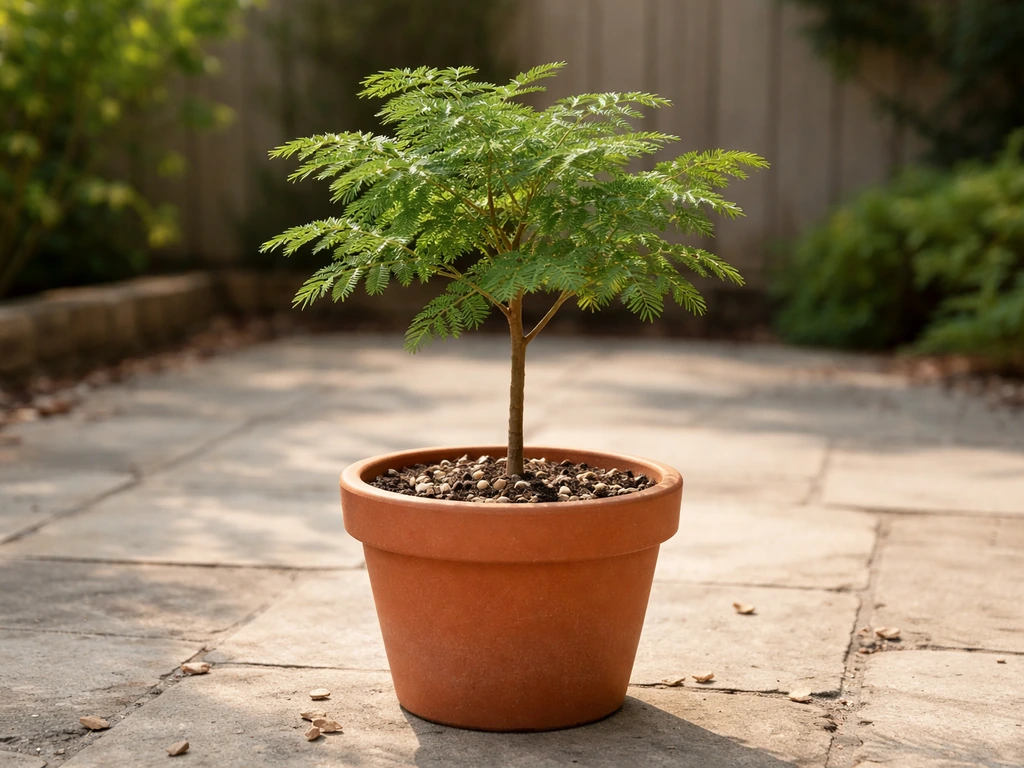
If you're not in a reliably mild area, containers are actually a sensible approach. You get complete control over drainage, soil mix, and winter location. Use a free-draining, loam-based compost mixed with at least 30% perlite or horticultural grit. The RHS recommends a final container size of around 45cm (18 inches) for container-grown trees, and that's a useful benchmark: go too small and the roots get pot-bound quickly, but a larger container retains more soil warmth and root volume, which helps winter survival. Pot up in stages rather than jumping straight to the largest size.
For winter, move the container to a sheltered position: an unheated greenhouse, a frost-free garage, or a very sheltered porch all work well. blank" rel="noopener noreferrer">Wrap the pot itself in bubble wrap or hessian to insulate the roots, because roots in containers are much more exposed to freezing than roots in the ground. The RHS notes that blank" rel="noopener noreferrer">heavier grades of horticultural fleece can provide around 2°C of protection, which is worth doing for the foliage too during cold snaps if the plant is in a sheltered outdoor spot.
Common challenges and how to handle them
Winter dieback
This is the most common issue UK growers report. Even a plant that survives winter may have significant die-back on the tips and outer growth. Don't panic and don't prune hard in early spring before you can see what's actually dead. The RHS advice to leave previous season's growth in place over winter applies here: it acts as a buffer against frost damage on the living tissue underneath.
Once you're past the last frost date (which in most of the UK means waiting until April or even May in colder areas), prune back to healthy wood and the plant will often push new growth vigorously. You can usually expect acacias to start growing leaves once temperatures consistently rise in spring after winter dieback when acacias grow leaves in spring.
Waterlogged and compacted soil
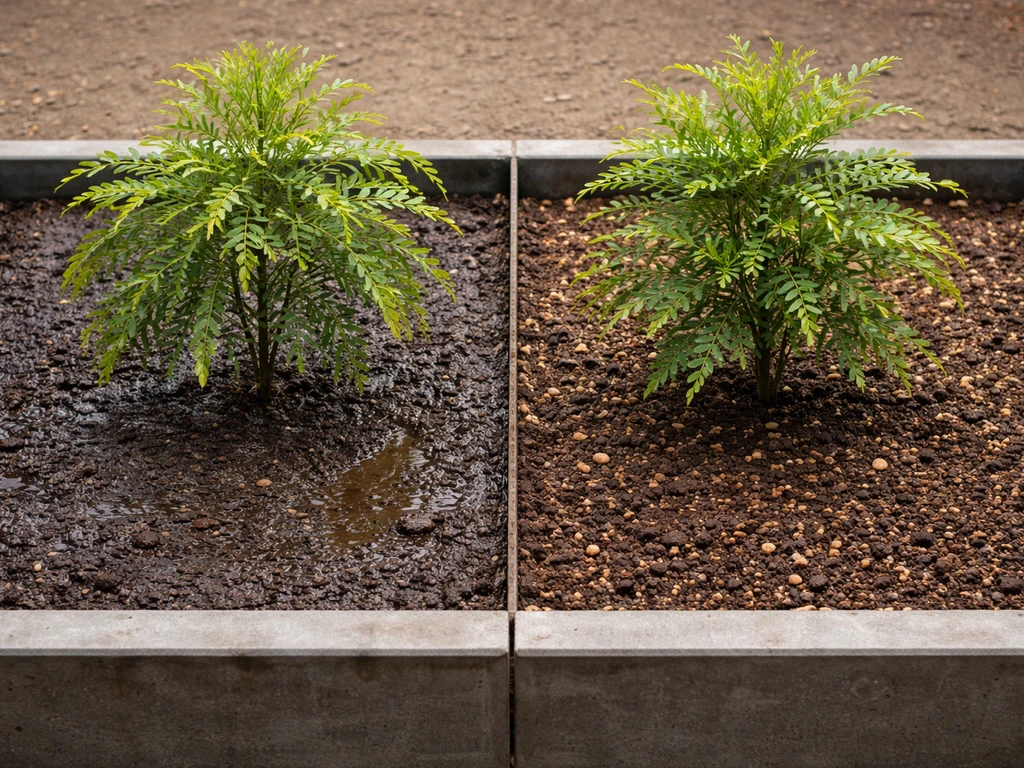
Acacias are highly susceptible to Phytophthora root and crown rot if the soil stays wet for extended periods, and this is one of the most common reasons UK attempts fail even when frost doesn't kill the plant outright. Planting too deeply makes this worse. If you're on heavy clay or a low-lying site, raised beds or mounded planting are genuinely worth considering. Container growing on a gravel or paved surface also helps: avoid standing water pooling around the base of the pot.
Pests and diseases
Acacia isn't particularly troubled by pests in UK conditions compared to some exotic species. Scale insects and spider mites can be an issue on container plants kept indoors over winter, but they're manageable with appropriate treatments. The bigger disease risk worth knowing about is honey fungus: the RHS lists Acacia (mimosa) as a susceptible host. If you're planting in a garden where honey fungus has previously been an issue, that's a real consideration because there's no cure once established.
Propagation
If you want to grow from scratch, seed is the most practical route for most people. Acacia seed has a hard coat that needs scarifying before it will germinate: nick the seed coat with a knife or soak in near-boiling water for a few hours, then sow in a free-draining mix at around 20-25°C. Semi-ripe cuttings taken in late summer can work too, though success rates are variable. Either way, seedlings and young plants are more tender than hardened stock, so buy a container-grown plant that's been hardened off by a UK nursery if you want the best chance of outdoor success in year one.
Best varieties to try, and what to avoid
One thing to sort out before you buy: the name "acacia" is used loosely in UK horticulture. True acacias are now split between Acacia (mainly Australian species) and Vachellia or Senegalia (mainly African species) following botanical reclassification, but most garden centres and seed suppliers still sell them all as "acacia." Some plants sold as "acacia" in the UK are actually Robinia pseudoacacia (false acacia), which is a completely different, much hardier tree. Check the full botanical name before you buy.
| Species / Variety | Hardiness (approx.) | Best for | UK suitability |
|---|---|---|---|
| Acacia dealbata (Silver wattle / Mimosa) | H2-H3, down to about -5°C | Outdoor specimen in mild areas, container elsewhere | Best overall choice for UK; widely available |
| Acacia baileyana (Cootamundra wattle) | H2-H3, similar to A. dealbata | Outdoor growing in mild coastal gardens | Good choice; recorded in UK cultivation since 1894 |
| Acacia cultriformis (Knife-leaf wattle) | H2-H3 | Sheltered outdoor or container | Worth trying; similar limitations to A. dealbata |
| Acacia pravissima (Ovens wattle) | H3, possibly slightly hardier | Sheltered outdoor in most of southern England | One of the hardier options; good for mild Midlands/North |
| Acacia melanoxylon (Blackwood) | H3-H4 | Larger sheltered gardens in mild areas | Taller, less ornamental; less commonly grown |
| Robinia pseudoacacia (False acacia) | H6-H7 | Open garden anywhere in UK | Not a true acacia but fully hardy; different plant entirely |
Of these, Acacia pravissima is probably the most underrated option for UK gardeners who want to push a little further north than the South West. It's a bit hardier than A. dealbata, has attractive arching stems with small grey-green leaves, and produces clusters of yellow flowers in spring. It's worth seeking out from specialist nurseries if the classic mimosa feels like too much of a gamble for your site.
Avoid anything described only as a tropical or subtropical acacia without a specific hardiness rating. Many Acacia species are purely equatorial and have no place in an unheated UK garden at any time of year. If you're interested in other trees that sit in this same challenging-to-grow-in-the-UK territory, the questions around carob trees and date trees involve very similar decisions about microclimate, container growing, and winter protection. The questions around carob trees and date trees involve very similar decisions about microclimate, container growing, and winter protection.
Realistic expectations and next steps
If you're in Cornwall, coastal Devon, or a genuinely sheltered, sunny spot in southern England, plant Acacia dealbata or A. pravissima against a south-facing wall this spring and you have a real shot at a flowering tree within a few years. If you're in the Midlands, a container-grown A. dealbata that you can move under cover in winter is achievable and rewarding.
If you're in Scotland, northern England, or an exposed site anywhere, I'd be honest with you: it's a significant challenge, container culture is more or less mandatory, and you need to go in expecting that a bad winter could set you back to square one. That's not a reason not to try, but it's worth knowing before you invest in a large specimen.
Coca leaves have very different growing requirements, so it helps to check whether the UK climate could realistically support them.
FAQ
How can I tell whether the acacia I’m buying is hardy enough for my exact UK area?
If you buy an “acacia” for outdoor planting, prioritize the botanical name plus an actual hardiness rating (for example, an H-number) and clone details if available. Many UK labels are imprecise, so a plant sold as acacia can be a different genus, or a less cold-tolerant clone than the one your area can support.
Is the best time to plant an acacia outdoors in the UK spring, or can I plant in autumn too?
Yes, but timing helps. Planting late in the year increases the risk that roots are still forming when winter wet and cold arrive. Aim to plant in spring so the tree spends its first warm season building roots in your drainage conditions.
Can acacia trees grow outdoors on heavy clay in the UK?
They can, but it is often a mistake unless you can control drainage and protect from winter wet. Raised beds, mounded planting, and avoiding low spots reduce crown and root rot risk, and you should also ensure water does not pool around the base after rain.
What should I do if my outdoor acacia dies back over winter, should I prune in March?
Use pruning only after winter dieback has revealed the dead wood. Cutting hard too early can remove living tissue and delay recovery, and it can also encourage rot if cuts stay damp. Wait until you see healthy growth, then prune back to firm, living branches.
If I grow acacia in a pot, how do I avoid root rot during UK winters?
For containers, don’t assume you can keep it “warm” by moving it under cover if the compost stays cold and saturated. Root rot is driven by wet conditions as much as temperature, so use a free-draining mix, keep the potting medium barely moist during the coldest months, and empty any saucer that collects runoff.
Will my acacia drop leaves or get stressed if I overwinter it in a greenhouse or garage?
When bringing a pot indoors or into a greenhouse, transition gradually. If you move it suddenly from cold, bright conditions to a warm, dim room, stress can trigger leaf drop, and pests can become more active on tender growth. Start with cooler shelter (unheated) and only move to warmth if you must, then give lots of light.
Does wind exposure matter as much as temperature for acacia survival in the UK?
Watch for a mismatch between hardiness and exposure. A south-facing wall in a mild region can work, but an exposed garden even in the South West may still fail due to wind-rock and leaf burn. If your site is windy, prioritize shelter and keep the trunk stabilized to prevent root movement on frozen soil.
If my acacia looks dead in spring, how can I tell whether it might recover?
Under UK conditions, many gardeners treat leafless or twiggy plants as “dead” too soon. If the main stems are firm and not blackened at the crown, it may re-sprout once spring temperatures rise. A practical test is to scratch a small patch of bark near the base, healthy tissue should look greenish, dead tissue is brown and dry.
Is growing acacia from seed in the UK likely to succeed, or is it better to buy a plant?
Be cautious with “unknown acacia” seed or seedlings. Seed-grown plants can vary, and young plants are typically less tolerant of cold wet winters than established stock. The safest approach is to start with a nursery-grown plant that has been hardened off for UK conditions, or use a winter-protected container setup for the first year outdoors.
How do “false acacia” and true acacia differ in UK growing difficulty?
Treat false acacia (Robinia pseudoacacia) as a different decision. It is generally much hardier and easier in the UK, so if you want a tough tree, you might choose it intentionally, but you should not expect it to behave like mimosa-type acacias in flowering timing or care.
Next Article
Can You Grow Tiger Nuts in the UK? Practical Guide for Gardeners
Can you grow tiger nuts in the UK? Practical, regional guide with planting dates, containers, harvest & recipes.